
[논문 리뷰] A Curriculum-style Self-training Approach for Source-Free Semantic Segmentation
이 논문은 소스 데이터에 접근할 수 없는 환경에서 도메인 적응을 가능하게 하는, 새로운 커리큘럼 스타일의 자기학습 프레임워크인 ATP를 제안한다. 암묵적 특징 정렬을 통한 가설 전이, 양성 및 음성 허위 레이블을 활용한 双방향 자기학습, 그리고 도메인 내 일관성을 위한 정보 전파를 통해, ATP는 GTA5→Cityscapes 및 크로스시티 주행 벤치마크에서 최신 기술 수준(SOTA) 성능을 달성하며, 소스 데이터 접근이 필요한 기존 방법들을 능가한다.
Source-free domain adaptation has developed rapidly in recent years, where the well-trained source model is adapted to the target domain instead of the source data, offering the potential for privacy concerns and intellectual property protection. However, a number of feature alignment techniques in prior domain adaptation methods are not feasible in this challenging problem setting. Thereby, we resort to probing inherent domain-invariant feature learning and propose a curriculum-style self-training approach for source-free domain adaptive semantic segmentation. In particular, we introduce a curriculum-style entropy minimization method to explore the implicit knowledge from the source model, which fits the trained source model to the target data using certain information from easy-to-hard predictions. We then train the segmentation network by the proposed complementary curriculum-style self-training, which utilizes the negative and positive pseudo labels following the curriculum-learning manner. Although negative pseudo-labels with high uncertainty cannot be identified with the correct labels, they can definitely indicate absent classes. Moreover, we employ an information propagation scheme to further reduce the intra-domain discrepancy within the target domain, which could act as a standard post-processing method for the domain adaptation field. Furthermore, we extend the proposed method to a more challenging black-box source model scenario where only the source model's predictions are available. Extensive experiments validate that our method yields state-of-the-art performance on source-free semantic segmentation tasks for both synthetic-to-real and adverse conditions datasets. The code and corresponding trained models are released at \url{https://github.com/yxiwang/ATP}.
연구 동기 및 목표
- 개인정보나 지적재산권 제약으로 인해 소스 데이터 접근이 불가능한 상황에서의 세그멘테이션 도메인 이동 문제를 해결한다.
- 소스 데이터에 의존하지 않고, 사전 학습된 소스 모델만을 이용해 새로운 타겟 도메인으로의 도메인 적응 프레임워크를 개발한다.
- 소스 모델의 예측 결과만 제공되는 더 실용적인 블랙박스 시나리오로 프레임워크를 확장한다.
- 음성 허위 레이블과 도메인 내 일관성 정규화를 도입하여 타겟 도메인 내 표현 학습을 향상시킨다.
제안 방법
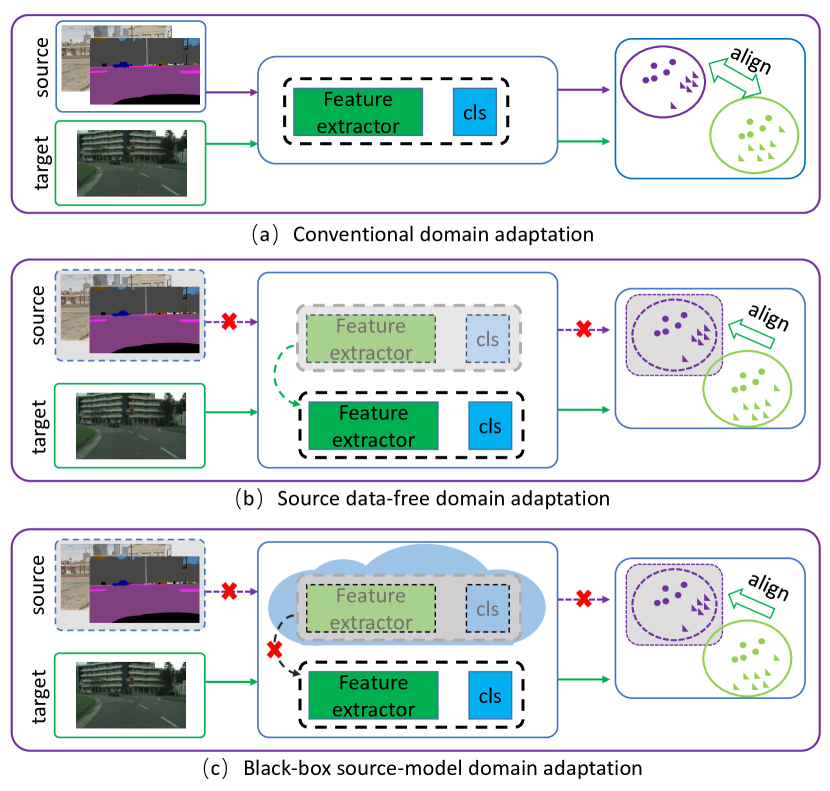
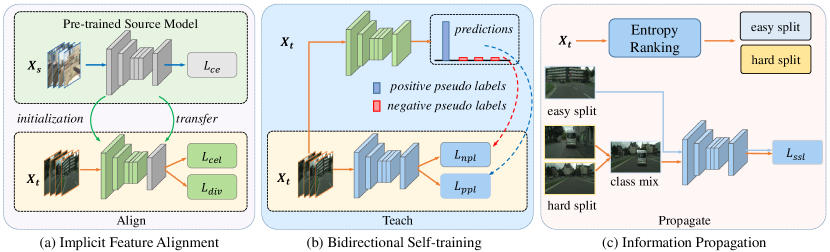
- 소스 모델의 예측을 활용해, 소스 데이터가 없는 경우에도 타겟 특징을 미시적 방식으로 소스 특징과 정렬하는 커리큘럼 스타일 엔트로피 최소화 목적함수를 제안한다.
- 낮은 신뢰도 및 어려운 샘플에 집중하기 위해, 양성 및 음성 허위 레이블을 모두 활용한 양방향 자기학습을 도입하여 특징 학습을 향상시킨다.
- 타겟 도메인 내 부정확도를 줄이기 위해, 허위 반감독 학습을 적용하는 정보 전파 기반 설계를 제안한다.
- 고정된 소스 분류기를 활용한 가설 전이를 통해 특징 정렬을 안정화하고, 적응 과정에서 분포 이동을 방지한다.
- 클래스에 관계없이 특징 다양성을 증진시켜 일반화 성능을 향상시키기 위해 가중치가 부여된 다양성 손실을 도입한다.
- 소스 특징에 대한 액세스를 소스 모델의 출력 예측 결과로만 대체함으로써, 프레임워크를 블랙박스 설정으로 확장한다.
실험 결과
연구 질문
- RQ1소스 데이터 접근이 불가능한 상황에서, 가설 전이를 통한 암묵적 특징 정렬이 명시적 도메인 정렬을 효과적으로 대체할 수 있는가?
- RQ2자기학습 과정에 음성 허위 레이블을 통합하면 소스 프리 도메인 적응에서 표현 학습이 향상되는가?
- RQ3허위 반감독 학습을 통한 정보 전파로 도메인 내 이질성은 감소하고 세그멘테이션 정확도는 향상되는가?
- RQ4특히 소스 데이터가 없는 상황에서, 제안된 방법의 하이퍼파rameter 선택에 대해 얼마나 강건한가?
- RQ5소스 모델의 예측 결과만 제공되는 블랙박스 시나리오로도 프레임워크가 일반화 가능한가?
주요 결과
- ATP는 GTA5→Cityscapes 벤치마크에서 평균 교차율(mIoU) 39.8을 기록하여, 이전의 모든 소스 프리 방법을 능가하고, 소스 데이터 접근이 필요한 방법들과도 동등한 성능을 달성한다.
- 모델는 하이퍼파rameter, 특히 음성 허위 레이블 임계값 λ_neg에 대해 매우 강건하며, λ_neg < 0.1일 때 최적의 성능을 보인다.
- 제거 실험을 통해 암묵적 정렬, 이중 자기학습, 정보 전파 각각의 구성 요소가 성능 향상에 기여한다는 것이 확인되었다.
- 소스 모델의 예측 결과만 제공되는 블랙박스 시나리오에서도 경쟁력 있는 성능을 보이며, 실용성의 타당성을 입증한다.
- 소스 분류기가 미세조정되지 않은 상태에서도 빠르게 수렴하고 높은 성능을 유지함으로써, 가설 전이 기반 메커니즘이 매우 안정적임을 시사한다.
- 일반적인 클래스에서는 성능 향상이 두드러지지만, fencing, pole, signal, train 등 희귀하거나 도메인 간 격차가 큰 카테고리에서는 여전히 어려움을 겪는다.
더 나은 연구,지금 바로 시작하세요
논문 읽기부터 검토까지, 연구 시간을 획기적으로 줄여보세요.
카드 등록 없음 · 무료 플랜 제공
이 리뷰는 AI가 만들고, 인간 에디터가 검토했습니다.