
[논문 리뷰] A fast-rotator post-starburst galaxy quenched by supermassive black-hole feedback at z=3
이 JWST 연구는 z=3.064에서의 거대 비활성 은하에 대한 NIRSpec IFU 관측을 제시하며, 빠르게 회전하는 원반이 있는 SMBH 주도 배출적 피드백을 보여주고, 별의 원반을 파괴하지 않으면서 성간/가스의 억제를 증거로 제시합니다.
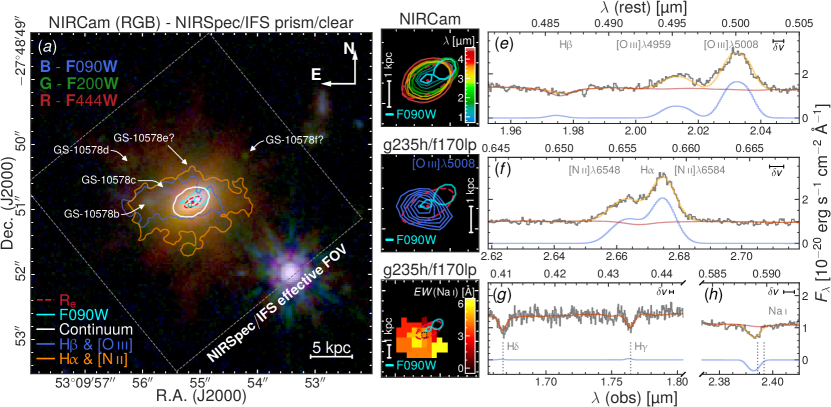
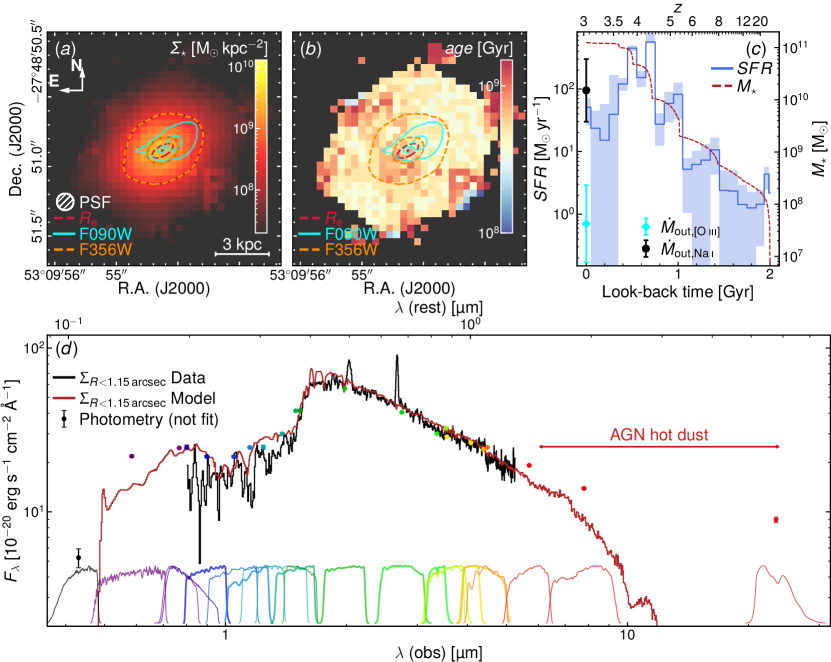
There is compelling evidence that the most massive galaxies in the Universe stopped forming stars due to the time-integrated feedback from their central super-massive black holes (SMBHs). However, the exact quenching mechanism is not yet understood, because local massive galaxies were quenched billions of years ago. We present JWST/NIRSpec integral-field spectroscopy observations of GS-10578, a massive, quiescent galaxy at redshift z=3.064. From the spectrum we infer that the galaxy has a stellar mass of $M_*=1.6\pm0.2 imes 10^{11}$ MSun and a dynamical mass $M_{ m dyn}=2.0\pm0.5 imes 10^{11}$ MSun. Half of its stellar mass formed at z=3.7-4.6, and the system is now quiescent, with the current star-formation rate SFR<9 MSun/yr. We detect ionised- and neutral-gas outflows traced by [OIII] emission and NaI absorption. Outflow velocities reach $v_{ m out}\approx$1,000 km/s, comparable to the galaxy escape velocity and too high to be explained by star formation alone. GS-10578 hosts an Active Galactic Nucleus (AGN), evidence that these outflows are due to SMBH feedback. The outflow rates are 0.14-2.9 and 30-300 MSun/yr for the ionised and neutral phases, respectively. The neutral outflow rate is ten times higher than the SFR, hence this is direct evidence for ejective SMBH feedback, with mass-loading capable of interrupting star formation by rapidly removing its fuel. Stellar kinematics show ordered rotation, with spin parameter $λ_{Re}=0.62\pm0.07$, meaning GS-10578 is rotation supported. This study shows direct evidence for ejective AGN feedback in a massive, recently quenched galaxy, thus clarifying how SMBHs quench their hosts. Quenching can occur without destroying the stellar disc.
연구 동기 및 목표
- 가장 거대한 은하들이 어떻게 quench되는지 이해를 촉진하고 quenching이 AGN 피드백에 의한 가스 제거를 필요로 하는지 여부를 평가한다.
- z~3 비활성 은하에서 별질 질량, 역학 질량, 별 형성 이력, 현재의 SFR를 정량화한다.
- 이온화 및 중성 가스를 포함한 가스의 아웃플로우를 탐지하고 특성화하며 AGN 활동과의 연계를 평가한다.
- quenching 중 은하의 회전 지지 여부를 판단하고 회전-지배 동역학 상태를 평가한다.
제안 방법
- 프리즘/클리어 및 고해상도 g235h/f170lp 구성에서 JWST/NIRSpec IFS 데이터를 얻어 은하 전역의 별질 및 가스 특성을 매핑한다.
- spaxel별 전체 스펙트럴 에너지 분포(SED) 모델링을 수행하여 표면별 질량 밀도, 항성집단 연령, 별 형성 이력을 도출한다.
- BPT 다이어그램 포함의 발광선 진단을 이용해 AGN 광이온화 및 아웃플로우 신호를 식별하고 O III 및 Hα+nII로부터 이온화된 아웃플로우 속도를 추정한다.
- Na I 흡수를 통해 중성 가스를 검출하고 대규모의 빠른 중성 아웃플로우를 추적하며 속도와 질량 적재를 추정한다.
- 별 형성 동역학을 측정하여 회전(λ_R)과 은하가 빠른 회전자(fast rotator)인지 여부를 도출하고 역학적 질량과 비교한다.
실험 결과
연구 질문
- RQ1이 질감 z~3 은하의 quenching은 별 형성에 의해 주도된 바람보다 SMBH 피드백에 의해 이뤄졌는가?
- RQ2온화된(ionised) 및 중성 가스의 아웃플로우가 미래의 별 형성을 억제할 만큼 충분한 질량과 운동량을 운반하는가?
- RQ3은하가 회전 지지(빠른 회전자)되는가, 그리고 이것이 z=0으로의 진화 경로에 무엇을 시사하는가?
- RQ4주된 별 형성 에피소드의 시점과 관측 시점에 대한 항성집단 연령은 무엇인가?
- RQ5이 시스템에서 AGN이 ISM/CGM의 형태와 운동학에 어떤 영향을 미치는가?
주요 결과
- Stellar mass Mstar = 1.6 ± 0.2 × 10^11 solar masses and a dynamical mass Mdynvalue; main star-formation episode occurred at z = 3.7–4.6, with current SFR < 9 solar masses per year.
- Outflows detected in ionised (O III) and neutral (Na I) gas with velocities up to ~1000 km/s, comparable to the escape velocity and exceeding what star formation alone would drive.
- Ionised-gas outflow rate is 0.14–2.9 solar masses per year, while neutral-gas outflow rate is 30–300 solar masses per year, with neutral loading far exceeding the SFR, indicating ejective SMBH feedback capable of removing star-forming fuel.
- AGN evidence includes X-ray luminosity and mid-infrared SED excess; AGN bolometric luminosity L_AGN ≈ 2.6 ± 0.9 × 10^45 erg/s.
- Stellar kinematics show ordered rotation with spin parameter lambda_R(Re) = 0.62 ± 0.07, indicating the galaxy is rotation-supported (fast rotator) despite quenching and compactness.
- Galaxy is extremely compact and, in the local universe, would be a strong outlier on mass-size relations; comparison suggests significant dynamical and morphological evolution required between z ≈ 3 and present to grow in size and reduce angular momentum.
더 나은 연구,지금 바로 시작하세요
연구 설계부터 논문 작성까지, 연구 시간을 획기적으로 줄여보세요.
카드 등록 없음 · 무료 플랜 제공
이 리뷰는 AI가 만들고, 인간 에디터가 검토했습니다.