
[논문 리뷰] A JWST/NIRSpec First Census of Broad-Line AGNs at z=4-7: Detection of 10 Faint AGNs with M_BH~10^6-10^8 M_sun and Their Host Galaxy Properties
JWST/NIRSpec이 z=4-7에서 질량이 작은 블랙홀(~10^6–10^8 M_sun)을 가진 10개의 미약한 광폭-선 AGN을 식별하고, 이들의 호스트 은하, 형태, 재이온화에의 기여를 분석한다.
We present a first statistical sample of faint type-1 AGNs at $z>4$ identified by JWST/NIRSpec deep spectroscopy. Among the 185 galaxies at $z_\mathrm{spec}=3.8-8.9$ confirmed with NIRSpec, our systematic search for broad-line emission reveals 10 type-1 AGNs at $z=4.015-6.936$ whose broad component is only seen in the permitted H$α$ line and not in the forbidden [OIII]$λ$5007 line that is detected with greater significance than H$α$. The broad H$α$ line widths of $\mathrm{FWHM}\simeq1000-6000\ \mathrm{km\ s^{-1}}$ suggest that the AGNs have low-mass black holes with $M_\mathrm{BH}\sim10^6-10^8\ M_\odot$, remarkably lower than those of low-luminosity quasars previously identified at $z>4$ with ground-based telescopes. JWST and HST high-resolution images reveal that the majority of them show extended morphologies indicating significant contribution to the total lights from their host galaxies, except for three compact objects two of which show red SEDs, probably in a transition phase from faint AGNs to low luminosity quasars. Careful AGN-host decomposition analyses show that their host's stellar masses are systematically lower than the local relation between the black hole mass and the stellar mass, implying a fast black hole growth consistent with predictions from theoretical simulations. A high fraction of the broad-line AGNs ($\sim5\%$), higher than $z\sim0$, indicates that a number density of such faint AGNs is higher than an extrapolation of the quasar luminosity function, implying a large population of AGNs including type 1 and type 2 in the early universe. Such faint AGNs contribute to cosmic reionization, while the total contribution is not large, up to $\sim50\%$ at $z\sim6$, because of their faint nature.
연구 동기 및 목표
- JWST/NIRSpec 분광학을 통해 z>4에서 확인된 광폭-선(타입-1) AGN의 집단을 조사한다.
- 이들 저질량 SMBH의 블랙홀 질량, 전체 광도, Eddington 비율을 특성화한다.
- 별질량, 형태, 먼지 흡수 등 호스트 은하 특성을 평가한다.
- 미약한 AGN이 우주 재이온화에 기여하는 정도를 평가하고 국소 및 고z AGN 집단과 비교한다.
제안 방법
- ERO GLASS, CEERS 및 관련 프로그램의 z-spec 3.8-8.9 은 JWST/NIRSpec 분광 데이터를 가진 185개 은하에서 광폭 선의 체계적 탐색.
- narrow 및 broad 구성으로 Hβ, [OIII], Hα, [NII]를 각 선의 분해; broad Hα 또는 Hβ의 FWHM > 1000 km/s 및 SNR > 5 요구.
- AGNs의 광폭선 특성을 outflows 또는 병합으로부터 구별하기 위해 [OIII], [NII]의 좁은 구성 기준을 적용.
- z~0에서 보정된 broad Hα 기반 관계(Greene & Ho 2005)로 M_BH를 추정하고 L_bol 및 Eddington 비를 도출.
- 고해상도 JWST/HST 이미징으로 호스트-AGN 분해를 수행하고 호스트 은하 특성을 평가한다.
- Balmer 디크렘트와 Calzetti 먼지 법칙을 사용해 AGN의 E(B-V)와 먼지 흡수를 평가한다.
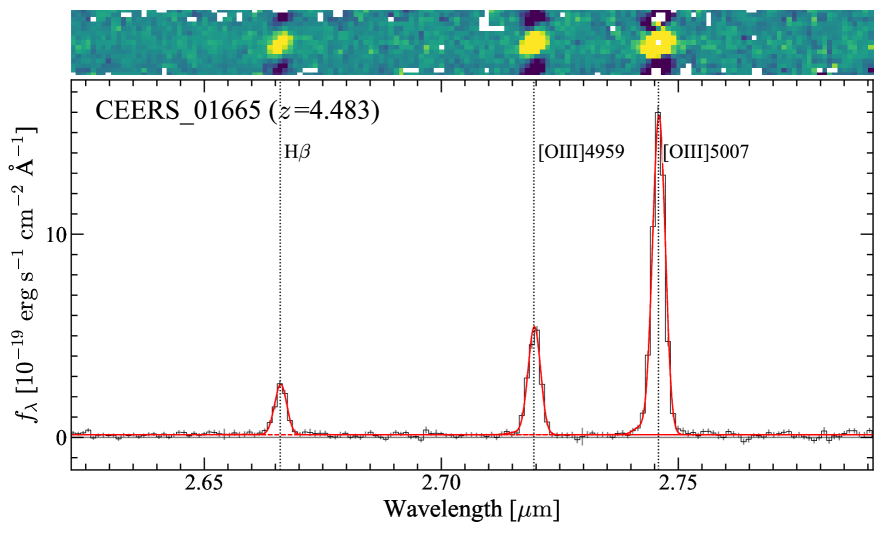
![Figure 1: NIRSpec spectra of CEERS_01244, GLASS_160133, GLASS_150029, and CEERS_00746. For each object, the left and middle panels show spectra around H $\beta$ +[ Oiii ] $\lambda\lambda$ 4959,5007 and H $\alpha$ +[ Nii ] $\lambda\lambda$ 6548,6584, respectively. The 2D and 1D spectra are shown in t](https://ar5iv.labs.arxiv.org/html/2303.11946/assets/x1.png)
실험 결과
연구 질문
- RQ1JWST/NIRSpec 샘플에서 z=4-7의 미약한 광폭-선 AGN의 발생률과 특성은 어떠한가?
- RQ2이 저질량 SMBH의 블랙홀 질량, 광도 및 Eddington 비율은 어떠한가?
- RQ3이 AGN 호스트의 은하 질량, 형태, 먼지 내용은 어떠한가?
- RQ4이 미약한 AGN들이 국소 혹은 고-z에서 관찰되는 M_BH–M_* 관계를 따르는가, 아니면 SMBH의 초기 성장을 보이는가?
주요 결과
- z=4.015-6.936에서 Broad Hα 방출을 보이고 [OIII]에 Broad 구성 없이 질량이 낮은 블랙홀 M_BH ~ 10^6–10^8 M_sun임을 나타낸 10개의 타-1 AGN을 식별했다.
- Broad Hα 선의 FWHM은 대략 1000–6000 km/s 범위로, 지상 관측 설문에서 확인된 고-z 퀘사르에 비해 상대적으로 낮은 질량의 SMBH를 시사한다.
- 대부분의 호스트가 JWST/HST 이미징에서 확장된 것으로 보이며, significant한 호스트 은하 빛이 존재; 먼지로 붉은 SED를 보이는 3개의 압축된 객체는 다양한 호스트 환경을 시사한다.
- AGN-호스트 분해는 호스트의 질량이 국소 M_BH–M_* 관계보다 체계적으로 낮음을 보여주며, 호스트에 비해 흡수된 흑색홀의 빠른 성장을 시사한다.
- AGN은 z=4-7 은하 샘플의 약 5%를 차지하며 -22 < M_UV < -17 구간에서 나타나, z~0 AGN 비율보다 높아 초기에 더 큰 미약한 AGN 모집단이 존재함을 시사한다.
- 일부 하위집합의 Rest-UV 선 진단은 혼합 특징을 보이며, 일부 객체는 더 붉은 연속스펙트럼과 뚜렷한 먼지 흡수(E(B-V) 약 1.4까지)를 보여 더 먼지로 가려진 AGN일 가능성이 있다.
더 나은 연구,지금 바로 시작하세요
논문 읽기부터 검토까지, 연구 시간을 획기적으로 줄여보세요.
카드 등록 없음 · 무료 플랜 제공
이 리뷰는 AI가 만들고, 인간 에디터가 검토했습니다.