
[논문 리뷰] A massive quiescent galaxy at redshift 4.658
스펙트roscopic JWST 확인 GS-9209가 z=4.658에서 대질량의 정지은 은하임을 확인, 별질 질량 3.8±0.2×10^10 M⊙이고 quenching은 z≈6.5에서 완료되어 초기의 빠른 형성 및 차단을 시사합니다.
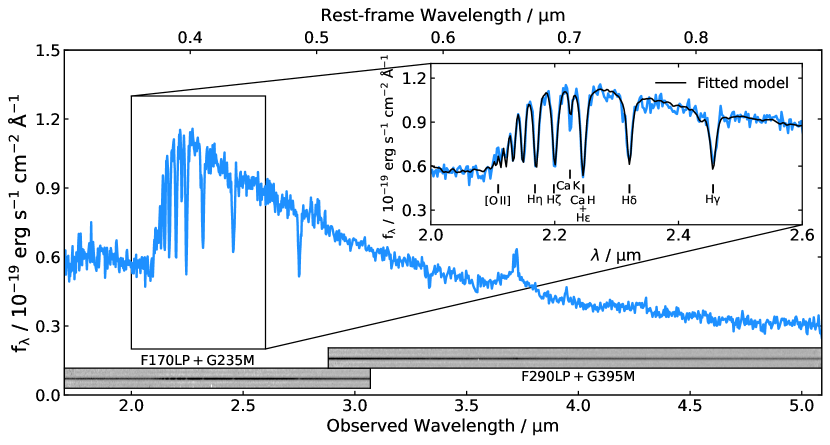
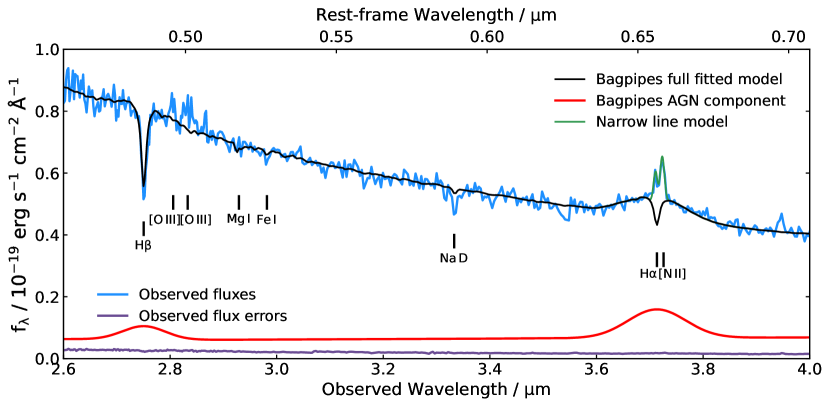
The extremely rapid assembly of the earliest galaxies during the first billion years of cosmic history is a major challenge for our understanding of galaxy formation physics. The advent of JWST has exacerbated this issue by confirming the existence of galaxies in significant numbers as early as the first few hundred million years. Perhaps even more surprisingly, in some galaxies, this initial highly efficient star formation rapidly shuts down, or quenches, giving rise to massive quiescent galaxies as little as 1.5 billion years after the Big Bang. However, due to their faintness and red colour, it has proven extremely challenging to learn about these extreme quiescent galaxies, or to confirm whether any exist at earlier times. Here we report the spectroscopic confirmation of a massive quiescent galaxy, GS-9209, at redshift $z=4.658$, just 1.25 billion years after the Big Bang, using JWST NIRSpec. From these data we infer a stellar mass of $M_* = 3.8\pm0.2 imes10^{10}\ M_\odot$, which formed over a $\simeq200$ Myr period before this galaxy quenched its star formation activity at $z=6.5^{+0.2}_{-0.5}$, when the Universe was $\simeq800$ million years old. Based on the presence of broad H$α$ in the spectrum and a high narrow-line [NII]/H$α$ ratio, we infer the presence of an accreting supermassive black hole, with a mass of $M_\bullet = 5\pm1 imes10^{8}\ M_\odot$. This large black hole mass relative to the stellar mass suggests that active galactic nucleus (AGN) feedback may have been responsible for quenching this galaxy. GS-9209 is also extremely compact, with an effective radius, $r_e=215\pm20$ parsecs. This galaxy is both a likely descendent of the highest-redshift submillimetre galaxies and quasars, and a likely progenitor for the dense, ancient cores of the most massive local galaxies.
연구 동기 및 목표
- JWST NIRSpec 데이터를 사용하여 z>4에서의 대질량 정지은 은하의 존재를 입증한다.
- 질량, 별 형성 이력, 차단 시점을 포함한 별 형성 인구 특성을 추론한다.
- 관찰 스펙트럼과 은하 진화에 미치는 AGN의 존재 여부와 영향력을 평가한다.
- GS-9209를 초기 대질량 시스템 맥락에 위치시키기 위한 은하의 크기, 밀도, 동역학 질량을 특성화한다.
제안 방법
- G235M 및 G395M 격자로 JWST NIRSpec 분광법(R≈1000)으로 1.7–5.1 μm 범위에서 Balmer 특징을 탐지.
- 스펙트로폴리틱 피팅을 위해 Bagpipes 코드로 분광 데이터와 다파장 광측정치를 결합하여 전체 피팅.
- BC03/MILES 라이브러리 및 이중-전력 법칙 SFH에서 도출된 사전 정보를 갖춘 22-매개변수 모델로 별-먼지-성운-AGN 구성요소를 포함.
- 은하 형성으로의 잠재적 별형성에 대해 AGN에서 좁은 방출선을 마스킹하면서 성운 구성요소를 피팅.
- AGN 연속체와 광범위한 Hα/Hβ 방출을 모델링하여 별 구성요소와 비별 구성요소를 분리.
- PetroFit을 이용한 JWST NIRCam F210M 이미징으로 크기 및 구조 분석을 수행하여 별 구성요소와 AGN 구성요소를 분해.
실험 결과
연구 질문
- RQ1GS-9209의 적색편차와 분광 확인 여부는 무엇인가?
- RQ2GS-9209의 질량과 별 형성 이력은 무엇이며 언제 형성되고 차단되었나?
- RQ3GS-9209가 AGN을 보유하고 있는가, 그리고 그것이 관찰된 스펙트럼과 추정된 특성에 어떤 영향을 주는가?
- RQ4GS-9209의 구조적 및 동역학적 특성(크기, 밀도, 속도분산, 동역학 질량)은 무엇이며, 이를 다른 고적층 정지은 시스템과 어떻게 비교되는가?
주요 결과
- GS-9209는 z = 4.6582 ± 0.0002에서 발현되며 Balmer-지배 스펙트럼은 SFR의 급속한 최근 감소를 나타낸다.
- 질량은 log10(M*/M⊙) = 10.58 ± 0.02이고, 먼지 감쇠는 미미하며 AV = 0.02 ± 0.02이다.
- 형성 시점은 zform = 6.9 ± 0.2이고 차단은 zquench = 6.5^{+0.2}_{-0.5}에서 발생하며 차단 이전에 약 200 Myr의 별형성 에피소드가 있다.
- Broad Hα 방출 및 [N II]/Hα 비가 약 -0.01 ± 0.04로 AGN 활성을 나타내며, AGN은 5100 Å에서 약 7.5%의 플럭스를 기여하고 broad Hα의 FWHM은 ≈ 10300 ± 700 km s⁻¹이다.
- 별 구성요소의 유효 반경은 re = 0.033 ± 0.003 arcsec로, z = 4.658에서 이는 215 ± 20 pc에 해당하며 Sérsic 지수 n = 2.3 ± 0.3이고 표면 밀도 log10(Σeff/M⊙ kpc⁻²) = 11.15 ± 0.08이다.
- 동역학 질량은 log10(Mdyn/M⊙) = 10.3 ± 0.1로, 별 질량보다 약간 낮고, Hα 및 속도 분산 측정을 기반으로 SMBH 질량이 약 (0.5–1)×10^9 M⊙로 추정된다.
더 나은 연구,지금 바로 시작하세요
연구 설계부터 논문 작성까지, 연구 시간을 획기적으로 줄여보세요.
카드 등록 없음 · 무료 플랜 제공
이 리뷰는 AI가 만들고, 인간 에디터가 검토했습니다.