
[논문 리뷰] A Posteriori Evaluation of a Physics-Constrained Neural Ordinary Differential Equations Approach Coupled with CFD Solver for Modeling Stiff Chemical Kinetics
이 논문은 강한 화학 동역학을 모델링할 때 훈련 중 손실 함수에 직접적으로 원소 질량 보존 조건을 적용하는 물리 제약 신경 미분방정식(PC-NODE) 프레임워크를 제안한다. 이는 물리적 일致성과 정확도를 크게 향상시킨다. CFD 솔버와 결합할 경우, PC-NODE는 순수 데이터 기반의 NODE 모델보다 열역학적 상태 예측에서 뛰어난 성능을 보이며, 최소한의 오차 누적으로 예측된 조건 이외의 상황에도 강인한 일반화 성능을 유지한다.
The high computational cost associated with solving for detailed chemistry poses a significant challenge for predictive computational fluid dynamics (CFD) simulations of turbulent reacting flows. These models often require solving a system of coupled stiff ordinary differential equations (ODEs). While deep learning techniques have been experimented with to develop faster surrogate models, they often fail to integrate reliably with CFD solvers. This instability arises because deep learning methods optimize for training error without ensuring compatibility with ODE solvers, leading to accumulation of errors over time. Recently, NeuralODE-based techniques have offered a promising solution by effectively modeling chemical kinetics. In this study, we extend the NeuralODE framework for stiff chemical kinetics by incorporating mass conservation constraints directly into the loss function during training. This ensures that the total mass and the elemental mass are conserved, a critical requirement for reliable downstream integration with CFD solvers. Proof-of-concept studies are performed with physics-constrained neuralODE (PC-NODE) approach for homogeneous autoignition of hydrogen-air mixture over a range of composition and thermodynamic conditions. Our results demonstrate that this enhancement not only improves the physical consistency with respect to mass conservation criteria but also ensures better robustness. Lastly, a posteriori studies are performed wherein the trained PC-NODE model is coupled with a 3D CFD solver for computing the chemical source terms. PC-NODE is shown to be more accurate relative to the purely data-driven neuralODE approach. Moreover, PC-NODE also exhibits robustness and generalizability to unseen initial conditions from within (interpolative capability) as well as outside (extrapolative capability) the training regime.
연구 동기 및 목표
- CFD 솔버와 결합된 강한 화학 동역학을 위한 데이터 기반 대체 모델에서의 불안정성과 물리적 일치성 부족 문제를 해결하기 위해.
- 신경 ODE 훈련 과정에 원소 질량 보존 제약 조건을 통합하여 훈련 효율성과 물리적 정확도를 향상시키기 위해.
- 다양한 초기 조건, 특히 분포 외 영역에 해당하는 조건에서도 열역학적 상태 변화에 대해 강인하고 일반화 가능한 예측을 가능하게 하기 위해.
- 수소-공기 자가ignition 사례를 활용한 3D CFD 환경에서 물리 제약 기반 접근의 실현 가능성과 우수성을 입증하기 위해.
제안 방법
- 신경 ODE 훈련 중 손실 함수에 원소 질량 보존 조건을 정규화 항으로 통합하여 총 질량과 원소 질량이 보존되도록 보장한다.
- 강한 ODE 시스템 내 화학 소스 항을 신경망으로 매개변수화하고, 훈련 중에 강한 ODE 솔버를 통해 통합한다.
- 세부 화학 메커니즘으로부터의 참값 해를 기반으로, 예측된 열역학적 궤적과 참값 간의 차이를 최소화하여 모델을 종합적으로 훈련한다.
- 훈련된 PC-NODE 모델을 CONVERGE CFD 솔버 내 화학 소스 항의 서브스티튜션으로 통합하여 3D 시뮬레이션을 수행한다.
- 다양한 계기비와 초기 온도 조건에서 수소-공기 혼합물의 균질한 자가ignition에 프레임워크를 적용한다.
- 후처리 CFD 시뮬레이션을 통해 성능을 평가하고, 순수 데이터 기반의 NODE 모델(NO-CONS) 및 참값 메커니즘과 비교한다.
실험 결과
연구 질문
- RQ1손실 함수에 원소 질량 보존 조건을 적용함으로써 강한 화학 동역학을 위한 신경 ODE 모델의 물리적 일치성이 향상되는가?
- RQ2시간이 지남에 따라 오차가 누적되는 경향이 있는 경우, 물리 제약 기반 PC-NODE 모델이 순수 데이터 기반의 NODE 모델에 비해 정확도와 오차 누적 측면에서 어떻게 비교되는가?
- RQ3PC-NODE 모델이 훈련 분포 외의 초기 조건, 특히 외삽 영역에 대해 얼마나 잘 일반화되는가?
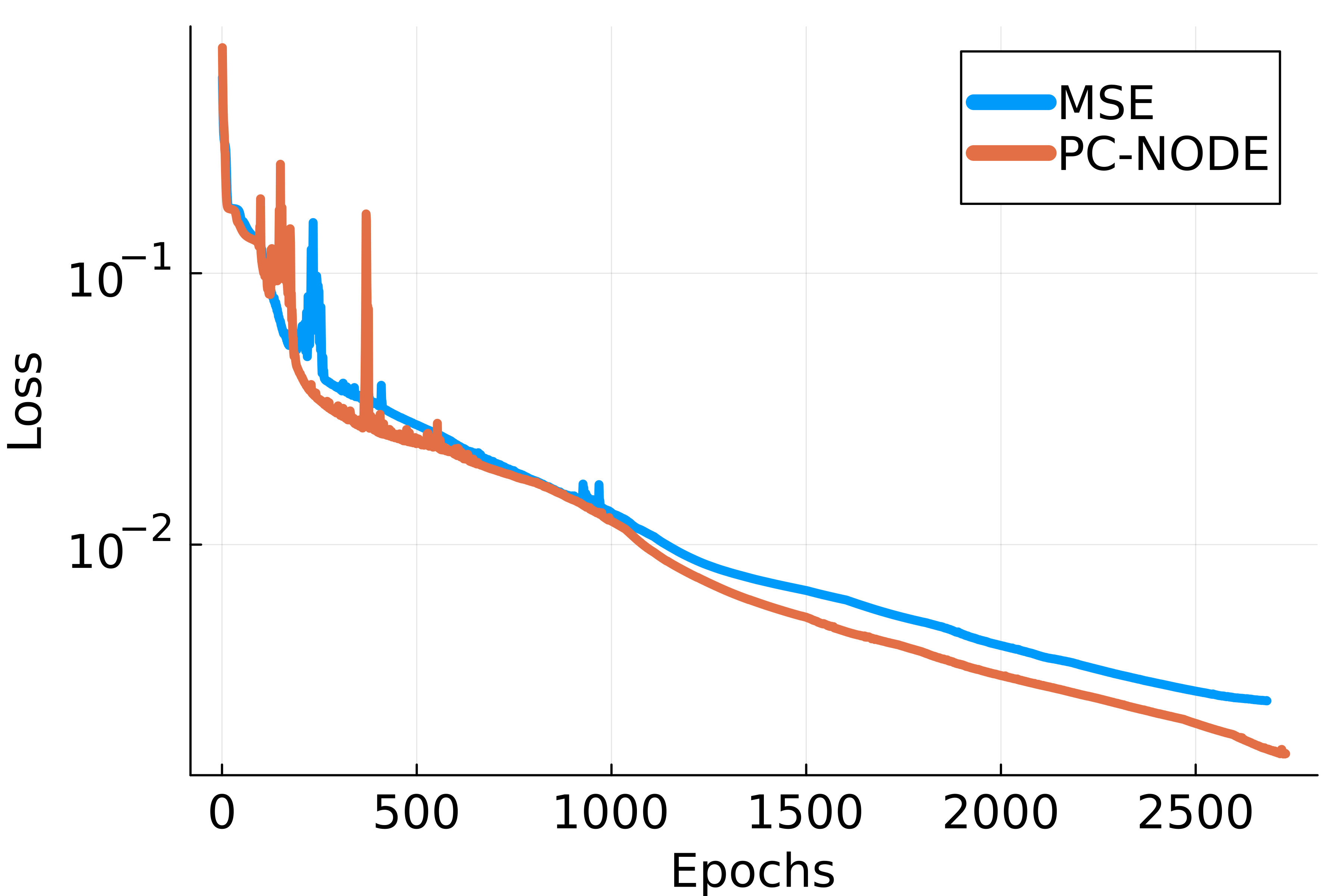
- RQ4질량 보존 제약 조건의 포함이 강한 ODE 시스템 환경에서 훈련 효율성과 수렴 성능 향상에 기여하는가?
주요 결과
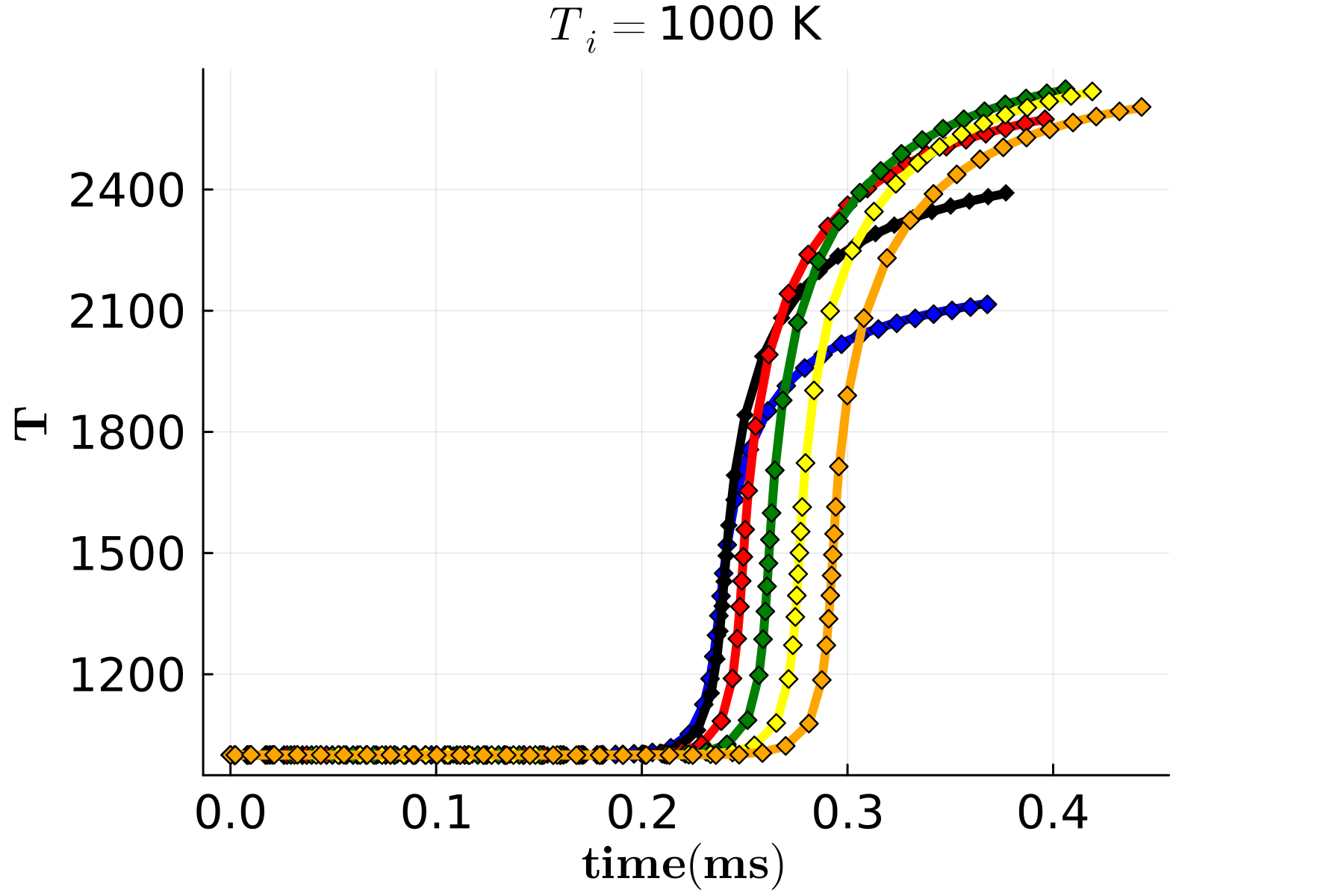
- 원소 질량 보존 제약 조건을 적용한 PC-NODE 모델(ELE-CONS)은 온도 및 종 분율에 대해 참값과 뛰어난 일치도를 보였고, 제약 조건이 없는 모델(NO-CONS)은 상당한 편차를 보였다.
- PC-NODE 예측에서는 수소와 산소의 원소 질량 분율이 수치적 허용 오차 내에서 보존되었으며, 이는 물리적 일치성을 확인한다.
- PC-NODE 모델은 훈련 범위 외의 초기 온도 1200 K 및 계기비 φ=0.4 및 φ=1.6 조건에도 강인한 외삽 일반화 성능을 보였다.
- 순수 데이터 기반의 NODE 접근 방식에 비해 PC-NODE 예측은 열역학적 스칼라의 시간적 변화에서 훨씬 낮은 오차를 보였다.
- 물리 법칙이 손실 함수에 정규화되어 있어, 물리 제약 기반 모델은 향상된 훈련 효율성과 더 나은 수렴 행동을 달성했다.
- CONVERGE CFD 솔버와 결합된 상황에서 PC-NODE는 질량 보존에서 낮은 편차를 유지하며 3D 유닛 셀 시뮬레이션 전반에 걸쳐 정확하고 안정된 해를 생성했다.
더 나은 연구,지금 바로 시작하세요
논문 읽기부터 검토까지, 연구 시간을 획기적으로 줄여보세요.
카드 등록 없음 · 무료 플랜 제공
이 리뷰는 AI가 만들고, 인간 에디터가 검토했습니다.