
[논문 리뷰] A superconducting-nanowire single-photon camera with 400,000 pixels
이 논문은 교차된 WSi 나노와이어를 사용한 열적으로 결합된 행-열 다중화 아키텍처를 기반으로 한 400,000픽셀 초전도 나노와이어 단광자 카메라를 제시한다. 장치는 5×5 µm 해상도를 달성했으며, 370 nm와 635 nm에서 일치하는 양자 효율을 보였고, 어둠이 없는 카운트 레이트는 배열 전체에서 0.13 cps였으며, 0.8 K에서 작동하고 네 개의 마이크로파 코ax 라인을 통한 확장 가능한 읽기 방식을 구현하였다.
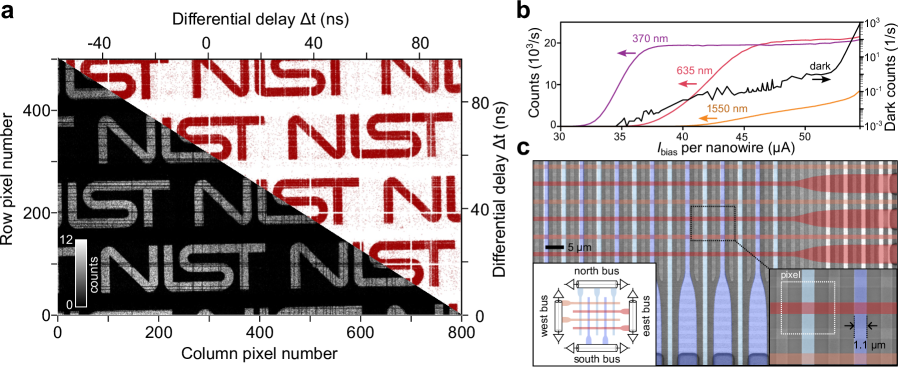
For the last 50 years, superconducting detectors have offered exceptional sensitivity and speed for detecting faint electromagnetic signals in a wide range of applications. These detectors operate at very low temperatures and generate a minimum of excess noise, making them ideal for testing the non-local nature of reality, investigating dark matter, mapping the early universe, and performing quantum computation and communication. Despite their appealing properties, however, there are currently no large-scale superconducting cameras - even the largest demonstrations have never exceeded 20 thousand pixels. This is especially true for one of the most promising detector technologies, the superconducting nanowire single-photon detector (SNSPD). These detectors have been demonstrated with system detection efficiencies of 98.0%, sub-3-ps timing jitter, sensitivity from the ultraviolet (250nm) to the mid-infrared (10um), and dark count rates below 6.2e-6 counts per second (cps), but despite more than two decades of development they have never achieved an array size larger than a kilopixel. Here, we report on the implementation and characterization of a 400,000 pixel SNSPD camera, a factor of 400 improvement over the previous state-of-the-art. The array spanned an area 4x2.5 mm with a 5x5um resolution, reached unity quantum efficiency at wavelengths of 370 nm and 635 nm, counted at a rate of 1.1e5 cps, and had a dark count rate of 1e-4 cps per detector (corresponding to 0.13 cps over the whole array). The imaging area contains no ancillary circuitry and the architecture is scalable well beyond the current demonstration, paving the way for large-format superconducting cameras with 100% fill factors and near-unity detection efficiencies across a vast range of the electromagnetic spectrum.
연구 동기 및 목표
- 초전도 나노와이어 단광자 검출기(SNSPDs)의 확장성 한계를 극복하기 위해 대규모, 고밀도 픽셀 배열을 가능하게 하기 위해.
- SNSPDs는 낮은 진폭과 광역 밴드패시브 펄스를 생성하므로 대규모로 효율적으로 읽기 어려운 점을 해결하기 위해.
- 킬로픽셀 이상의 배열에서 고신호대잡음비를 유지하고 교차왜곡을 최소화하면서도 확장 가능한 저노이즈 읽기 아키텍처를 개발하기 위해.
- 큰 영상 영역에서 근접한 일치 양자 효율과 낮은 어둠이 없는 카운트 레이트를 동시에 확보하고 100% 필드 포화율을 달성하기 위해.
- 표준 리소그래피와 열적 결합 원리를 활용한 대규모 SNSPD 배열의 실용적이고 재현 가능한 제조 공정을 개발하기 위해.
제안 방법
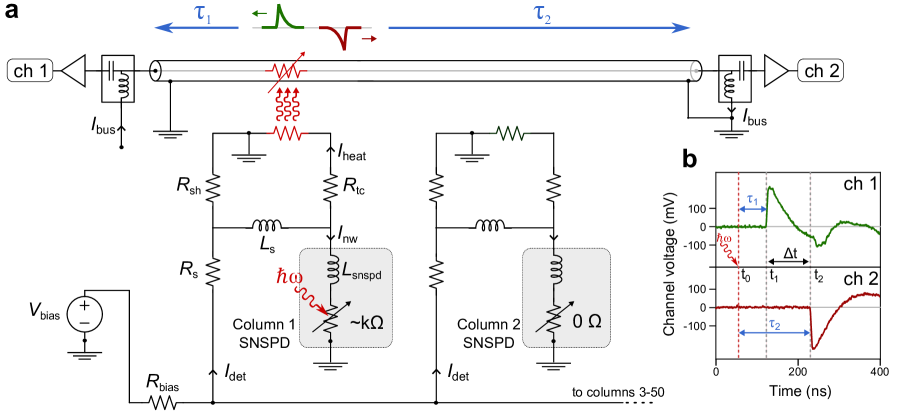
- SNSPDs를 격자형으로 배열하고 저항성 열결합기를 통해 공유 읽기 버스에 연결한 열적으로 결합된 행-열 다중화 아키텍처를 사용하였다.
- Tc = 3.4 K이고 운동학적 인덕턴스가 250 pH/sq인 4-nm 두께의 WSi 필름으로 1.1 µm 폭과 5 µm 간격으로 패tern된 교차 배열 행 및 열 나노와이어 검출기를 사용하였다.
- 각 버스가 열결합기를 통해 50개의 검출기와 연결된 4버스 읽기 시스템을 구현하여 다중화를 구현하였다. 이 시스템은 8개의 마이크로파 코ax 라인을 사용하였다.
- 균일한 전류 분포, 낮은 교차왜곡, 빠른 리셋 시간을 확보하기 위해 회로 파라미터(R_bias = 1000 Ω, R_s = 80 Ω, R_sh = 16 Ω, R_tc = 16 Ω, L_s = 1.25 µH, L_snspd = 1.14 µH)를 최적화하였다.
- 스테퍼 리소그래피 기법을 사용해 10개의 검출기를 포함한 유닛 셀을 1000×1000 배열에 반복 적용하여 균일한 수율을 확보한 확장 가능한 제조 공정을 구현하였다.
- 버스에서의 시간지연 데이터를 타임태깅하고 히스토GRAM을 분석하여 2차원 영상 재구성 및 검출 성능 정량화를 수행하였다.
실험 결과
연구 질문
- RQ1열적 결합과 다중화를 활용해 대규모 SNSPD 배열에 대해 확장 가능하고 교차왜곡이 낮은 읽기 아키텍처를 개발할 수 있는가?
- RQ2높은 양자 효율과 낮은 어둠이 없는 카운트 레이트를 유지하면서도 초전도 나노와이어 단광자 카메라에서 달성 가능한 최대 픽셀 수는 얼마인가?
- RQ3열적 행-열 아키텍처는 이전의 다중화 기법에 비해 신호대잡음비와 확장성 측면에서 어떻게 비교되는가?
- RQ4표준 리소그래피 기법을 사용할 경우 대규모 SNSPD 배열에서 제조 수율과 균일성이 얼마나 유지될 수 있는가?
- RQ5400,000픽셀 SNSPD 배열이 동시에 근접한 일치 양자 효율과 cps 이하의 어둠이 없는 카운트 레이트를 달성할 수 있는가?
주요 결과
- SNSPD 배열은 400,000픽셀을 달성했으며, 5×5 µm 해상도를 확보하여 이전 최고 성능인 1,024픽셀 대비 400배 향상된 성능을 보였다.
- 370 nm와 635 nm에서 일치 양자 효율을 보였으며, 가시광선 영역에서 근본적인 광자 탐지 성능을 입증하였다.
- 어둠이 없는 카운트 레이트는 1.0×10⁻⁴ cps/검출기로 측정되었으며, 전체 배열 기준 총합 0.13 cps로 낮은 노이즈 작동을 확인하였다.
- 시스템은 0.8 K에서 1.1×10⁵ cps의 카운트 레이트로 작동하여 높은 다이나믹 레인지와 빠른 리셋 능력을 보였다.
- 전체 배열에 대해 단지 네 개의 마이크로파 코어 라인만 사용하여 확장 가능한 저열 부하 다중화를 실현했으며, 교차왜곡도 최소화되었다.
- 제조된 배열은 영상 영역에 보조 회로가 존재하지 않아 100% 필드 포화율을 달성했으며, 더 큰 형식으로의 완전한 확장 가능성을 입증하였다.
더 나은 연구,지금 바로 시작하세요
논문 읽기부터 검토까지, 연구 시간을 획기적으로 줄여보세요.
카드 등록 없음 · 무료 플랜 제공
이 리뷰는 AI가 만들고, 인간 에디터가 검토했습니다.