
[논문 리뷰] A Unified Picture of Short and Long Gamma-ray Bursts from Compact Binary Mergers
이 논문은 단기 및 장기 감마선 폭발(GRBs)을 압축 이중성 고체 융합으로 연결하는 통합 프레임워크를 제안한다. 고질량 이중성(M_tot ≳ 2.8 M☉)에서 형성된 블랙홀 주변의 거대한 질량 은하수는 장기 지속 GRB를 일으키며, 이는 GRB 211211A 및 GRB 230307A와 유사하다. 반면 저질량 이중성(M_tot ≲ 2.8 M☉)에서 형성된 초질량 중성자별(HMNSs)은 자기장이 강한 외부 유동을 통해 단기 GRB를 생성한다. 이는 다양한 GRB 지속 시간을 이중성 융합 물리학과 통합하여 설명한다.
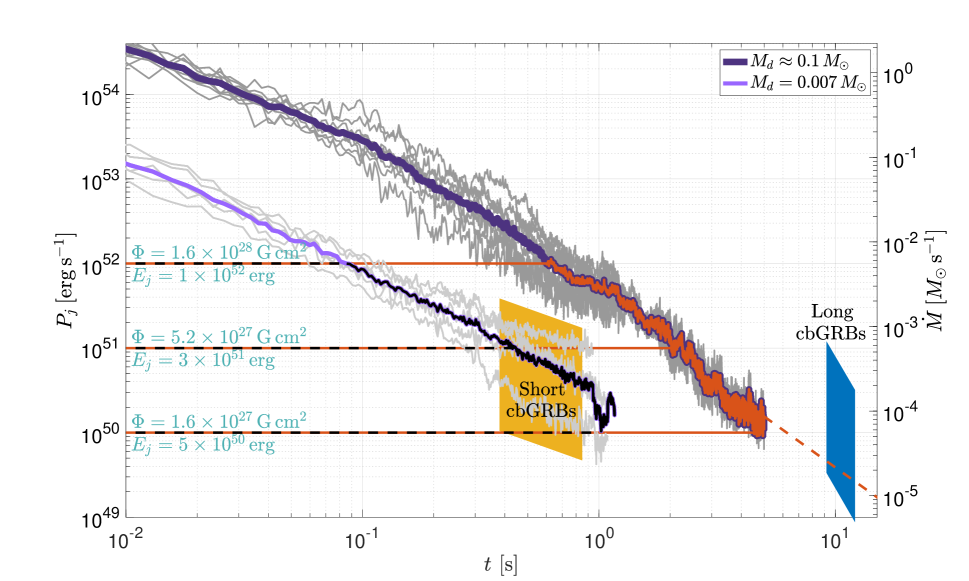
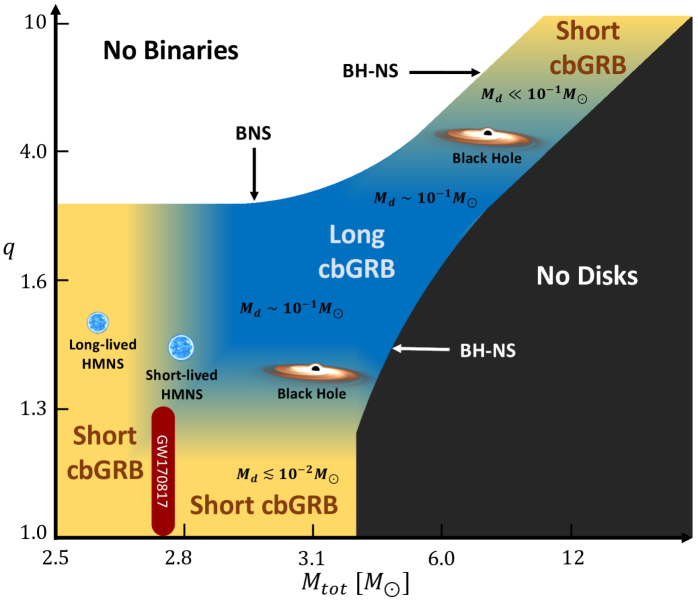
The recent detections of the $\sim10$-s long $γ$-ray bursts (GRBs) 211211A and 230307A followed by softer temporally extended emission (EE) and kilonovae, point to a new GRB class. Using state-of-the-art first-principles simulations, we introduce a unifying theoretical framework that connects binary neutron star (BNS) and black hole-NS (BH-NS) merger populations with the fundamental physics governing compact-binary GRBs (cbGRBs). For binaries with large total masses $M_{ m tot}\gtrsim2.8\,M_\odot$, the compact remnant created by the merger promptly collapses into a BH, surrounded by an accretion disk. The duration of the pre-magnetically arrested disk (MAD) phase sets the duration of the roughly constant power cbGRB and could be influenced by the disk mass, $M_d$. We show that massive disks ($M_d\gtrsim0.1\,M_\odot$), which form for large binary mass ratio $q\gtrsim1.2$ in BNS or $q\lesssim3$ in BH-NS mergers, inevitably produce 211211A-like long cbGRBs. Once the disk becomes MAD, the jet power drops with the mass accretion rate as $\dot{M}\sim t^{-2}$, naturally establishing the EE decay. Two scenarios are plausible for short cbGRBs. They can be powered by BHs with less massive disks, which form for other $q$ values. Alternatively, for binaries with $M_{ m tot}\lesssim2.8\,M_\odot$, mergers should go through a hypermassive NS (HMNS) phase, as inferred for GW170817. Magnetized outflows from such HMNSs, which typically live for $\lesssim1\,{ m s}$, offer an alternative progenitor for short cbGRBs. The first scenario is challenged by the bimodal GRB duration distribution and the fact that the Galactic BNS population peaks at sufficiently low masses that most mergers should go through a HMNS phase.
연구 동기 및 목표
- 장기 지속 감마선 폭발(GRBs)이 콘텐서와 관련이 없음에도 불구하고 지속 시간이 긴 문제를 해결하는 것, 특히 킬로노바와 함께 관측된 10초 정도 지속되는 GRB 이후로 발생한 문제를 해결한다.
- 압축 이중성 융합 기반의 단일 이론적 프레임워크 내에서 단기 및 장기 GRB의 기원을 통합하는 것.
- 관측 제약 조건이 상충되는 상황에서, 블랙홀 질량 은하수 또는 초질량 중성자별(HMNSs) 중 어느 것이 단기 GRB의 주요 원천인지 규명하는 것.
- 다양한 물리적 메커니즘을 통해 GRB 빛의 세기 변화 곡선의 시간적 특성, 즉 즉각적 방출, 침묵 기간, 연장 방출(EE)을 설명하는 것.
- GRB의 이중 분포 지속 시간을 이중성 질량 비율과 잔류 물체의 진화에 기반한 물리학과 조율하는 것.
제안 방법
- 압축 이중성 융합의 기본 원리에 기반한 자기장 유체역학(MHD) 시뮬레이션을 수행하며, 블랙홀-중성자별(BH–NS) 및 이중 중성자별(BNS) 시스템을 포함한다.
- 융합 후 질량 은하수의 형성과 진화를 모델링하며, 특히 은하수 질량(M_d)과 자기장 구조, 특히 자기장에 의해 정지된 은하수(MAD) 단계에 초점을 맞춘다.
- 질량 유입률에 따른 제트 파워의 변화를 분석하며, MAD 단계 동안 제트 파워는 Ṁ ∼ t⁻² 비례로 감소함을 보여, 연장 방출의 감쇠를 이끌어낸다.
- 이중성 질량 비율(q)과 총 질량(M_tot)을 핵심 매개변수로 삼아 융합 결과를 분류: M_tot ≳ 2.8 M☉일 경우 즉각적 블랙홀 형성 vs. M_tot ≲ 2.8 M☉일 경우 초질량 중성자별(HMNS) 형성.
- BH-은하수 및 HMNS-제트 모델에서 유도된 이론적 빛의 세기 곡선을 관측된 GRB 211211A 및 GRB 230307A의 빛의 세기 곡선과 비교하며, 예비 플레어와 침묵 기간을 포함한다.
- 킬로노바 관측, 라디오 후광, 은하계 이중 중성자별(BNS) 인구의 질량 분포 등 제약 조건을 바탕으로 다양한 원천 시나리오의 타당성을 평가한다.
실험 결과
연구 질문
- RQ1압축 이중성 융합에서 어떤 물리적 메커니즘이 연장 방출과 함께 10초 정도 지속되는 장기 지속 GRB(T90 ≈ 10 s)와 킬로노바를 동반하는가?
- RQ2모두가 이중성 융합에서 기인하지만 일부는 단기 GRB(T90 ≲ 1 s)를, 다른 일부는 장기 GRB를 생성하는 이유는 무엇인가?
- RQ3관측된 GRB의 이중 지속 시간 분포는 블랙홀-은하수 시스템과 HMNSs를 별도의 원천 채널로 설명할 수 있는가?
- RQ4이중성의 질량 비율(q)과 총 질량(M_tot)이 어떤 방식으로 거대한 은하수 또는 초질량 중성자별의 형성에 영향을 미치는가?
- RQ5GRB 211211A와 GRB 230307A에서 즉각적 방출과 연장 방출 사이의 침묵 기간은 무엇을 의미하며, 원천 진화와 어떻게 관련되어 있는가?
주요 결과
- 고질량 이중성 융합(M_tot ≳ 2.8 M☉, BNS의 경우 q ≳ 1.2 또는 BH–NS의 경우 q ≲ 3)에서 형성된 거대한 은하수(M_d ≳ 0.1 M☉)는 반드시 GRB 211211A 및 GRB 230307A와 유사한 장기 지속 GRB를 일으킨다.
- 장기 GRB에서의 연장 방출(EE) 감쇠는 자기장에 의해 정지된 은하수(MAD) 단계에서 질량 유입률이 기인한 t⁻² 거듭제곱 법칙을 따르며, 관측 결과와 일치한다.
- 단기 GRB는 초질량 중성자별(HMNSs)에서 발생하는 자기장이 강한 외부 유동에 의해 주로 공급되며, 이들은 ≲1초 동안 존재하여 짧은 지속 시간과 즉각적 방출 이후의 침묵 기간을 설명할 수 있다.
- 낮은 은하수 질량(M_d ≲ 10⁻² M☉)을 가진 블랙홀-은하수 시스템은 일반적인 단기 GRB를 생성할 수 있지만, 이 시나리오는 이중 지속 시간 분포와 은하계 BNS 인구의 질량 분포에 의해 도전받는다.
- 은하계 BNS 인구는 M_tot ≲ 2.75 M☉에서 피크를 이룬다. 이는 대부분의 BNS 융합이 즉각적 블랙홀 형성보다는 HMNS 형성을 유도함을 시사하며, 이는 단기 GRB의 주요 원천으로서 HMNSs를 지지한다.
- 단기 GRB들 사이에 두 개의 별개의 하위군이 관측되지 않는다는 점은, HMNS 기반 제트와 BH 기반 제트가 물리적으로 구별되지 않거나, 한 채널이 지배적임을 의미한다. 현재의 증거는 단기 GRB의 주요 원천으로서 HMNSs를 지지한다.
더 나은 연구,지금 바로 시작하세요
논문 읽기부터 검토까지, 연구 시간을 획기적으로 줄여보세요.
카드 등록 없음 · 무료 플랜 제공
이 리뷰는 AI가 만들고, 인간 에디터가 검토했습니다.