
[논문 리뷰] Act3D: 3D Feature Field Transformers for Multi-Task Robotic Manipulation
Act3D는 단일 RGB-D 이미지와 언어 지시어를 사용하여 다중 작업 로봇 조작을 위한 연속 해상도 3D 동작 맵을 예측하는 3D 특징 필드 트랜스포머 정책을 제안한다. 근사에서 정밀으로의 3D 점 샘플링과 상대적 위치 임베딩, 시각-언어 사전 훈련을 활용함으로써 Act3D는 RLBench에서 최고 성능을 기록하고 다양한 카메라 시점에서 강인하게 일반화되며, 시점 변화 상황에서 74.2%의 성공률을 달성하여 HiveFormer의 20.4%에 비해 뛰어난 내성성을 입증한다.
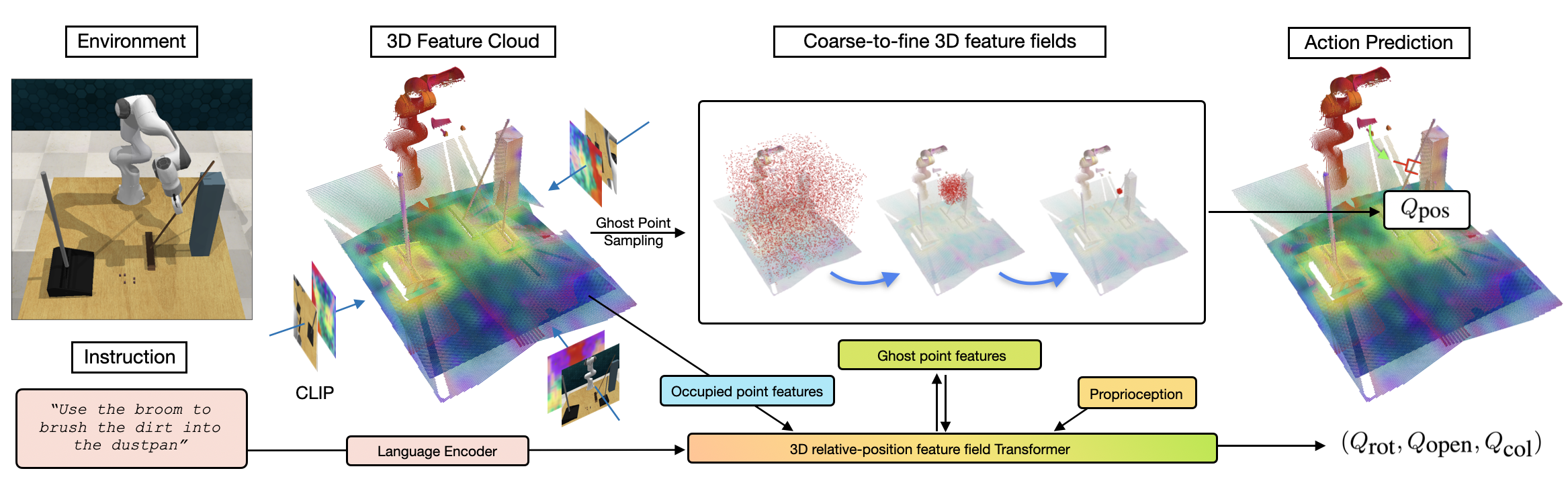
3D perceptual representations are well suited for robot manipulation as they easily encode occlusions and simplify spatial reasoning. Many manipulation tasks require high spatial precision in end-effector pose prediction, which typically demands high-resolution 3D feature grids that are computationally expensive to process. As a result, most manipulation policies operate directly in 2D, foregoing 3D inductive biases. In this paper, we introduce Act3D, a manipulation policy transformer that represents the robot's workspace using a 3D feature field with adaptive resolutions dependent on the task at hand. The model lifts 2D pre-trained features to 3D using sensed depth, and attends to them to compute features for sampled 3D points. It samples 3D point grids in a coarse to fine manner, featurizes them using relative-position attention, and selects where to focus the next round of point sampling. In this way, it efficiently computes 3D action maps of high spatial resolution. Act3D sets a new state-of-the-art in RL-Bench, an established manipulation benchmark, where it achieves 10% absolute improvement over the previous SOTA 2D multi-view policy on 74 RLBench tasks and 22% absolute improvement with 3x less compute over the previous SOTA 3D policy. We quantify the importance of relative spatial attention, large-scale vision-language pre-trained 2D backbones, and weight tying across coarse-to-fine attentions in ablative experiments. Code and videos are available on our project website: https://act3d.github.io/.
연구 동기 및 목표
- 최소한의 시연로 다양한 작업과 시점에서 일반화되는 로봇 조작 정책을 해결한다.
- 시점 변화 상황에서 실패하는 2D 다중 시점 방법의 국한된 점수 회귀 문제를 극복한다.
- 단일 RGB-D 카메라를 사용하여 복잡한 조작 작업을 위한 고정밀 연속 해상도 3D 동작 예측을 가능하게 한다.
- 3D 특징 필드 모델링과 시각-언어 정렬을 통해 제로샷 일반화와 깊이 노이즈 및 시점 이동에 대한 강인성을 향상시킨다.
- 다양한 물체 유형과 상호작용을 포함하는 언어 조건 정책을 위한 다중 작업 학습을 지원하는 통합 프레임워크를 개발한다.
제안 방법
- 각 점이 상대적 3D 위치 임베딩을 통해 접근되는 근사에서 정밀으로의 3D 점 샘플링을 통해 연속 해상도 특징 필드로 3D 장면를 표현한다.
- CLIP 사전 훈련된 ResNet50 특징을 사용하는 시각-언어 트랜스포머 기반 모델을 활용하여 자연어 지시어에 따라 동작 예측을 조건화한다.
- 근사에서 정밀으로의 샘플링 단계 간 가중치 묶음을 적용하고 국소적인 정밀한 시각적 특징에 주목함으로써 정위치 정확도를 향상시킨다.
- 공간적으로 적응형 계산을 적용하여 3D 공간에 가짜 점을 샘플링함으로써 추론 비용과 성능 사이의 동적 트레이드오프를 가능하게 한다.
- 모델을 3D 검출 출력으로서 동작을 예측하도록 훈련하여 연속 3D 특징 필드를 통해 무한 해상도를 구현함으로써 정밀한 동작 정위치를 가능하게 한다.
- 다중 시점 일致성과 무작위 자르기와 같은 데이터 증강 기법을 활용하여 강인성을 향상시키며, 요동 각도 회전과 같은 해로운 왜곡은 피한다.
실험 결과
연구 질문
- RQ1근사에서 정밀으로의 샘플링을 갖는 3D 특징 필드 트랜스포머는 2D 다중 시점 회귀 방법에 비해 시점 변화에 대해 더 뛰어난 일반화 성능을 달성할 수 있는가?
- RQ2샘플링 단계 간 상대적 3D 위치 인코딩과 가중치 묶음은 정책 성능과 일반화에 어떤 영향을 미치는가?
- RQ3CLIP로 사전 훈련된 2D 시각적 특징은 다중 작업 언어 조건 정책에서 제로샷 성공률을 얼마나 향상시키는가?
- RQ4샘플된 가짜 점의 수는 추론 비용과 동작 예측 정확도 사이의 트레이드오프에 어떤 영향을 미치는가?
- RQ5단일 3D 검출 기반 정책이 몇 개의 운동학적 시범만으로도 액체, 관절이 있는 물체, 변형 가능한 물체를 포함한 다양한 조작 작업에 일반화될 수 있는가?
주요 결과
- Act3D는 시점 변화 상황에서 74.2%의 성공률을 기록하여 HiveFormer의 20.4%에 비해 상대적 24% 감소를 보였고, HiveFormer는 77% 감소를 기록하여 더 뛰어난 내성성을 입증한다.
- 가중치 묶음을 제거하거나 상대적 3D 위치 임베딩을 제거하면 각각 17.5%와 42.7%의 성능 저하가 발생하여 이들이 일반화에 핵심적인 역할을 한다는 것을 확인한다.
- 세 단계 대신 두 단계 샘플링을 사용할 경우 4.5%의 성능 저하가 발생하여 근사에서 정밀으로의 완전한 정밀화가 필요하다는 것을 확인한다.
- 모든 단계에서 국소적인 정밀 특징 대신 전체적인 근사 특징에 주목할 경우 8.3%의 성능 저하가 발생하여 정밀 단계에서 국소적 주목의 중요성을 확인한다.
- 가짜 점 샘플링 수를 1,000에서 10,000으로 늘일 경우 성능이 4.9% 향상되며, 이는 높은 샘플링 밀도가 비용 증가에 비해 정확도 향상에 기여함을 보여준다.
- 다중 작업 설정에서 CLIP 사전 훈련된 ResNet50 특징은 ImageNet 사전 훈련된 특징보다 8.7% 높은 성공률을 기록하며, 특히 언어 지시어가 중요한 경우에 뚜렷한 향상 효과를 보인다.
![Figure 2: Tasks. We conduct experiments on 92 simulated tasks in RLBench [ 16 ] (only 10 shown), and 8 real-world tasks (only 5 shown).](https://ar5iv.labs.arxiv.org/html/2306.17817/assets/final_figures/tasks.png)
더 나은 연구,지금 바로 시작하세요
논문 읽기부터 검토까지, 연구 시간을 획기적으로 줄여보세요.
카드 등록 없음 · 무료 플랜 제공
이 리뷰는 AI가 만들고, 인간 에디터가 검토했습니다.