
[논문 리뷰] Active and reactive behaviour in human mobility: the influence of attraction points on pedestrians
이 연구는 공개 페스티벌에서 인간 이동성의 능동적(내재적) 및 반응적(맥락에 따라 달라지는) 성분을 분리하기 위해 랭지비안 역학 기반 모델을 제안한다. GPS로 추적한 보행자와 시뮬레이션된 유인 지점 자료를 바탕으로, 눈에 보이는 부스에서 유도되는 반응적 힘이 이동 패턴을 크게 형성하는 반면, 능동적 지속성과 기억은 궤적의 복잡성에 기여하며, 도시 계획 및 이벤트 설계에 적용 가능한 확장 가능한 프레임워크를 제공한다.
Human mobility is becoming an accessible field of study thanks to the progress and availability of tracking technologies as a common feature of smart phones. We describe an example of a scalable experiment exploiting these circumstances at a public, outdoor fair in Barcelona (Spain). Participants were tracked while wandering through an open space with activity stands attracting their attention. We develop a general modeling framework based on Langevin Dynamics, which allows us to test the influence of two distinct types of ingredients on mobility: reactive or context-dependent factors, modelled by means of a force field generated by attraction points in a given spatial configuration, and active or inherent factors, modelled from intrinsic movement patterns of the subjects. The additive and constructive framework model accounts for the observed features. Starting with the simplest model (purely random walkers) as a reference, we progressively introduce different ingredients such as persistence, memory, and perceptual landscape, aiming to untangle active and reactive contributions and quantify their respective relevance. The proposed approach may help in anticipating the spatial distribution of citizens in alternative scenarios and in improving the design of public events based on a facts-based approach.
연구 동기 및 목표
- 시민 과학과 GPS 추적을 활용해 인간 이동성을 연구하기 위한 확장 가능하고 공개 접근이 가능한 실험 프레임워크를 개발하기 위해.
- 도시 유사 환경 내 보행자 이동에서 능동적(내재적) 및 반응적(맥락에 기반한) 행동의 상대 기여도를 정량화하기 위해.
- 지속성, 기억, 인지적 지형을 통합하는 랭지비안 역학 기반 일반화된 모델링 프레임워크를 구축하기 위해.
- 스페인 바르셀로나에서 개최된 공개 과학 페스티벌에서 관찰된 실제 이동 패턴을 재현할 수 있는지 모델의 능력을 테스트하기 위해.
- 도시 환경에서 집단 이동 패턴을 예측하고 공공 공간 설계를 향상시키기 위한 데이터 기반 접근법을 제공하기 위해.
제안 방법
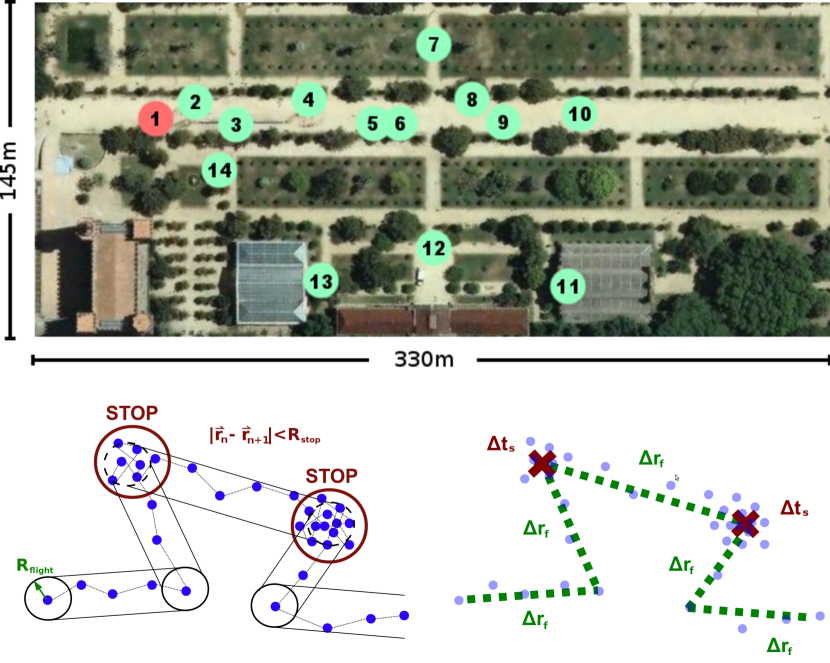
- 스페인 바르셀로나의 공개 페스티벌에서 대규모 시민 과학 실험을 수행하여 GPS 기능이 탑재된 스마트폰으로 50명 이상의 참가자를 추적하였다.
- 실제 데이터 수집을 시뮬레이션하기 위해 평균 위치 오차가 4.071미터이고 샘플링 간격이 15초인 실세계 GPS 데이터를 수집하였다.
- 추가 성분을 갖춘 랭지비안 역학 모델을 개발하였으며, 무작위 운동을 위한 확률적 항, 베르누이-미제스 분포를 통한 지속성 항, 부스를 나타내는 잠재력 우물(힘장)을 포함한 유인 지점에서 유도되는 힘을 포함하였다.
- 실제 페스티벌과 동일한 부스 구성으로 330m × 145m 영역에서 20,000초(5.5시간)의 이동을 시뮬레이션하였다.
- 홈 레인지와 궤적 분산을 계산하기 위해 dBBMM(dynamic Brownian bridge movement model)와 GIS 도구(ArcGIS, Geospatial Modelling Environment)를 사용하였다.
- 궤적 분산을 계산하고 시간에 따른 이동 복잡성 평가를 위해 11개 점의 슬라이딩 윈도우를 적용하였다.
실험 결과
연구 질문
- RQ1눈에 보이는 유인 지점에서 유도되는 반응적 힘이 개방형 도시 유사 공간 내 보행자 이동 패턴에 어떤 영향을 미치는가?
- RQ2지속성과 기억과 같은 내재적 이동 성질이 인간 이동 궤적에 얼마나 큰 영향을 미치는가?
- RQ3능동적 및 반응적 성분을 통합함으로써 랭지비안 기반의 통합 모델이 실제 보행자 역학을 효과적으로 재현할 수 있는가?
- RQ4인지 지형과 개인의 이동 패턴 간의 상호작용이 공간 분포 및 홈 레인지 추정에 어떤 영향을 미치는가?
- RQ5공개 행사에서 집단 이동 패턴을 형성하는 데 있어 능동적 행동과 반응적 행동 중 어느 쪽이 더 큰 기여를 하는가?
주요 결과
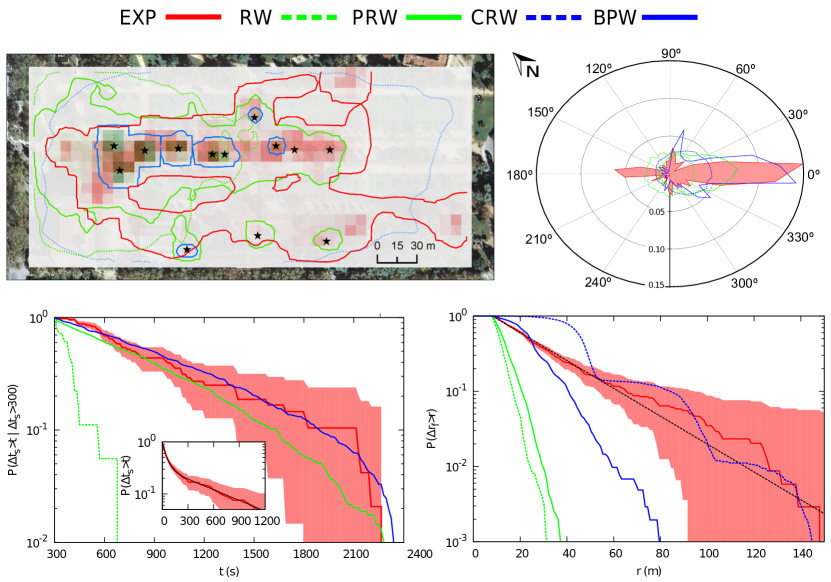
- 랭지비안 모델에 유인 지점(잠재력 우물)을 포함시킴으로써 실제 GPS 궤적에 대한 적합도가 크게 향상되어 눈에 보이는 부스에서 유도되는 강력한 반응적 영향을 확인하였다.
- 궤적 분산 분석 결과, 유인 지점 근처에서는 이동 복잡성이 증가하여 맥락 기반 행동 변화가 확인되었다.
- dBBMM 분석 결과, 반응적 힘을 포함한 시뮬레이션에서 참가자의 95% 홈 레인지가 순수하게 능동적인 모델보다 항상 더 넓게 나타났다.
- 지속성과 기억 성분을 모두 포함한 모델이 단 하나 또는 전혀 포함하지 않은 모델보다 관측된 이동 패턴을 더 잘 재현하였다.
- 모의 궤적은 실제 데이터의 공간 분포와 이동 강도 측면에서 유사하게 나타나, 모델의 예측 능력을 검증하였다.
- 연구는 눈에 보이는 유인 지점에 의해 유도되는 반응적 행동이 특히 부스 주변의 고밀도 지역에서 보행자 유량을 형성하는 데 지배적인 요소임을 입증하였다.
더 나은 연구,지금 바로 시작하세요
논문 읽기부터 검토까지, 연구 시간을 획기적으로 줄여보세요.
카드 등록 없음 · 무료 플랜 제공
이 리뷰는 AI가 만들고, 인간 에디터가 검토했습니다.