
[논문 리뷰] Adaptive estimation of quantum observables
이 논문은 양자 해밀토니안의 기댓값과 분산을 실시간으로 추정함으로써 측정 자원을 동적으로 할당하는 적응형 양자 관측량 추정 알고리즘인 AEQuO를 소개한다. 실시간 오차 모니터링을 활용하고 비비트워이즈 교환 관계가 성립하지 않는 파울리 군집을 허용함으로써, AEQuO는 NISQ 시대의 양자 알고리즘에서 측정 오차를 기존 최고 수준의 방법들보다 낮게 유지하며 측정 오 overhead 를 크게 감소시킨다.
The accurate estimation of quantum observables is a critical task in science. With progress on the hardware, measuring a quantum system will become increasingly demanding, particularly for variational protocols that require extensive sampling. Here, we introduce a measurement scheme that adaptively modifies the estimator based on previously obtained data. Our algorithm, which we call AEQuO, continuously monitors both the estimated average and the associated error of the considered observable, and determines the next measurement step based on this information. We allow both for overlap and non-bitwise commutation relations in the subsets of Pauli operators that are simultaneously probed, thereby maximizing the amount of gathered information. AEQuO comes in two variants: a greedy bucket-filling algorithm with good performance for small problem instances, and a machine learning-based algorithm with more favorable scaling for larger instances. The measurement configuration determined by these subroutines is further post-processed in order to lower the error on the estimator. We test our protocol on chemistry Hamiltonians, for which AEQuO provides error estimates that improve on all state-of-the-art methods based on various grouping techniques or randomized measurements, thus greatly lowering the toll of measurements in current and future quantum applications.
연구 동기 및 목표
- 변이형 양자 고유값 해법에서 광범위한 샘플링이 요구되는 바, NISQ 시대의 양자 알고리즘에서 높은 측정 비용 문제를 해결하기 위해.
- 기존 측정 프로토콜이 고정된 군집 전략에 의존하거나 비트워이즈 교환 관계를 가정하는 데서 비롯되는 제약을 극복하기 위해.
- 양자 관측량의 평균과 분산을 지속적으로 추정함으로써 측정 예산을 적응적으로 할당하는 방법을 개발하기 위해.
- 중첩 및 비비트워이즈 교환 관계가 성립하지 않는 파울리 연산자 군집을 허용함으로써 측정 당 정보 수확량을 극대화하고 추정 정확도를 향상시키기 위해.
- 최고 수준의 방법들인 랜덤 측정, 군집 기반 기법, 최적 측정 프로토콜과의 성능 비교를 통해 성능을 평가하기 위해.
제안 방법
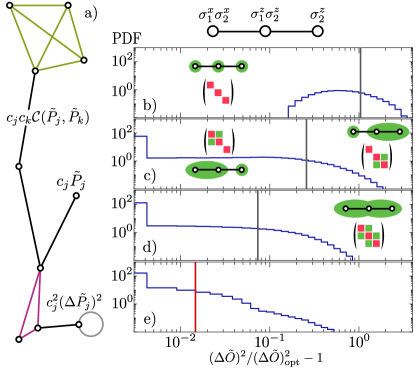
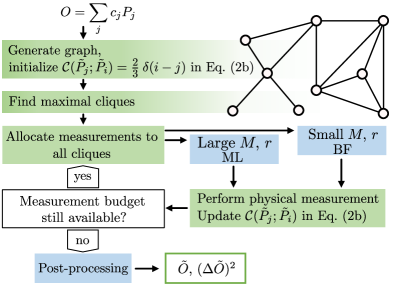
- AEQuO는 파울리 스트링을 정점으로, 교환 관계를 간선으로 하는 가중 그래프 문제로 관측량 추정 문제를 재구성한다.
- 알고리즘은 두 가지 핵심 서브루틴을 사용한다: 소규모 문제에 적합한 근사적 버킷 채우기 방법과 대규모 인스턴스에 적합한 기계학습 기반 방법.
- 측정 과정에서 관측량의 추정 평균과 분산을 지속적으로 모니터링함으로써 측정 전략을 실시간으로 적응시킨다.
- 기존의 교환 기반 군집화를 초월하여 중첩 및 비비트워이즈 교환 관계가 성립하지 않는 파울리 군집을 허용함으로써 정보 효율성을 높인다.
- 측정 설정의 후처리를 통해 추정기 오차를 추가 측정 없이도 감소시켜 최종 정밀도를 향상시킨다.
- 알고리즘은 분자 해밀토니안을 기반으로 평가되었으며, OGM, LDF, Derand 및 비적응형 AEQuO와의 성능 비교가 이루어졌다.
실험 결과
연구 질문
- RQ1실시간 오차 추정을 기반으로 한 적응형 측정 자원 할당이 양자 관측량 추정에서 고정 또는 비적응형 측정 프로토콜을 능가할 수 있는가?
- RQ2비비트워이즈 교환 관계가 성립하지 않거나 중첩되는 파울리 군집을 허용할 경우, 추정 정확도 향상과 측정 오 overhead 감소에 어느 정도 기여하는가?
- RQ3OGM, LDF, 랜덤 측정과 같은 최고 수준의 방법들과 비교했을 때, AEQuO는 추정 오차와 측정 효율성 측면에서 어떤가?
- RQ4AEQuO의 적응적 특성은 작은 계수를 가진 해밀토니안을 포함한 다양한 양자 화학 해밀토니안에서 일관된 이점을 제공하는가?
- RQ5AEQuO의 기계학습 기반 서브루틴은 비틀림 또는 조합 기반 접근 방식에 비해 더 큰 양자 시스템에 대해 유리하게 확장 가능한가?
주요 결과
- AEQuO는 다양한 화학 해밀토니안에서 OGM, LDF, Derand, 비적응형 AEQuO를 포함한 모든 최고 수준의 방법들보다 낮은 추정 오차를 기록한다.
- H₂O 분자에 대해 L=3, l=4 설정에서 AEQuO는 모든 다른 프로토콜을 능가하며, OGM이 작은 측정 예산에서 더 나은 성능을 보일 수 있는 이유는 저계수 항을 제거함으로써 통계적 노이즈를 줄이기 때문이다.
- OGM의 초기 우위는 저계수 항을 제거함으로써 발생하며, AEQuO는 이러한 항들을 포함하지만 여전히 전체 성능에서 뛰어나다.
- AEQuO의 적응 전략은 테스트된 모든 해밀토니안에서 오차를 지속적으로 감소시켜 고정 군집 기반 방법에 비해 뛰어난 강건성과 확장성을 입증한다.
- 기계학습 기반 AEQuO의 변종은 대규모 문제 인스턴스에 대해 유리한 스케일링을 보이며, 측정 효율성 측면에서 근사적 접근보다 뛰어나다.
- D=2 및 D=3 차원 격자 해밀토니안에서도 AEQuO는 뛰어난 성능을 유지하여 분자 시스템 외부에서도 효과적임을 확인한다.
더 나은 연구,지금 바로 시작하세요
논문 읽기부터 검토까지, 연구 시간을 획기적으로 줄여보세요.
카드 등록 없음 · 무료 플랜 제공
이 리뷰는 AI가 만들고, 인간 에디터가 검토했습니다.