
[논문 리뷰] AirPhyNet: Harnessing Physics-Guided Neural Networks for Air Quality Prediction
AirPhyNet은 확산-대류 물리를 신경망에 통합하여 PM2.5를 예측하며, 특히 데이터가 희소한 상황에서 정확도가 향상되고 최첨단 baselines보다 성능이 좋다.
Air quality prediction and modelling plays a pivotal role in public health and environment management, for individuals and authorities to make informed decisions. Although traditional data-driven models have shown promise in this domain, their long-term prediction accuracy can be limited, especially in scenarios with sparse or incomplete data and they often rely on black-box deep learning structures that lack solid physical foundation leading to reduced transparency and interpretability in predictions. To address these limitations, this paper presents a novel approach named Physics guided Neural Network for Air Quality Prediction (AirPhyNet). Specifically, we leverage two well-established physics principles of air particle movement (diffusion and advection) by representing them as differential equation networks. Then, we utilize a graph structure to integrate physics knowledge into a neural network architecture and exploit latent representations to capture spatio-temporal relationships within the air quality data. Experiments on two real-world benchmark datasets demonstrate that AirPhyNet outperforms state-of-the-art models for different testing scenarios including different lead time (24h, 48h, 72h), sparse data and sudden change prediction, achieving reduction in prediction errors up to 10%. Moreover, a case study further validates that our model captures underlying physical processes of particle movement and generates accurate predictions with real physical meaning.
연구 동기 및 목표
- 물리학과 데이터 기반 학습을 결합하여 실외 PM2.5 예측의 정확성을 높인다.
- 딥 러닝 프레임워크에 기본 대기 운송 물리(확산 및 대류)를 통합한다.
- 희소 데이터와 급변 상황에서 예측 정확도와 해석 가능성을 향상시킨다.
제안 방법
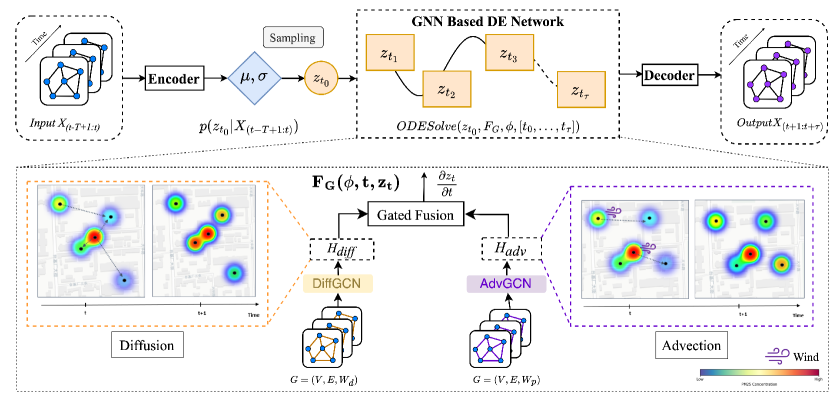
- 역사적 PM2.5 및 기상 데이터를 GRU 기반의 RNN 인코더로 인코딩한다.
- 센서 네트워크에서의 확산 및 대류를 그래프 라플라시안으로 표현한 미분방정식 네트워크로 모델링한다.
- 확산 및 대류 역학을 게이트 메커니즘으로 융합하여 확산-대류 미분방정식(DE)을 형성한다.
- DE 네트워크를 GNN 기반의 신경 ODE로 매개변수화하여 잠재 상태를 시간에 따라 전개한다.
- 잠재 예측을 향후 수평선(최대 72시간)에서 PM2.5 농도로 디코딩한다.
- 예측 농도와 실제 농도의 MAE를 최소화하여 엔드 투 엔드로 학습한다.
실험 결과
연구 질문
- RQ1물리 가이던스 딥러닝(확산-대류)이 순수 데이터 기반 모델보다 실외 PM2.5 예측을 향상시킬 수 있는가?
- RQ2물리 정보를 갖춘 구성 요소가 희소 데이터 및 급변 상황에서 성능을 향상시키는가?
- RQ3제안된 GNN 기반 미분방정식 네트워크가 센서 네트워크에서 시공간 운반 역학을 효과적으로 포착하는가?
- RQ4예측을 기저 확산 및 대류 과정과 연결하는 해석 가능성은 어떤 이점을 주는가?
주요 결과
- AirPhyNet은 24h, 48h, 72h 예측에서 베이징과 선전 데이터셋 모두에서 일관되게 베이스라인을 능가한다.
- 전체 데이터 설정에서 두 번째로 최적의 방법 대비 평균 MAE에서 3.7%, RMSE에서 6.1%의 개선을 보인다.
- 희소 데이터 설정에서 AirPhyNet은 경쟁자 대비 평균적으로 MAE 8.3%, RMSE 8.1%의 개선을 보인다.
- 급변 시나리오에서 예측 오차를 최대 8%까지 감소시키는 모델 성능을 보인다.
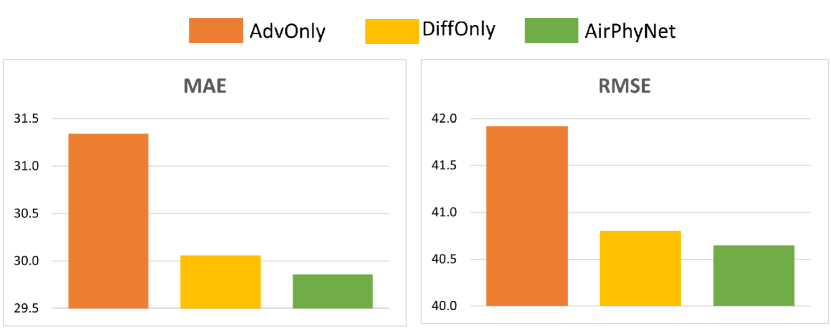
- Ablation 연구는 확산과 대류의 결합 이점과 TCN 기반 인코더보다 GRU 인코더의 이점을 시사한다.
- 사례 연구 시각화는 예측에서 물리적으로 의미 있는 확산 및 대류 패턴을 보여준다.
더 나은 연구,지금 바로 시작하세요
논문 읽기부터 검토까지, 연구 시간을 획기적으로 줄여보세요.
카드 등록 없음 · 무료 플랜 제공
이 리뷰는 AI가 만들고, 인간 에디터가 검토했습니다.