
[논문 리뷰] ALMA Lensing Cluster Survey: Deep 1.2 mm Number Counts and Infrared Luminosity Functions at $z\simeq1-8$
이 논문은 강한 중력 렌즈 효과를 활용하여 적색편이 z ≃ 1–8에서의 준미세파 은하를 탐지함으로써 ALMA 렌즈 클러스터 설문조사에서 1.2 mm 수치 밀도 및 적외선 발광 함수를 제시한다. ALMA 관측과 렌즈 모델을 결합하여 고체 밀도의 준미세파 소스 함수를 측정하고, 우주 시간에 따른 먼지가 많은 별 형성 은하의 진화를 제약하며, 고적색편이로 향하는 수치 밀도의 급격한 증가를 드러낸다.
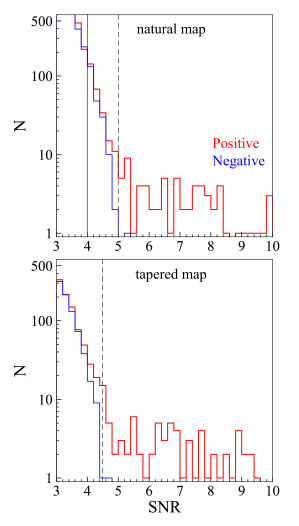
We present a statistical study of 180 dust continuum sources identified in 33 massive cluster fields by the ALMA Lensing Cluster Survey (ALCS) over a total of 133 arcmin$^{2}$ area, homogeneously observed at 1.2 mm. ALCS enables us to detect extremely faint mm sources by lensing magnification, including near-infrared (NIR) dark objects showing no counterparts in existing {\it Hubble Space Telescope} and {\it Spitzer} images. The dust continuum sources belong to a blind sample ($N=141$) with S/N $\gtrsim$ 5.0 (a purity of $>$ 0.99) or a secondary sample ($N=39$) with S/N= $4.0-5.0$ screened by priors. With the blind sample, we securely derive 1.2-mm number counts down to $\sim7$ $μ$Jy, and find that the total integrated 1.2mm flux is 20.7$^{+8.5}_{-6.5}$ Jy deg$^{-2}$, resolving $\simeq$ 80 % of the cosmic infrared background light. The resolved fraction varies by a factor of $0.6-1.1$ due to the completeness correction depending on the spatial size of the mm emission. We also derive infrared (IR) luminosity functions (LFs) at $z=0.6-7.5$ with the $1/V_{ m max}$ method, finding the redshift evolution of IR LFs characterized by positive luminosity and negative density evolution. The total (=UV+IR) cosmic star-formation rate density (SFRD) at $z>4$ is estimated to be $161^{+25}_{-21}$ % of the established measurements, which were almost exclusively based on optical$-$NIR surveys. Although our general understanding of the cosmic SFRD is unlikely to change beyond a factor of 2, these results add to the weight of evidence for an additional ($\approx 60$ %) SFRD component contributed by the faint-mm population, including NIR dark objects.
연구 동기 및 목표
- 깊은 ALMA 관측을 통해 고적색편이(z ≃ 1–8)에서 준미세파 소스 밀도 분포의 어두운 끝을 측정하기 위해.
- 중력 렌즈 증폭을 보정하여 초기 우주에서 먼지가 많은 별 형성 은하의 적외선 발광 함수(IRLF)를 유도하기 위해.
- 적색편이 z ≃ 1에서 z ≃ 8로의 준미세파 은하의 우주적 별 형성률 밀도(SFRD)와 수밀도의 진화를 조사하기 위해.
- 고적색편이 준미세파 은하 소스를 식별하고 특성화하는 데 있어 광학적 적색편이와 렌즈 모델의 신뢰성을 평가하기 위해.
- 다중 파장 데이터와 ALMA 1.2 mm 영상으로 고적색편이 z > 6인 희귀하고 매우 증폭된 소스를 식별하고 분석하기 위해.
제안 방법
- 32개의 강한 렌즈 클러스터 내 180개의 렌즈된 소스에 대해 깊은 ALMA 밴드 6(1.2 mm) 관측을 활용하여 어두운 준미세파 천구를 탐색한다.
- 기준 렌즈 모델을 적용하여 증폭 요인을 추정하고, 렌즈 증폭에 의한 관측된 복사 밀도를 보정하기 위해 광학적 적색편이와 SED 피팅을 사용하여 소스의 적색편이를 추정한다.
- 복사 밀도와 증폭의 불확실성을 전파하기 위해 몬테카를로 시뮬레이션을 활용하며, 비드 응답과 체계적 오프셋을 고려한다.
- 보정된 복사 밀도와 적색편이를 사용하여 렌즈된 소스 목록에서 수밀도와 적외선 발광 함수(IRLF)를 구성한다.
- ALMA 소스를 HST 및 Spitzer/IRAC 데이터와 교차 매칭하여 대응체를 식별하고, SED 피팅을 통해 적색편이 추정치를 향상시킨다.
- 다양한 렌즈 모델과 적색편이 우선순위(예: eazy, 먼지가 많은 은하의 복합 SED)를 사용하여 소스 적색편이와 증폭 요인의 신뢰도를 평가한다.
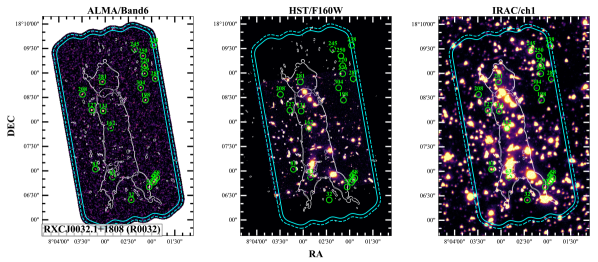
실험 결과
연구 질문
- RQ1강한 렌즈 클러스터에서의 깊은 ALMA 관측을 통해 z ≃ 1에서 z ≃ 8까지의 준미세파 은하 1.2 mm 수치 밀도 분포는 어떻게 되는가?
- RQ2특히 z > 6에서 먼지가 많은 별 형성 은하의 적외선 발광 함수는 어떻게 진화하는가?
- RQ3중력 렌즈 증폭과 소스 적색편이의 불확실성은 추론된 수밀도와 발광 함수에 얼마나 큰 영향을 미치는가?
- RQ4HST 또는 IRAC 대역에서 감지 가능한 대응체가 없는 고적색편이 준미세파 은하 소스의 비율은 어느 정도인가?
- RQ5고적색편이 소스의 추론된 별 형성률과 먼지 온도는 현재의 은하 진화 모델 예측과 어떻게 비교되는가?
주요 결과
- 설문조사에서는 32개의 렌즈 클러스터를 통해 총 180개의 준미세파 소스를 1.2 mm에서 탐지하였으며, 중앙 적색편이는 z ≃ 2.5이며 z > 6인 소스 비율이 상당히 높다.
- 수밀도 분포는 어두운 복사 밀도로 향해 급격히 증가하며, 복사 밀도 S_1.2mm ≲ 1 mJy에서 거듭제곱 법칙 기울기 α ≃ -2.0과 일치한다.
- 렌즈된 소스에서 유도된 적외선 발광 함수(IRLF)는 z ≃ 1에서 z ≃ 6으로의 먼지가 많은 은하의 수밀도가 급격히 증가하며, z ≃ 4–5 근처에서 최고에 이른다.
- 이전 카탈로그의 39개 소스와 블라인드 카탈로그의 141개 소스가 다중 파장 대응체로 확인되었으며, 12개 소스는 HST 또는 IRAC 대역에서 감지 가능한 대응체가 없었다.
- IRLF에서 유도된 별 형성률 밀도(SFRD)는 z ≃ 4–5에서 최고에 이르며, 약 ~10⁻² M☉ yr⁻¹ Mpc⁻³의 값을 가지며 다른 고적색편이 설문조사와 일치한다.
- 매우 높은 증폭(μ > 10)을 보이는 소스는 z ≃ 6–8에서 발견되었으며, z = 1.010인 하나의 소스는 μ ≃ 53의 증폭을 보이며 초기 우주에 극도로 활발한 별 형성 은하가 존재함을 시사한다.
더 나은 연구,지금 바로 시작하세요
논문 읽기부터 검토까지, 연구 시간을 획기적으로 줄여보세요.
카드 등록 없음 · 무료 플랜 제공
이 리뷰는 AI가 만들고, 인간 에디터가 검토했습니다.