
[논문 리뷰] An Exploration of AGN and Stellar Feedback Effects in the Intergalactic Medium via the Low Redshift Lyman-$α$ Forest
이 연구는 CAMELS 시뮬레이션 세트에서 유도된 천체역학적 시뮬레이션을 활용하여 활성은하핵(AGN)과 항성 피드백이 저적률 라이만-알파 포아르에 미치는 영향을 조사한다. Simba 모델에서의 AGN 제트 피드백이 간성간 매질의 열역학적 상태와 열역학적 상태를 결정짓는 열역학적 상태를 크게 변화시키는 것으로 나타났으며, 항성 피드백은 블랙홀 성장을 조절하고 간성간 매질의 열역학적 상태에 영향을 미친다. 이는 두 피드백 메커니즘을 동시에 모델링할 필요성을 강조한다.
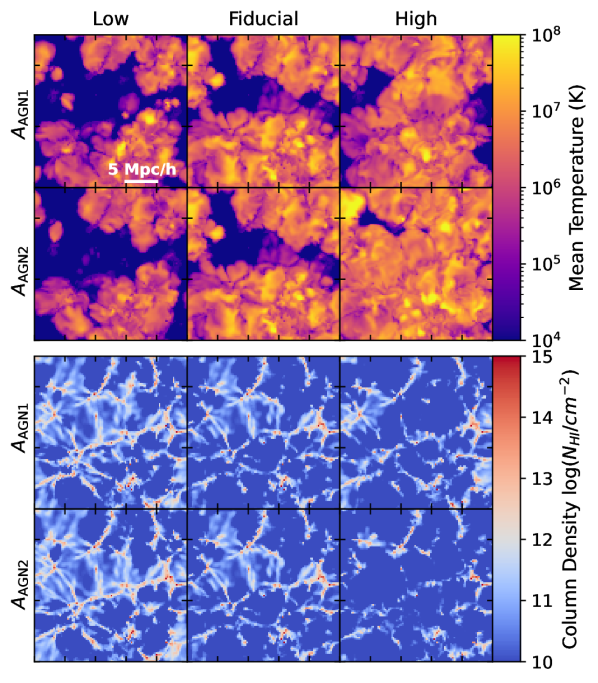
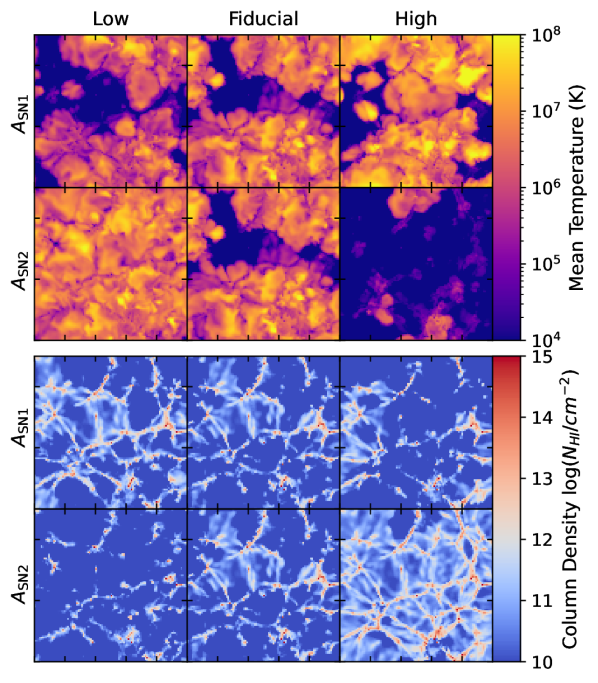
We explore the role of galactic feedback on the low redshift Lyman-$α$ (Ly$α$)~forest ($z \lesssim 2$) statistics and its potential to alter the thermal state of the intergalactic medium. Using the Cosmology and Astrophysics with Machine Learning Simulations (CAMELS) suite, we explore variations of the AGN and stellar feedback models in the IllustrisTNG and Simba sub-grid models. We find that both AGN and stellar feedback in Simba play a role in setting the Ly$α$ forest column density distribution function (CDD) and the Doppler width ($b$-value) distribution. The Simba AGN jet feedback mode is able to efficiently transport energy out to the diffuse IGM causing changes in the shape and normalization of the CDD and a broadening of the $b$-value distribution. We find that stellar feedback plays a prominent role in regulating supermassive black hole growth and feedback, highlighting the importance of constraining stellar and AGN feedback simultaneously. In IllustrisTNG, the AGN feedback variations explored in CAMELS do not affect the Ly$α$ forest, but varying the stellar feedback model does produce subtle changes. Our results imply that the low-$z$ Ly$α$ forest can be sensitive to changes in the ultraviolet background (UVB), stellar and black hole feedback, and that AGN jet feedback in particular can have a strong effect on the thermal state of the IGM.
연구 동기 및 목표
- 저적률 라이만-알파 포아르(지 ≤ 2)에 대한 AGN 및 항성 피드백의 영향을 평가하기 위해.
- 피드백 모델의 변동이 간성간 매질(IGM)의 열역학적 상태 분포함수(CDD) 및 도플러 b값 분포에 미치는 영향을 규명하기 위해.
- 자외선 배경(UVB), 항성 피드백, AGN 피드백의 변화에 대한 라이만-알파 포아르의 민감도를 평가하기 위해.
- 항성 피드백과 초거대 블랙홀 성장 간의 상호작용이 간성간 매질 조건을 어떻게 규제하는지 탐구하기 위해.
제안 방법
- IllustrisTNG 및 Simba 하위 그리드 모델에서의 AGN 및 항성 피드백 모델의 변동을 탐색하기 위해 CAMELS 천체역학적 시뮬레이션 세트를 활용하였다.
- 관측 데이터와 비교하기 위해 시뮬레이션된 라이만-알파 포아르 통계량—특히 열역학적 상태 분포함수(CDD) 및 도플러 b값 분포—을 분석하였다.
- 저적률 관측치와 일치시키기 위해 Haardt & Madau(2012)의 이온화 배경을 조정하여 UVB 보정을 적용하였으며, 보정 요소는 0.28에서 4.0 사이로 설정하였다.
- 시뮬레이션과 관측된 라이만-알파 포아르 데이터 간의 적합도를 정량화하기 위해 감소된 카이제곱(χ²_R) 통계량을 사용하였다.
- 여러 시뮬레이션 런 동안 피드백 강도 파ameter(A_AGN, A_SN)를 변화시켜 피드백 영향을 분석하였다.
- 고적률보다 덜 연구된 저적률 IGM(z ≲ 2)에 집중하였다.
실험 결과
연구 질문
- RQ1AGN 및 항성 피드백 모델은 저적률 라이만-알파 포아르의 열역학적 상태 분포함수(CDD)에 어떻게 영향을 미치는가?
- RQ2AGN 제트 피드백은 간성간 매질의 도플러 b값 분포 및 열역학적 상태에 어느 정도 영향을 미치는가?
- RQ3항성 피드백은 초거대 블랙홀 성장과 피드백 효율성에 어떻게 영향을 미치는가?
- RQ4왜 IllustrisTNG에서 AGN 피드백 변화는 라이만-알파 포아르에 눈에 띄는 영향을 미치지 않지만, 항성 피드백은 그러한 영향을 미치는가?
- RQ5저적률 라이만-알파 포아르는 간성간 매질의 열역학적 역사 및 이온화 배경을 제약할 수 있는가?
주요 결과
- Sim바 모델에서 AGN 제트 피드백은 열역학적 상태 분포함수(CDD)의 형태와 정규화에 상당한 영향을 미치며, 최적의 피팅 시뮬레이션에서 A_AGN1 = 1.32일 때 χ²_R ≈ 0.24를 기록하였다.
- Simba 모델의 AGN 제트 피드백 방식은 도플러 b값 분포를 넓히며, 간성간 매질의 열역학적 상태에 강력한 영향을 미친다.
- Simba에서 항성 피드백은 블랙홀 성장과 피드백을 조절하는 데 핵심적인 역할을 하며, 상호작용 피드백 모델링의 중요성을 보여준다.
- IllustrisTNG에서는 AGN 피드백 변화가 라이만-알파 포아르에 영향을 미치지 않았지만, 항성 피드백 변화는 CDD에 미세하지만 측정 가능한 변화를 일으켰다.
- CAMELS-Simba 시뮬레이션은 관측치와 뛰어난 일치를 보였으며, 감소된 χ²_R 값이 1에 가까워 저적률 라이만-알파 포아르 데이터에 대해 강력한 피팅을 제공하였다.
- CAMELS-Simba 시뮬레이션에서의 UVB 보정 범위는 Haardt & Madau(2012) 값의 0.28에서 4.0배로, 최적의 피팅은 일부 최신 관측 추정치보다 낮은 UVB 수준을 선호하였다.
더 나은 연구,지금 바로 시작하세요
논문 읽기부터 검토까지, 연구 시간을 획기적으로 줄여보세요.
카드 등록 없음 · 무료 플랜 제공
이 리뷰는 AI가 만들고, 인간 에디터가 검토했습니다.