
[논문 리뷰] Anomalies in Particle Physics
이 논문은 표준모형 예측에서 벗어난 최근 입자물리학의 이면 현상들을 검토한다—뮤온 g-2에서 희귀 B메손 붕괴, 힉스 쌍 생성에 이르기까지. 실험적 일관성, 이론적 신뢰성, 그리고 새로운 물리학 해석을 평가하며, 레프토크워크와 확장된 힉스 섹터와 같은 새로운 입자를 강조한다. 향후 콘서버 및 정밀도 실험의 가능성을 통해 이러한 신호를 확인하거나 배제할 수 있다.
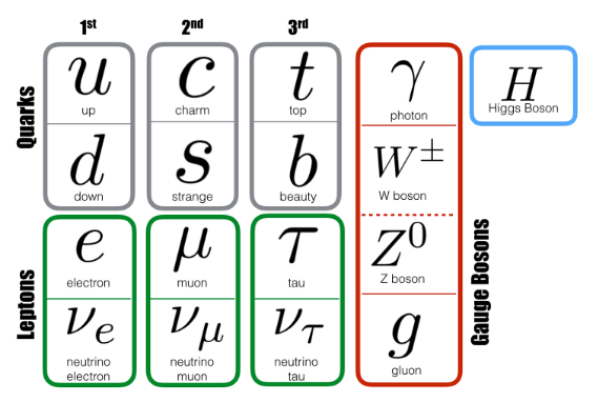
The currently accepted mathematical description of the fundamental constituents and interactions of matter is the Standard Model of particle physics. Its last missing particle, the famous Higgs boson, was observed at the Large Hadron Collider at CERN in 2012. However, it is clear that the Standard Model cannot be the ultimate theory of Nature, and e.g. cannot account for Dark Matter or non-vanishing neutrino masses (and does not include gravity). In fact, searches for physics beyond the SM have been intensified since the Higgs boson discovery. In this article, we review the hints for new physics, called ``anomalies'', obtained in particle physics experiments within the last years. We consider both direct high-energy searches for new resonances at the LHC and indirect low-energy precision experiments. These anomalies range from the nuclear scale (approximately the mass of the proton) to the electroweak scale (i.e. the mass of the Higgs boson) to the TeV scale (the highest scale directly accessible at the LHC), therefore spanning over four orders of magnitude. After discussing the experimental and theoretical status of the anomalies, we summarize possible explanations in terms of new particles and new interactions. In particular, new Higgs bosons and leptoquarks are promising candidates. Discovery prospects and implications for future colliders are discussed.
연구 동기 및 목표
- 최근 실험적 이면 현상들이 표준모형 예측에서 벗어나는지를 체계적으로 평가하고 통합한다.
- 이러한 이면 현상들이 서로 다른 실험 간에 얼마나 일관되고, 이론적 계산과 얼마나 호환되는지를 평가한다.
- 레프토크워크, 확장된 힉스 섹터, 새로운 페르미온 등이 관측된 편차를 설명할 수 있는 타당한 새로운 물리학 모델을 특정한다.
- LHC, FCC-ee, ILC, CEPC와 같은 현재 및 향후 실험들이 새로운 물리학을 확인하거나 배제할 수 있는 발견 잠재력을 개론한다.
- 표준모형을 초월한 물리학의 맥락에서 여러 이면 현상의 신뢰성과 상호연결성을 평가하는 종합적인 프레임워크를 제공한다.
제안 방법
- 실험적 일관성, 표준모형 예측의 신뢰성, 통계적 유의성, 새로운 물리학 해석의 타당성, 이면 현상 간의 일관된 연결성 등의 다기준 프레임워크를 사용한 이면 현상 체계적 평가.
- 고에너지 콘서버(예: LHC, Belle-II, LHCb)와 저에너지 정밀도 실험(예: 뮤온 g-2, 베타 붕괴, K→μν, Z→bb̄)의 실험 데이터 분석.
- 희귀 붕괴 및 강입자 진공 극화 기여도에 대한 이론적 예측을 향상시키기 위해 격자 QCD와 분산 관계의 활용.
- Belle-II, NA62, PIONEER, 향후 e+e− 콘서버(ILC, FCC-ee, CEPC)의 시뮬레이션 및 예상 감도를 통한 향후 발견 잠재력 평가.
- 레프토크워크, 확장된 힉스 섹터, 새로운 강하게 상호작용하는 입자들이 다수의 이면 현상에 자연스럽게 설명을 줄 수 있도록 모델 구축 분석.
- 표준화된 점수 체계를 사용한 이면 현상 간 상호 비교를 통해 그들의 신뢰성과 상호의존성을 순위 매김.
실험 결과
연구 질문
- RQ1뮤온 g-2, 희귀 B메손 붕괴, W 보손 질량 측정에서 관측된 이면 현상들이 표준모형을 초월한 새로운 물리학을 얼마나 잘 나타내는가?
- RQ2독립적인 측정 간에 실험 결과는 얼마나 일관되며, 해당 표준모형 예측의 신뢰성은 어떠한가?
- RQ3레프토크워크나 확장된 힉스 섹터와 같은 단일 새로운 물리학 모델이 R(D*)와 R(K) 이면 현상과 같은 다수의 이면 현상을 동시에 설명할 수 있는가?
- RQ4격자 QCD, 분산 관계 등 개선된 이론 계산이 실험과 표준모형 간의 갈등을 어떻게 해결하는가?
- RQ5FCC-ee, ILC, CEPC, 또는 고광도 LHC와 같은 향후 실험 및 콘서버 중에서 관측된 이면 현상을 확인하거나 배제할 잠재력이 가장 큰 것은 무엇인가?
주요 결과
- 뮤온의 이례적 자기모멘트(a_μ)는 표준모형과 4.2σ의 괴리가 나타나지만, 향후 Belle-II와 MUonE의 데이터 및 개선된 HVP 계산으로 일부 갈등이 해결될 수 있다.
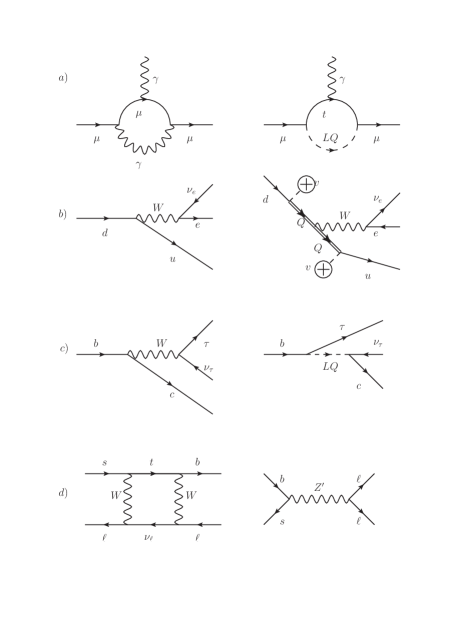
- B메손 붕괴에서의 R(D*)와 R(K) 이면 현상—레프톤의 맛 보존 위반 가능성을 시사—는 2.5–3σ의 유의미한 신호를 보이며, 레프토크워크 또는 Z′ 보손 설명과 일관된다.
- CDF II 실험에서의 W 보손 질량 측정은 표준모형 예측에서 7σ의 편차를 보이지만, 이 결과는 여전히 논란의 여지가 있으며 향후 e+e− 콘서버에서 해결될 수 있다.
- LHC에서의 디제트 및 디포톤 최종 상태에서의 초과 신호(예: 750 GeV 디포톤 공진)는 런3 데이터로 인해 이제 불리한 상황이 되었지만, 힉스 쌍 생성(yy)에서의 유사 신호는 여전히 타당하며 고광도 LHC 런에서 검증 가능하다.
- 타우에서 뮤온으로의 붕괴 이면 현상(τ→μνν)은 2.5σ의 편차를 보이며, 향후 Belle-II 또는 FCC-ee 측정을 통해 확인되거나 배제될 수 있다.
- R(D*)와 R(K) 이면 현상, W 질량 이면 현상, eμ 초과와 같은 이면 현상들 사이에 일관된 연결성이 존재하며, 이는 레프토크워크 또는 특정 코어가 있는 Z′ 보손을 포함하는 공통된 기초 모델을 시사한다.
더 나은 연구,지금 바로 시작하세요
논문 읽기부터 검토까지, 연구 시간을 획기적으로 줄여보세요.
카드 등록 없음 · 무료 플랜 제공
이 리뷰는 AI가 만들고, 인간 에디터가 검토했습니다.