
[논문 리뷰] Anomaly Detection with Conditioned Denoising Diffusion Models
DDAD는 입력 대상(target)에 의해 가이드되는 조건부 노이즈 제거 확산 프레임워크를 도입하여 이상 없이 이미지를 재구성하고, 픽셀 및 특징 기반의 이상 위치 식별과 도메인에 적응된 특징 추출을 가능하게 하며, MVTec, VisA, MTD에서 최첨단 성능을 달성한다.
Traditional reconstruction-based methods have struggled to achieve competitive performance in anomaly detection. In this paper, we introduce Denoising Diffusion Anomaly Detection (DDAD), a novel denoising process for image reconstruction conditioned on a target image. This ensures a coherent restoration that closely resembles the target image. Our anomaly detection framework employs the conditioning mechanism, where the target image is set as the input image to guide the denoising process, leading to a defectless reconstruction while maintaining nominal patterns. Anomalies are then localised via a pixel-wise and feature-wise comparison of the input and reconstructed image. Finally, to enhance the effectiveness of the feature-wise comparison, we introduce a domain adaptation method that utilises nearly identical generated examples from our conditioned denoising process to fine-tune the pretrained feature extractor. The veracity of DDAD is demonstrated on various datasets including MVTec and VisA benchmarks, achieving state-of-the-art results of \(99.8 \%\) and \(98.9 \%\) image-level AUROC respectively.
연구 동기 및 목표
- 재구성 기반 이상 탐지의 동기를 제시하고 재구성 품질과 정상 분포 커버리지에서의 기존 방법의 한계를 다룬다.
- 이상 제거를 위한 타깃 이미지로의 denoising 방향을 안내하는 확산 기반 재구성의 조건 부여 메커니즘을 제안한다.
- 이상 탐지 및 위치 파악의 정확성을 높이기 위해 픽셀 단위와 특징 단위 비교를 결합한다.
- 문제 도메인에 맞게 특징 추출기를 비지도 학습 도메인 적응 기법을 도입하여 적응시킨다.
- 산업 이상 탐지 데이터셋(MVTec, VisA)과 새로운 데이터셋(MTD)에서 최첨단 성능을 입증한다.
제안 방법
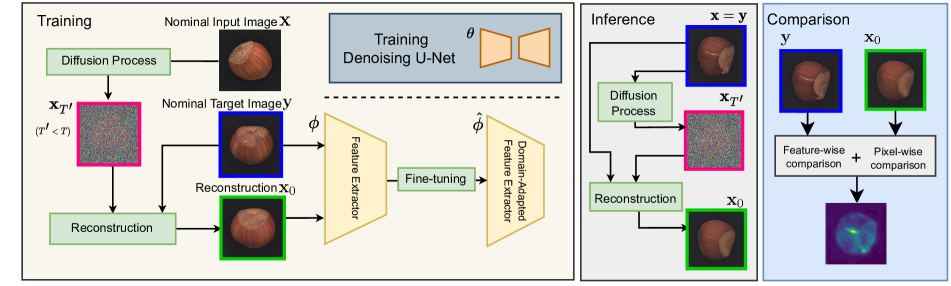
- 타깃 이미지 y가 섞인 입력 x_t를 정상 재구성 x_0 toward denoising하도록 안내하는 조건부 노이즈 제거 프로세스를 재구성한다.
- 사후 점도 기울기 ∇_{x_t} log p_theta(x_t|y_t)를 무조건 점수와 가능도 보정 항의 합으로 형식화하며, 조건화 가중치 w를 둔다.
- y_t−x_t의 차이를 고려하는 수정된 epsilon_hat를 사용하여 x_{t-1}을 생성하도록 디노이저 예측을 업데이트한다(식(7)).
- 타깃 y를 입력 x로 설정하고 이상 없는 버전을 재구성하여 이상 탐지를 수행한다; 이상은 x_0와 y 사이의 픽셀 거리 D_p 및 특징 거리 D_f(코사인 유사도 기반)로 로컬라이즈된다.
- 픽셀 수준 거리와 특징 수준 거리를 결합하여 최종 이상 점수 D_anomaly를 산출해 강건한 로컬라이제이션을 달성한다.
- 재구성된 이미지와 대상 도메인 간의 특징 거리를 최소화하여 사전 학습된 특징 추출기를 대상 도메인에 맞게 조정하기 위한 비지도 도메인 적응(및 증류)을 적용하고, 잊어버림 방지를 위한 증류 손실을 사용한다.
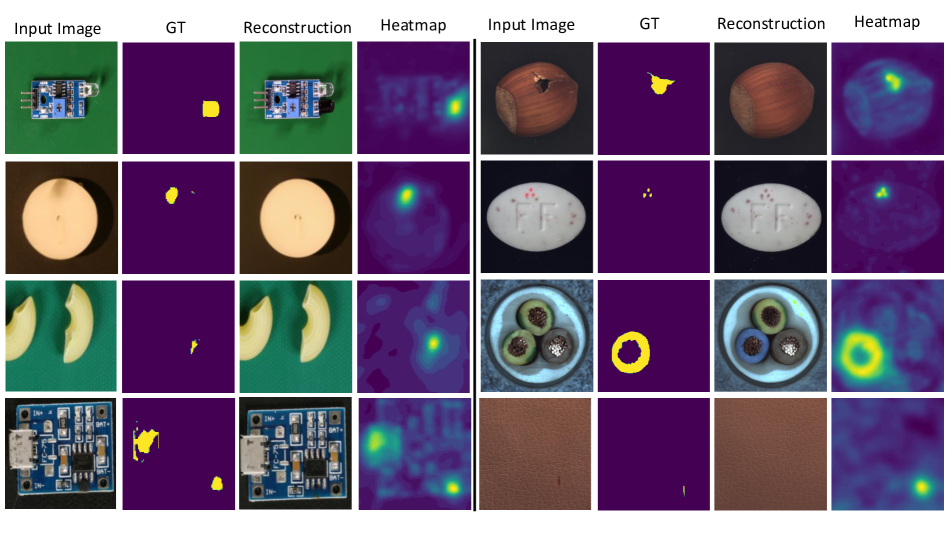
실험 결과
연구 질문
- RQ1타깃 이미지를 조건으로 한 확산 기반 재구성이 이상이 없는 복원과 따라서 이상 탐지 성능을 향상시킬 수 있는가?
- RQ2픽셀 단위 및 특징 단위 비교의 결합이 이상 로컬라이제이션 정확도를 향상시킬 수 있는가?
- RQ3특징 추출기의 비지도 도메인 적응이 도메인 특화 산업 데이터에서 탐지 및 로컬라이제이션을 더 향상시킬 수 있는가?
- RQ4표준 벤치마크(MVTec, VisA) 및 추가 데이터셋(MTD)에서 DDAD의 성능은 최첨단 방법과 비교하여 어떤가?
주요 결과
- 도메인 적응 및 특징 융합 후 DDAD는 MVTec에서 이미지 수준 AUROC 99.8%, VisA에서 98.9%를 달성한다.
- 확산 과정을 조건화하면 픽셀 수준 안내를 통한 무조건적 노이즈 제거에 비해 MVTec에서 이미지 AUROC를 85.7%에서 92.4%로, VisA에서 87.0%에서 94.1%로 향상시킨다.
- 특징 추출기의 도메인 적응은 MVTec/VisA 데이터셋에서 특징 기반 분기에 이상 탐지 8.2%, 로컬라이제이션 4.8%의 개선을 가져온다.
- 픽셀 및 특징 비교의 결합과 조건화를 더해 우수한 로컬라이제이션을 달성하고, 보고된 벤치마크에서 DDAD가 재구성 기반 및 표현 기반 베이스라인을 모두 능가한다.
- 경량 버전 DDAD-S(약 8백만 매개변수)는 더 빠른 추론으로 경쟁력 있는 성능을 유지하여 엣지 배포에 적합하다.
- MTD에서 DDAD-10은 이미지 AUROC 98.3%를 달성하여 단일 카테고리 결함 데이터셋에 대한 강한 일반화능력을 입증한다.
더 나은 연구,지금 바로 시작하세요
연구 설계부터 논문 작성까지, 연구 시간을 획기적으로 줄여보세요.
카드 등록 없음 · 무료 플랜 제공
이 리뷰는 AI가 만들고, 인간 에디터가 검토했습니다.