
[논문 리뷰] Auto-Encoding Score Distribution Regression for Action Quality Assessment
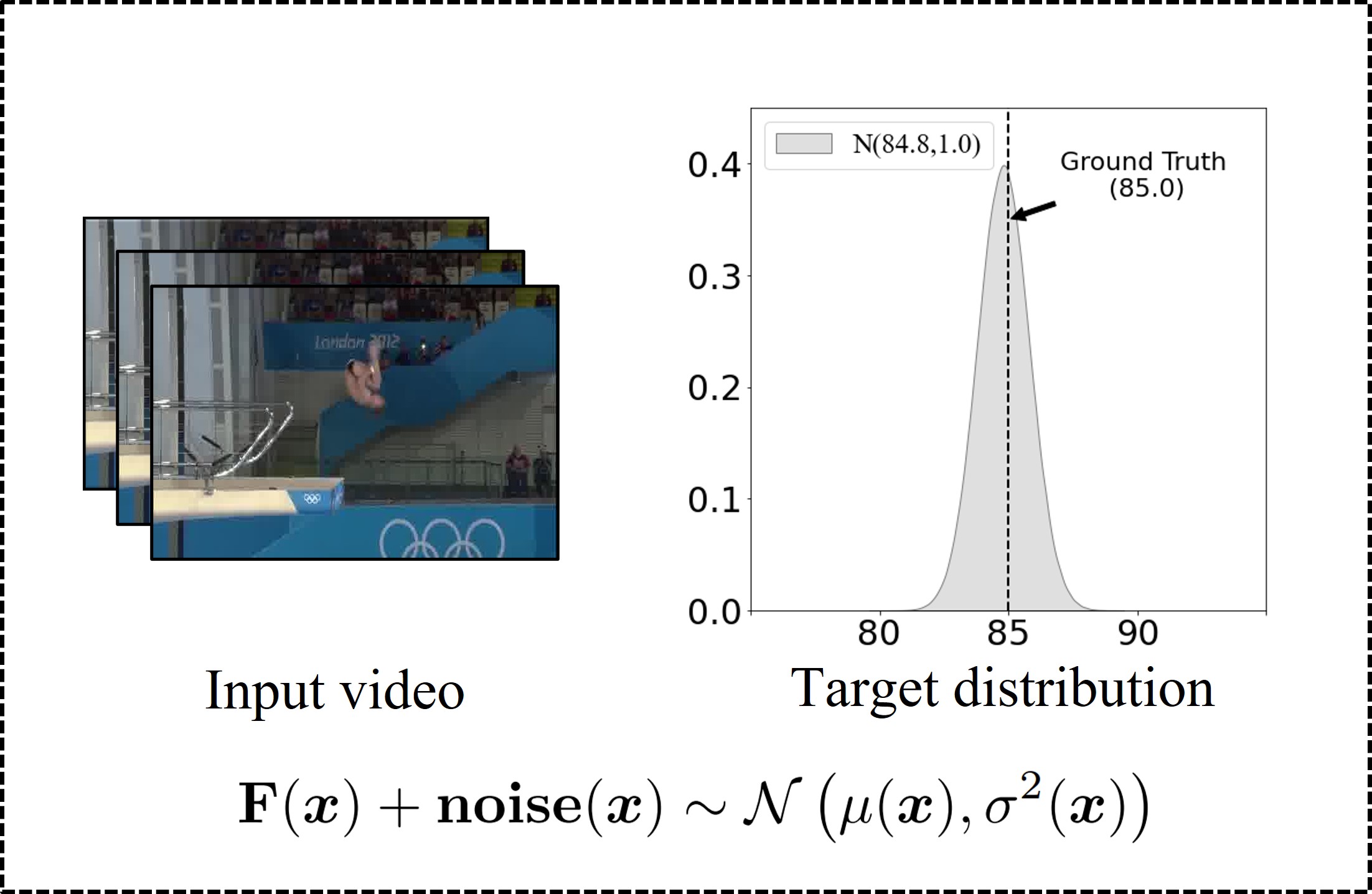
이 논문은 변분 추론을 사용하여 액션 스코어를 학습된 확률 분포로 모델링함으로써 액션 품질 평가(AQA)를 위한 플러그-앤플레이 어림불러운 회귀 모듈인 분포 자동에코더(DAE)를 제안한다. 재파arameterization을 통한 샘플링을 통해 비디오 특징을 분포로 인코딩함으로써 DAE는 예측 정확도와 불확실성 추정을 향상시키며, AQA-7, MTL-AQA, JIGSAWS에서 최신 기술 수준(SOTA) 성능을 달성하면서도 유의미한 추론 시간 오버헤드 없이 구현된다.
The action quality assessment (AQA) of videos is a challenging vision task since the relation between videos and action scores is difficult to model. Thus, AQA has been widely studied in the literature. Traditionally, AQA is treated as a regression problem to learn the underlying mappings between videos and action scores. But previous methods ignored data uncertainty in AQA dataset. To address aleatoric uncertainty, we further develop a plug-and-play module Distribution Auto-Encoder (DAE). Specifically, it encodes videos into distributions and uses the reparameterization trick in variational auto-encoders (VAE) to sample scores, which establishes a more accurate mapping between videos and scores. Meanwhile, a likelihood loss is used to learn the uncertainty parameters. We plug our DAE approach into MUSDL and CoRe. Experimental results on public datasets demonstrate that our method achieves state-of-the-art on AQA-7, MTL-AQA, and JIGSAWS datasets. Our code is available at https://github.com/InfoX-SEU/DAE-AQA.
연구 동기 및 목표
- 인간 애너테이션 스코어에서 암시된 알레아토릭 불확실성을 忽시하는 전통적 AQA 방법의 한계를 해결하기 위해.
- 단일 스칼라 값이 아닌 액션 스코어에 대한 분포를 학습하여 인간 판단의 본질적 변동성을 모델링하기 위해.
- 기존의 회귀 기반 AQA 프레임워크에 아키텍처의 대대적 개편 없이도 통합 가능한 일반화된 플러그-앤플레이 모듈을 개발하기 위해.
- 학습된 분산을 통한 불확실성 정량화를 통해 예측의 견고성과 해석 가능성을 향상시키기 위해.
제안 방법
- DAE는 비디오 특징를 매개변수화된 확률 분포(예: 가우시안)로 매핑하기 위해 변분 오토에코더 기반 아키텍처를 사용한다.
- 에코더는 스코어 분포의 평균과 분산을 출력하며, 재파라미터화 기법을 통해 미분 가능한 샘플링을 가능하게 하여 엔드 투 엔드 학습을 지원한다.
- 재구성 및 감독 항목을 결합한 새로운 가능도 기반 손실 함수를 도입하여 분포 매개변수와 예측 정확도를 동시에 최적화한다.
- 플러그-앤플레이 설계를 통해 기존 AQA 모델(MUSDL, CoRe, MLP 기반 베이스라인)에 통합된다.
- 모델은 감독 손실과 재구성 손실의 가중 조합을 사용하여 훈련되며, 이는 적응형 불확실성 추정을 가능하게 한다.
- DAE는 AQA-7, MTL-AQA, JIGSAWS의 세 개의 공개 데이터셋에서 평가되며, 손실 구성 요소와 추론 효율성에 대한 분석도 함께 수행된다.
실험 결과
연구 질문
- RQ1점 추정 대비 확률 분포로 액션 스코어를 모델링할 경우 AQA에서 회귀 성능이 향상되는가?
- RQ2학습 가능한 분포가 인간 애너테이션 비디오 스코어에 내재된 알레아토릭 불확실성을 얼마나 효과적으로 포착하는가?
- RQ3제안된 DAE 모듈이 다양한 AQA 아키텍처와 데이터셋에 일반화되는가?
- RQ4제안된 가능도 손실 함수가 불확실성 추정과 모델 안정성에 어떤 영향을 미치는가?
- RQ5DAE의 추론 시간은 기준 회귀 모델 대비 어떻게 되는가?
주요 결과
- DAE는 AQA-7, MTL-AQA, JIGSAWS에서 최신 기술 수준 성능을 달성하였으며, MTL-AQA에서 기준 모델 대비 6.1% 상대적 향상률을 기록했다.
- 제안된 가능도 손실은 표준 MSE 손실보다 우수한 성능을 보였으며, MTL-AQA에서 스피어만 상관계수 0.0037 향상, JIGSAWS에서는 0.04 향상되었다.
- 모델은 적응형 분산을 학습한다: 고품질 액션은 낮은 분산(안정된 스코어)을 보이고, 저품질 액션은 높은 분산(심판 간 이견)을 보인다.
- DAE-MT와 DAE-CoRe는 각각 7%와 9.7%의 추론 시간 증가를 보였으며, 이는 최소한의 계산 오버헤드를 의미한다.
- 사례 연구를 통해 DAE는 실제 세계의 불확실성 패턴을 잘 포착함을 확인하였으며, 분포가 인간 판단의 신뢰도를 반영한다.
- 절단 분석 결과, 단일 손실 대비 병합된 손실 함수가 더 높은 성능과 더 안정적인 분산 추정을 제공하는 것으로 나타났다.

더 나은 연구,지금 바로 시작하세요
논문 읽기부터 검토까지, 연구 시간을 획기적으로 줄여보세요.
카드 등록 없음 · 무료 플랜 제공
이 리뷰는 AI가 만들고, 인간 에디터가 검토했습니다.