
[논문 리뷰] Automatic Segmentation of Organs-at-Risk from Head-and-Neck CT using Separable Convolutional Neural Network with Hard-Region-Weighted Loss
이 논문은 헤드앤넥트 CT 스캔에서 위험 기관(OAR)의 정확하고 불확실성 인식 분할을 위한 분리 가능 컨볼루션과 하드 영역 가중 손실을 갖춘 3D-SepNet 프레임워크를 제안한다. 다기관 시각화를 위한 세그멘테이션 선형 함수(SLF)와 불확실성 추정을 위한 앙상블 학습을 통합함으로써, 가중 평균 DSC 스코어 80.52%와 95% 하우스도르프 거리 3.043 mm를 달성하였으며, 파rameter 수가 1/3에 불과한 3D UNet을 능가한다.
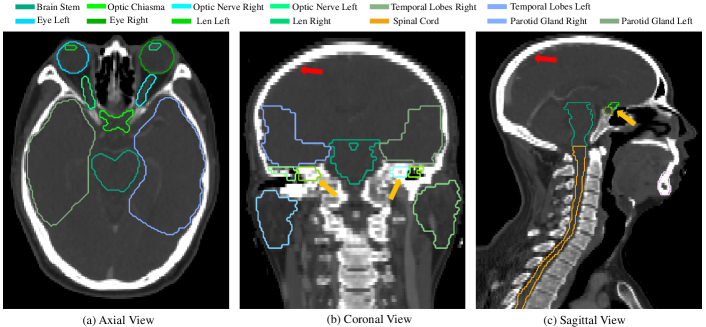
Nasopharyngeal Carcinoma (NPC) is a leading form of Head-and-Neck (HAN) cancer in the Arctic, China, Southeast Asia, and the Middle East/North Africa. Accurate segmentation of Organs-at-Risk (OAR) from Computed Tomography (CT) images with uncertainty information is critical for effective planning of radiation therapy for NPC treatment. Despite the stateof-the-art performance achieved by Convolutional Neural Networks (CNNs) for automatic segmentation of OARs, existing methods do not provide uncertainty estimation of the segmentation results for treatment planning, and their accuracy is still limited by several factors, including the low contrast of soft tissues in CT, highly imbalanced sizes of OARs and large inter-slice spacing. To address these problems, we propose a novel framework for accurate OAR segmentation with reliable uncertainty estimation. First, we propose a Segmental Linear Function (SLF) to transform the intensity of CT images to make multiple organs more distinguishable than existing methods based on a simple window width/level that often gives a better visibility of one organ while hiding the others. Second, to deal with the large inter-slice spacing, we introduce a novel 2.5D network (named as 3D-SepNet) specially designed for dealing with clinic HAN CT scans with anisotropic spacing. Thirdly, existing hardness-aware loss function often deal with class-level hardness, but our proposed attention to hard voxels (ATH) uses a voxel-level hardness strategy, which is more suitable to dealing with some hard regions despite that its corresponding class may be easy. Our code is now available at https://github.com/HiLab-git/SepNet.
연구 동기 및 목표
- 방사선 치료 계획을 위한 헤드앤넥트 CT에서 저대비 연조직과 극도로 불균형한 OAR 크기 문제를 해결하기 위해.
- 렌즈 및 시신경과 같이 작은, 평평한, 경계가 모호한 OAR의 분할 정확도를 향상시키기 위해.
- 방사선 치료에서 임상적 의사결정 지원을 위한 신뢰할 수 있는 불확실성 추정을 제공하기 위해.
- 이sovolumetric CT 스캔에서 고층간 간격을 가진 이미지에서 모델 복잡도를 감소시키면서도 성능을 유지하거나 향상시키기 위해.
- 강도 변환, 하드 볼록에 대한 주의, 앙상블 기반 불확실성 정량화를 통합하는 프레임워크를 개발하기 위해.
제안 방법
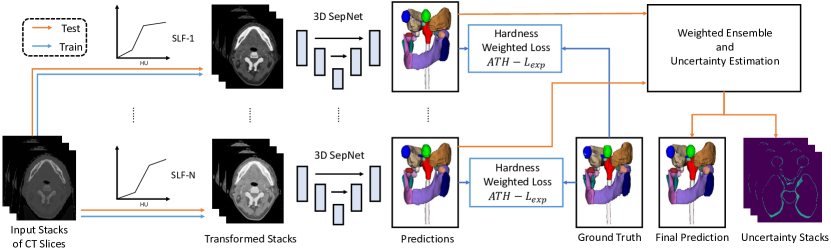
- 다양한 조직 유형에 따라 비균일한 강도 변환을 적용함으로써 동시에 여러 OAR의 가시성을 향상시키기 위해 세그멘테이션 선형 함수(SLF)를 도입한다.
- 수평 해상도는 높고 경사면 해상도는 낮은 이sovolumetric CT 스캔을 효율적으로 처리하기 위해 공간 분리 가능 3D 컨볼루션을 사용하는 3D-SepNet 아키텍처를 제안한다.
- 어려운 분할 영역을 강조함으로써 성능을 향상시키기 위해, 하드 볼록에 주목하는 손실 함수(ATH-LExp)를 설계한다. 이는 지수 손실과 결합된 형태이다.
- 다양한 SLF 강도 변환과 손실 함수로 훈련된 모델들을 조합함으로써 앙상블 학습을 수행하여 강건한 분할 출력과 내재된 불확실성 추정치를 생성한다.
- 앙상블 예측의 분산을 불확실성의 대체 지표로 사용하며, 이는 잘못 분할된 영역과 강하게 상관관계가 있음을 보여준다.
- 불균형한 OAR 데이터셋에서 일반화 성능을 향상시키고 과적합을 줄이기 위해 가중 평균 앙상블 전략을 적용한다.
실험 결과
연구 질문
- RQ1SLF와 같은 학습 가능한 강도 변환은 표준 윈도우 레벨 조정 대비 헤드앤넥트 CT에서 다기관 시각화와 분할 정확도를 향상시키는 데 효과적인가?
- RQ2고층간 간격을 가진 이sovolumetric CT 스캔에서 표준 3D UNet 대비 분리 가능 3D 컨볼루션 네트워크(3D-SepNet)의 OAR 분할 성능은 어떠한가?
- RQ3하드 볼록을 강조하는 손실 함수는 특히 작은 또는 저대비 OAR의 경우 분할 정확도를 향상시키는가?
- RQ4앙상블 기반 모델 출력은 임상 환경에서 분할 오류와 상관관계가 높은 신뢰할 수 있는 불확실성 추정치를 제공하는가?
- RQ5불확실성 맵은 방사선 치료 계획에서 수동 보정을 위해 고위험 영역에 초점을 맞추도록 방사선 전문의를 안내하는 데 어느 정도 기여하는가?
주요 결과
- 제안된 3D-SepNet는 StructSeg 2019 HAN OAR 챌린지에서 가중 평균 DSC 스코어 80.52%와 95% 하우스도르프 거리 3.043 mm를 기록하여 3위를 차지하였다.
- 3D UNet의 파라미터 수의 1/3에 불과한 3D-SepNet는 대부분의 OAR에서 분할 정확도에서 승승을 거두었으며, 특히 시신경과 렌즈와 같이 평평하거나 얇은 구조에서 두각을 나타냈다.
- SLF 기반 강도 변환은 동시에 여러 OAR의 가시성을 향상시켜 분할 정확도를 크게 향상시켰으며, 표준 선형 윈도우링보다 뛰어난 성능을 보였다.
- 하드 볼록을 강조하는 ATH-LExp 손실 함수는 표준 DSC나 지수 손실만을 사용하는 경우보다 더 높은 DSC 스코어를 달성하였으며, 특히 작은 크기이거나 경계가 모호한 OAR에서 두각을 나타냈다.
- 앙성 분산에서 유도된 불확실성 맵은 잘못 분할된 영역과 높은 상관관계를 보였으며, 보정을 위한 임상적 지침으로서 강력한 잠재력을 보였다.
- 이 방법은 다양한 데이터셋에서 강건성을 입증하였으며, 추가 훈련이나 추론 비용 없이도 실용적인 불확실성 정보를 제공하였다.
더 나은 연구,지금 바로 시작하세요
논문 읽기부터 검토까지, 연구 시간을 획기적으로 줄여보세요.
카드 등록 없음 · 무료 플랜 제공
이 리뷰는 AI가 만들고, 인간 에디터가 검토했습니다.