
[논문 리뷰] Backdiff: a diffusion model for generalized transferable protein backmapping
BackDiff는 다양한 군집화된(粗粒度, CG) 모델과 단백질 간에 일반화되고 이식 가능한 단백질 백맵핑을 위한 조건부 점수 기반 확산 모델을 제안한다. 변수적인 CG 원자와 다양체 제약 샘플링을 통해 자율 학습을 활용함으로써, 재학습 없이도 엔드 투 엔드로 백맵핑을 수행할 수 있으며, 여러 CG 모델과 단백질 유형에서 최신 기술 수준의 정확도와 뛰어난 일반화 능력을 확보한다.
Coarse-grained (CG) models play a crucial role in the study of protein structures, protein thermodynamic properties, and protein conformation dynamics. Due to the information loss in the coarse-graining process, backmapping from CG to all-atom configurations is essential in many protein design and drug discovery applications when detailed atomic representations are needed for in-depth studies. Despite recent progress in data-driven backmapping approaches, devising a backmapping method that can be universally applied across various CG models and proteins remains unresolved. In this work, we propose BackDiff, a new generative model designed to achieve generalization and reliability in the protein backmapping problem. BackDiff leverages the conditional score-based diffusion model with geometric representations. Since different CG models can contain different coarse-grained sites which include selected atoms (CG atoms) and simple CG auxiliary functions of atomistic coordinates (CG auxiliary variables), we design a self-supervised training framework to adapt to different CG atoms, and constrain the diffusion sampling paths with arbitrary CG auxiliary variables as conditions. Our method facilitates end-to-end training and allows efficient sampling across different proteins and diverse CG models without the need for retraining. Comprehensive experiments over multiple popular CG models demonstrate BackDiff's superior performance to existing state-of-the-art approaches, and generalization and flexibility that these approaches cannot achieve. A pretrained BackDiff model can offer a convenient yet reliable plug-and-play solution for protein researchers, enabling them to investigate further from their own CG models.
연구 동기 및 목표
- 기존의 데이터 기반 백맵핑 방법이 다양한 군집화된(CG) 모델과 단백질 유형 간에 일반화 부족 문제를 해결하기 위해.
- CG 기반의 구조에 조건부된 통합 전자구조 분포를 학습함으로써, 재학습 없이도 이식 가능한 백맵핑을 가능하게 하기 위해.
- 자율 학습 및 다양체 제약 프레임워크를 통해 변수적인 CG 원자와 임의의 CG 보조 변수를 처리하기 위해.
- 모델 미세조정 없이도 연구자가 자체 CG 모델을 사용할 수 있는 즉시 사용 가능한 솔루션을 제공하기 위해.
- 특히 비선형 CG 변수가 존재할 경우, 백맵핑된 전자구조의 샘플링 효율성과 기하학적 정확도를 향상시키기 위해.
제안 방법
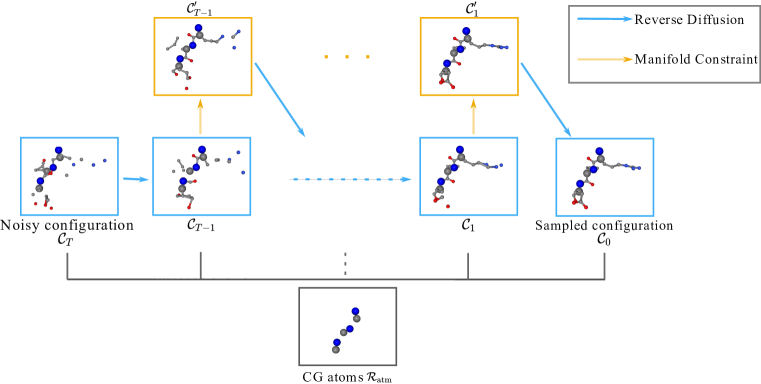
- BackDiff는 CG 입력에서 전자구조를 재구성하기 위해 역방향 노이즈 제거 과정을 학습하는 조건부 점수 기반 확산 모델을 사용한다.
- 모든 훈련 에포크 동안 무작위로 CG 원자를 선택하는 자율 학습 전략을 사용하여, 다양한 CG 표현 간의 이식 가능성을 향상시킨다.
- 추론 중에는 다양체 제약 샘플링이 적용되며, CG 보조 변수가 역방향 확산 경로를 안내하여 입력 CG 모델과의 일致성을 유지한다.
- 다양한 단백질 92종의 대규모 데이터셋을 기반으로 엔드 투 엔드로 훈련되어 단백질 공간과 CG 모델 유형 간의 일반화를 가능하게 한다.
- 고정형 및 이식 가능한 샘플링 모드를 모두 지원하며, 후자는 새로운 단백질과 CG 모델에 대해 제로샷 적응을 가능하게 한다.
- 기하학적 제약은 점수 기반 노이즈 제거를 통해 강제되며, 생성된 구조가 입력 CG 기하학과 보조 변수를 존중하도록 보장한다.
실험 결과
연구 질문
- RQ1단일 생성 모델이 재학습 없이도 다양한 군집화된 단백질 모델 간에 신뢰할 수 있는 백맵핑을 수행할 수 있는가?
- RQ2훈련 중에 볼 수 없었던 새로운 단백질과 CG 표현으로의 이식 성능는 어떻게 되는가?
- RQ3CG 보조 변수가 모델 간에 다양할 경우, 다양체 제약 샘플링이 기하학적 정확도에 얼마나 기여하는가?
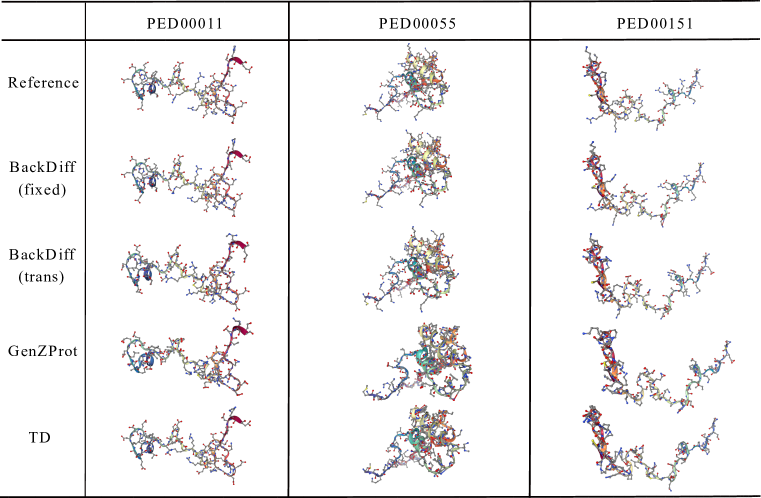
- RQ4GenZProt 및 토크셔널 확산(Torsional Diffusion)과 같은 기존 최신 기술 수준의 백맵핑 방법과 비교해 BackDiff의 정확도와 효율성은 어떠한가?
- RQ5확산 기반 백맵핑이 결합 각도와 입체화학적 비대칭성(치라리티)을 유지하는 데에 어떤 한계를 가지며, 이를 어떻게 보완할 수 있는가?
주요 결과
- 고정된 CG 설정에서 BackDiff는 RMSD가 0.030(0.005) Å로 가장 낮게 기록했으며, 전이 가능한 설정에서는 0.030(0.006) Å로 GenZProt 및 토크셔널 확산보다 뚜렷이 뛰어난 성능을 보였다.
- UNRES 모델을 사용한 다중 단백질 실험에서 BackDiff는 SCMSE가 0.147(0.072) Ų로 비교된 모든 방법 중에서 가장 낮아 기하학적 정확도가 뛰어나다는 것을 보여주었다.
- MARTINI 모델에서 BackDiff는 평균 RMSD가 0.028(0.005) Å로 다양한 단백질 유형과 CG 표현 간에 높은 정확도를 확보하였다.
- 모델는 재학습 없이도 새로운 단백질과 CG 모델에 대해 낮은 오차를 유지하며 강력한 일반화 능력을 보였다.
- 높은 정확도에도 불구하고, VAE 기반 모델인 GenZProt(0.009초)에 비해 더 높은 샘플링 지연(100개 샘플당 293초)을 보이며 효율성의 상충 관계를 드러냈다.
- 카르테시안 좌표계에서의 비선형 매핑로 인해 결합 각도 정확도가 떨어지며, 치라리티를 명시적으로 보존하지 않아 향후 개선이 필요한 영역으로 지목되었다.
더 나은 연구,지금 바로 시작하세요
논문 읽기부터 검토까지, 연구 시간을 획기적으로 줄여보세요.
카드 등록 없음 · 무료 플랜 제공
이 리뷰는 AI가 만들고, 인간 에디터가 검토했습니다.