
[논문 리뷰] Bayesian Optimal Experimental Design for Constitutive Model Calibration
이 논문은 구성 물성 모델 校정을 위한 가장 정보가 많은 하중 경로를 동적으로 선택하기 위해 베이지안 최적 실험 설계(BOED)를 사용하는 상호 연결된 특성화 및 校정(ICC) 프레임워크를 제안한다. 기대 정보 수익(EIG)에 기반해 적응적으로 변형 증분을 선택함으로써, 이 방법은 정적이고 인간의 직관에 기반한 하중 경로보다 더 효과적으로 모델 매개변수의 불확실성을 감소시킨다. 한 예시 문제에서 후행 불확실성을 100% 감소시켰으며, 진짜 매개변수 값을 더 정확하게 포착하는 데 있어 향상된 신뢰성을 보였다.
Computational simulation is increasingly relied upon for high-consequence engineering decisions, and a foundational element to solid mechanics simulations, such as finite element analysis (FEA), is a credible constitutive or material model. Calibration of these complex models is an essential step; however, the selection, calibration and validation of material models is often a discrete, multi-stage process that is decoupled from material characterization activities, which means the data collected does not always align with the data that is needed. To address this issue, an integrated workflow for delivering an enhanced characterization and calibration procedure (Interlaced Characterization and Calibration (ICC)) is introduced. This framework leverages Bayesian optimal experimental design (BOED) to select the optimal load path for a cruciform specimen in order to collect the most informative data for model calibration. The critical first piece of algorithm development is to demonstrate the active experimental design for a fast model with simulated data. For this demonstration, a material point simulator that models a plane stress elastoplastic material subject to bi-axial loading was chosen. The ICC framework is demonstrated on two exemplar problems in which BOED is used to determine which load step to take, e.g., in which direction to increment the strain, at each iteration of the characterization and calibration cycle. Calibration results from data obtained by adaptively selecting the load path within the ICC algorithm are compared to results from data generated under two naive static load paths that were chosen a priori based on human intuition. In these exemplar problems, data generated in an adaptive setting resulted in calibrated model parameters with reduced measures of uncertainty compared to the static settings.
연구 동기 및 목표
- 복잡한 구성 모델에 대해 일반적으로 발생하는 재료 특성화와 모델 校정의 분리 문제를 해결하기 위해.
- 베이지안 추론과 최적 실험 설계를 통합하여 데이터의 정보성과 재료 모델 매개변수의 불확실성 감소를 향상시키기 위해.
- 실시간 적응형 실험 설계를 가능하게 하는 실시간 FEA 모델 校정을 위한 프레임워크인 상호 연결된 특성화 및 校정(ICC)을 개발하기 위해.
- 기대 정보 수익(EIG) 기반의 적응형 하중 경로 선택의 성능을 정적이고 직관 기반의 하중 경로와 비교하여 후행 불확실성과 신뢰성 측면에서 평가하기 위해.
- 전장 디지털 영상 상관법(DIC) 데이터와 빠른 모델 평가를 활용한 향후 실시간 활성 제어 실험의 실현 가능성을 입증하기 위해.
제안 방법
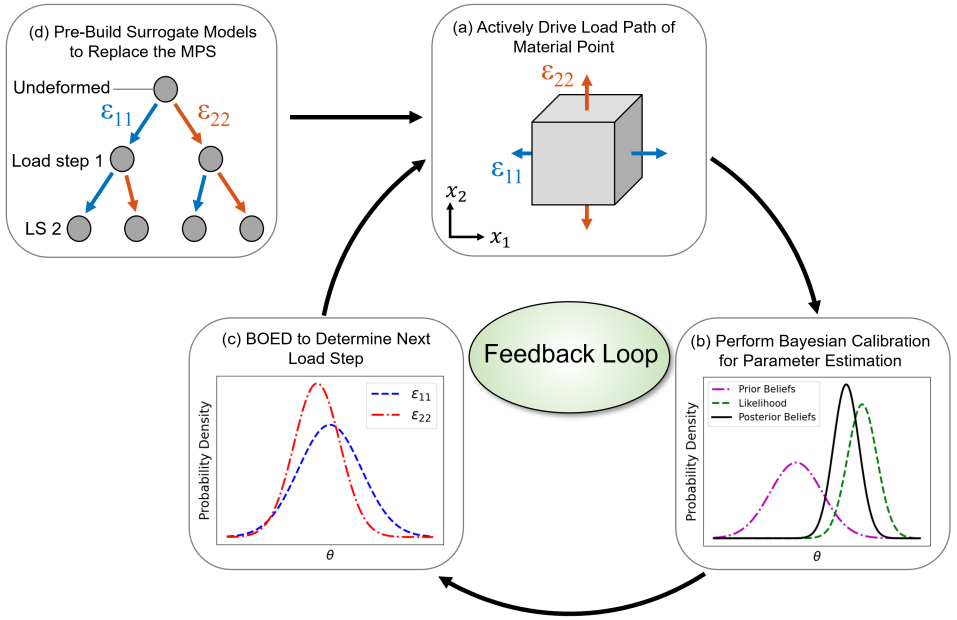
- ICC 프레임워크는 각 실험 단계 이후 구성 모델 매개변수에 대한 사후 분포를 업데이트하기 위해 베이지안 추론을 사용한다.
- 각 반복 단계에서, 알고리즘은 모든 후보 하중 단계(예: ε₁₁ 또는 ε₂₂ 방향의 변형 증분)에 대해 기대 정보 수익(EIG)을 계산하여 가장 정보가 많은 다음 단계를 식별한다.
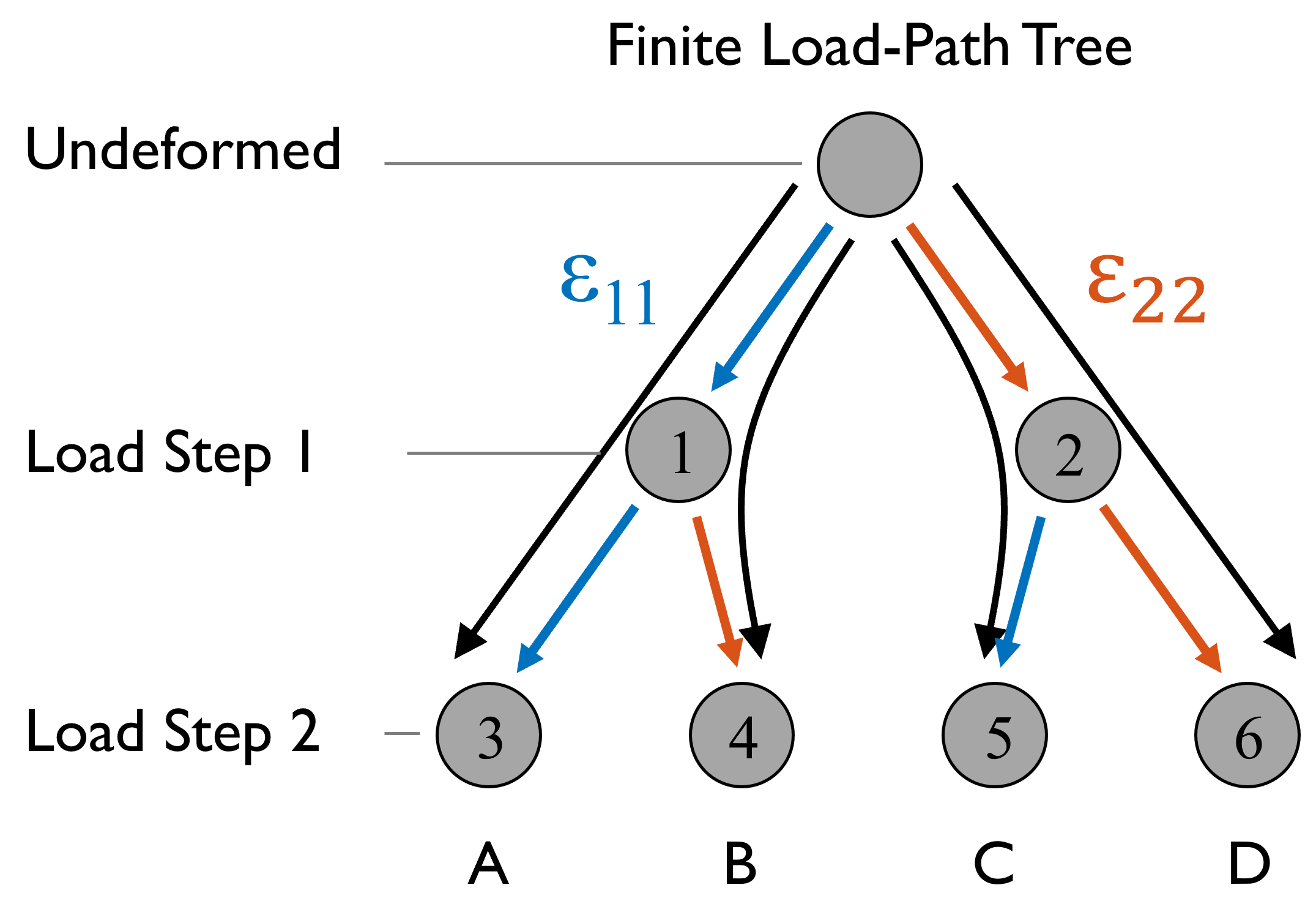
- 하중 경로 결정 공간은 이진 트리로 모델링되며, 각 노드는 변형 증분 선택을 나타내고, 각 자식 노드에 대해 EIG가 계산된다.
- EIG는 이중축 하중 하에서 평면 응력 비탄성 거동를 모델링하는 빠른 물질점 시뮬레이터를 사용하여 계산된다.
- 알고리즘은 인간의 직관에 기반한 두 가지 정적 사전 정의된 하중 경로와 비교하여, EIG 최대화를 통해 선택된 적응형 설계를 수행한다.
- 더 복잡한 예시 문제에서 단계당 실행 시간이 3분 이내로, 준실시간 구현에 적합함을 입증하였다.
실험 결과
연구 질문
- RQ1베이지안 최적 실험 설계(BOED)를 통한 적응형 하중 경로 선택이 정적이고 직관 기반의 하중 경로보다 구성 모델 校정의 매개변수 불확실성을 더 효과적으로 감소시킬 수 있는가?
- RQ2기대 정보 수익(EIG) 기준은 이중축 하중 조건에서 최적의 변형 증분 방향 선택을 어떻게 안내하는가?
- RQ3교차하는 하중 경로가 이방성 플라스틱성 모델의 매개변수 추정 정확도와 불확실성 감소에 어떤 영향을 미치는가?
- RQ4진짜 매개변수 값과의 거리로 측정된 사후 분포의 신뢰성은 적응형 설계와 정적 실험 설계 사이에서 어떻게 비교되는가?
- RQ5ICC 프레임워크는 전장 데이터를 활용한 실시간 활성 제어 실험을 지원하기 위해 실시간으로 효율적으로 실행될 수 있는가?
주요 결과
- BOED를 통한 적응형 하중 경로 선택은 한 예시 문제에서 정적이고 직관 기반의 하중 경로 대비 후행 매개변수 불확실성을 최대 100% 감소시켰다.
- 적응형 설계는 총 분산과 일반화된 분산이 낮아, 모델 매개변수의 더 정밀한 추정을 나타내었다.
- 적응형 설계는 평균적으로 진짜 매개변수와의 평균 거리(MD)가 낮아, 진짜 매개변수 값을 더 정확하게 포착하는 데 더 높은 신뢰성을 보였다.
- ε₁₁와 ε₂₂ 간의 교차하는 하중 경로(예: 번갈아가며 적용)는 알고리즘이 일관되게 선호했으며, 이는 이방성 항복 거동를 탐색하기 위한 필요성 때문일 것이다.
- 더 복잡한 예시 문제에서 EIG 계산과 추론을 포함한 단계당 실행 시간이 3분 이내로, 준실시간 응용에 대한 실현 가능성을 입증하였다.
- ICC 프레임워크는 압축 또는 동시 변형 증분을 포함하는 비이진 트리 구조로도 확장 가능하며, 핵심 알고리즘 논리에는 영향을 주지 않는다.
더 나은 연구,지금 바로 시작하세요
논문 읽기부터 검토까지, 연구 시간을 획기적으로 줄여보세요.
카드 등록 없음 · 무료 플랜 제공
이 리뷰는 AI가 만들고, 인간 에디터가 검토했습니다.