
[논문 리뷰] Breaking up with the continuous exoplanet mass-radius relation
저자들은 1053개의 확인된 행성에서 경험적 질량–반지름–온도 관계를 구성하고, 세 가지 뚜렷하고 비연속적인 영역과 온도 의존적의 Jovian 관계를 발견하여 예측 정확도를 개선합니다.
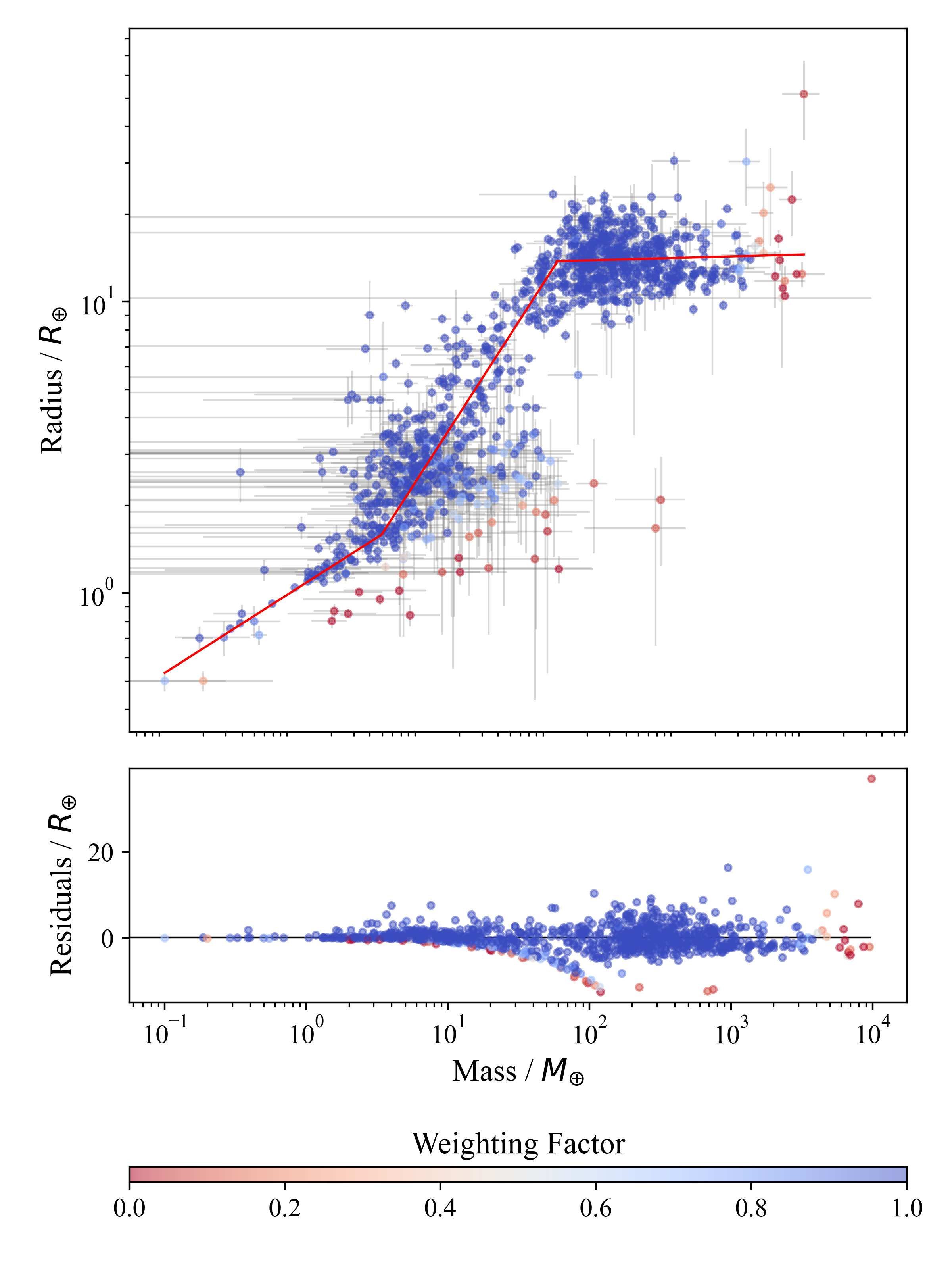
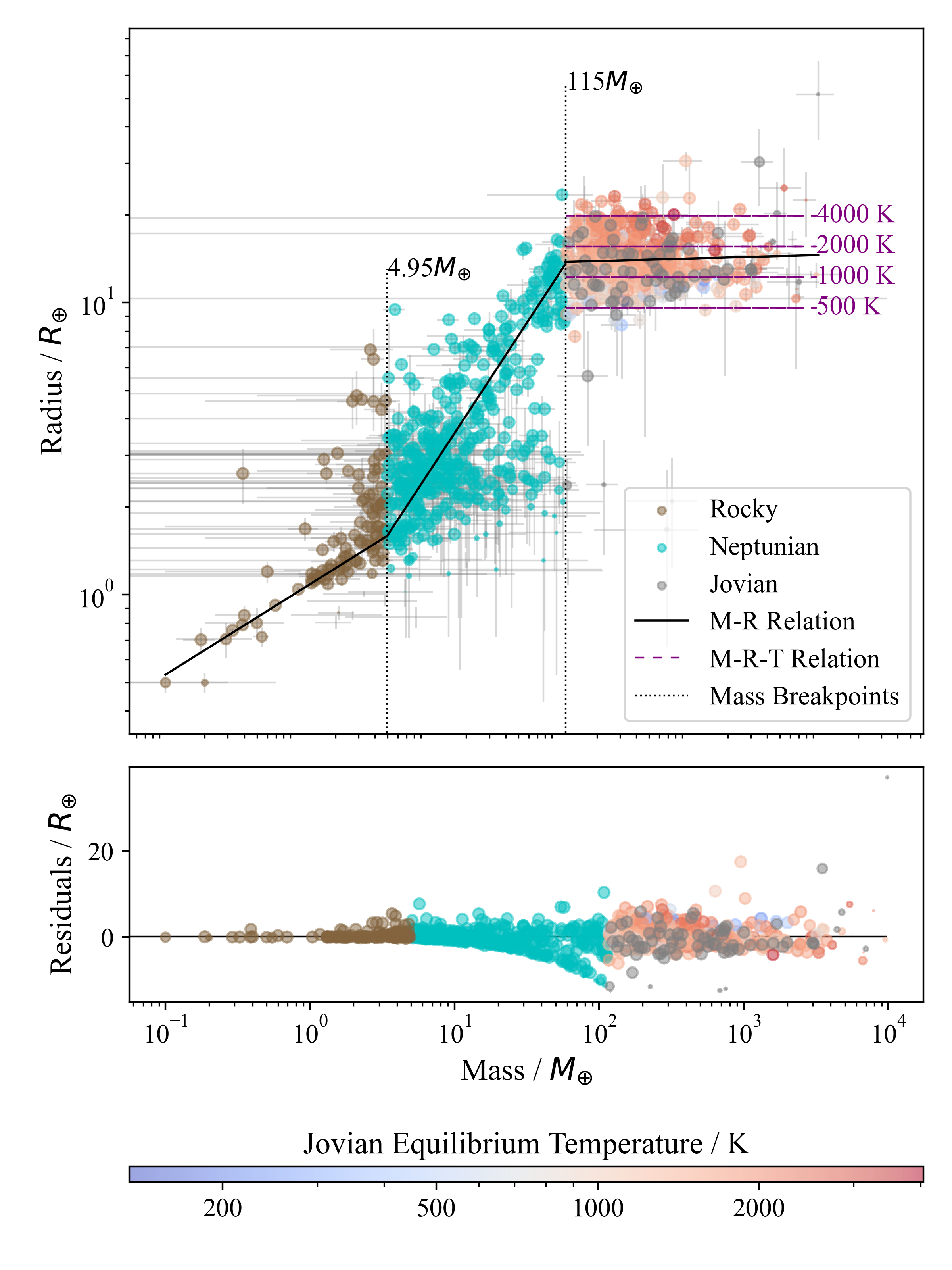
We use a carefully selected subsample of 1053 confirmed exoplanets from the NASA Exoplanet Archive to construct empirical power-law exoplanet mass-radius-temperature ($M$-$R$-$T$) relations. Using orthogonal distance regression to account for errors in both mass and radius, we allow the data to decide: 1) the number of distinct planetary regimes; 2) whether the boundaries of these regimes are best described by broken power laws joined at mass break points, or by discontinuous power laws motivated by changes in equations of state and temperature. We find strong support from the data for three distinct planetary $M$-$R$ regimes and for those regimes to be discontinuous. Our most successful model involves an $M$-$R$-$T$ relation in which ice/rock (rocky) and ice-giant (neptunian) planets are segregated by a pure-ice equation of state, whilst neptunes and gas giant (jovian) planets are segregated by a mass break at $M_{ m br} = 115\pm19~M_{\oplus}$. The rocky planet regime is shown to follow $M \propto R^{0.34\pm0.01}$, whilst neptunes have $M\propto R^{0.55\pm0.02}$. Planets in both regimes are seen to extend to similar maximum masses. In the jovian regime, we find that $M \propto R^{0.00\pm0.01}T^{0.35\pm 0.02}$, where $T$ is the planet equilibrium temperature. This implies that, for jovian planets detected so far, equilibrium temperature alone provides a robust estimator of mass.
연구 동기 및 목표
- 대폭 필터링된 대규모 샘플을 사용하여 외계행성 질량–반지름 관계를 정제할 필요성의 동기를 부여한다.
- 데이터가 연속적이거나 비연속적인 조각적 멱함수 M–R 관계를 지지하는지와 영역 경계가 어디에 놓여 있는지 결정한다.
- 거대 행성의 질량–반지름–온도(M–R–T) 관계를 포함하도록 분석을 확장하고, 평형 온도가 반지름 팽창에서 어떤 역할을 하는지 평가한다.
- 제안된 모델을 Forecaster 확률적 프레임워크와 비교하고 현재 데이터로 성능을 평가한다.]
- method:["NASA Exoplanet Archive에서 질량 및 반지름이 측정된 1053개의 외계행성의 큐레이팅된 하위샘플을 구성하고 이상치를 제외하기 위한 두 가지 타당성 기준을 적용한다.","직교 거리 회귀(ODR)를 사용하여 질량과 반지름의 오차를 모두 허용하면서 플로팅 가능한 브레이크 포인트를 고려한 조각적 멱함수 M–R 관계를 적합한다.","측정 불확실성과 타당성 확률을 혼합한 결합 가중치를 도입하여 적합에 영향을 주도록 한다.","잔차 및 샘플 전체의 반지름 예측 오차를 종합하는 지표를 평가하여 연속적 대 비연속적 M–R 관계를 테스트한다.","Jovian 행성에 대해 평형 온도 T를 포함한 M–R–T 모델로 R ∝ T^β1 M^β2의 곱적 멱함수를 적합하고, 온도에 무관한 적합과 비교한다.","모델을 Forecaster(Chen & Kipping, 2017)와 비교하여 상대적 예측 성능을 평가한다.]
- research_questions:["외계행성의 M–R 데이터가 다수의 뚜렷한 영역을 지지하는가, 그리고 이 영역들이 연속적이거나 비연속적 멱함수로 더 잘 설명되는가?"," rocky, neptunian, jovian 행성을 최적으로 구분하는 영역 경계(M의 위치)는 어디인가?","대형 행성에 대해 M–R–T 구성에서 평형 온도를 포함시키면 특히 hot Jupiters의 반지름 예측이 개선되는가?","현재 데이터로 평가할 때 비연속적 M–R–T 모델은 확률적 포캐스터 접근에 비해 어떻게 성능이 나타나는가?","경계(예: 4.95 M⊕, 115 M⊕) 및 순결한 아이스 EOS 분리가 행성 내부에 대해 어떤 물리적 해석을 시사하는가?"]
- key_findings:["데이터에 의해 세 가지 뚜렷한 행성 M–R 영역이 강하게 지지되며 비연속 전이의 타당성이 높다.","Rocky 영역: M ∝ R^0.34 (β = 0.34 ± 0.01) 브레이크가 ~4.95 ± 0.81 M⊕에서 발생한다.","Neptunian 영역: M ∝ R^0.55 (β = 0.55 ± 0.02) 브레이크가 115 ± 19 M⊕에서 neptunes와 jovians를 구분한다.","Jovian 영역: M ∝ R^0.00 T^0.35 (β1 = 0.35 ± 0.02, β2 ≈ 0, 즉 온도가 포함될 때 질량의 직접적 영향은 거의 없다).","Jovian 행성에 대한 비연속적 M–R–T 모델은 잔차를 더 낮추며(평균 절대 편차 3.81), 결합 M–R–T 모델은 예측을 더욱 개선한다(M 잔차 ≈ 0, R 잔차 보통)."," Forecaster와 비교할 때 비연속적 M–R–T 모델은 현재 데이터에서 일관되게 우수한 성능을 보이며, Forecaster는 중간 질량 범위의 반지름과 팽창 효과에 어려움을 겪는다."," 연구는 rocky와 neptunian 행성을 구분하기 위해 순수한 아이스 EOS를 사용하고 neptunian에서 jovian으로의 전환을 115 M⊕로 고정하는 분리 경계가 타당하다고 지지한다."," 온도를 고려하는 것은 hot Jupiters의 반지름 팽창을 설명하고 M–R 평면 전반의 산포를 줄이는 데 중요하다."]
- table_headers:[]
- table_rows:[]
제안 방법
- Assemble a curated subsample of 1053 exoplanets with measured mass and radius (from the NASA Exoplanet Archive) and apply two plausibility criteria to exclude outliers.
- Fit piecewise power-law M–R relations using orthogonal distance regression (ODR) while allowing floating break points and accounting for errors in both mass and radius.
- Incorporate a combined weighting factor that blends measurement uncertainties with plausibility probabilities to influence the fit.
- Test continuous versus discontinuous M–R relations by evaluating residuals and a metric that aggregates the radius prediction error across the sample.
- Extend the modeling to M–R–T for jovian planets by fitting a multiplicative power law R ∝ T^β1 M^β2 with T being the equilibrium temperature, and compare with temperature-independent fits.
- Compare models against Forecaster (Chen & Kipping, 2017) to assess relative predictive performance.
실험 결과
연구 질문
- RQ1Do the exoplanet M–R data support multiple distinct regimes, and are these regimes better described by continuous or discontinuous power laws?
- RQ2Where are the regime boundaries (in M) that optimally separate rocky, neptunian, and jovian planets?
- RQ3Does including equilibrium temperature in an M–R–T formulation for massive planets improve radius predictions, particularly for hot Jupiters?
- RQ4How does the discontinuous M–R–T model perform relative to a probabilistic forecaster approach when evaluated on current data?
- RQ5What physical interpretation do the boundaries (e.g., 4.95 M⊕, 115 M⊕) and the pure-ice EOS separation imply about planetary interiors?
주요 결과
- Three distinct planetary M–R regimes are strongly supported by the data and favor discontinuous transitions.
- Rocky regime: M ∝ R^0.34 (β = 0.34 ± 0.01) with a break at ~4.95 ± 0.81 M⊕.
- Neptunian regime: M ∝ R^0.55 (β = 0.55 ± 0.02) with a break at 115 ± 19 M⊕ separating neptunes from jovians.
- Jovian regime: M ∝ R^0.00 T^0.35 (β1 = 0.35 ± 0.02, β2 ≈ 0, i.e., mass has little direct influence when temperature is included).
- A discontinuous M–R–T model for jovian planets yields lower residuals (average absolute deviation 3.81) than continuous counterparts, and a combined M–R–T model further improves predictions (M residual ≈ 0, R residual moderate).
- Compared with Forecaster, the discontinuous M–R–T model consistently outperforms in current data; Forecaster struggles with radii in the intermediate mass range and bloating effects.
- The study supports using a pure-ice EOS to separate rocky from neptunian planets and a fixed break at 115 M⊕ for neptunian to jovian division.
- Accounting for temperature is crucial to explain radius inflation in hot Jupiters and to reduce scatter across the M–R plane.
더 나은 연구,지금 바로 시작하세요
연구 설계부터 논문 작성까지, 연구 시간을 획기적으로 줄여보세요.
카드 등록 없음 · 무료 플랜 제공
이 리뷰는 AI가 만들고, 인간 에디터가 검토했습니다.