
[논문 리뷰] Calibrating baryonic feedback with weak lensing and fast radio bursts
이 논문은 유사 유럽 우주선 유사 설문과 같은 설문에서 약 10⁴개의 빠른 은하폭발(FRBs)을 사용하여, 그들의 분산 측정값(DM)과 약한 중력 렌즈 신호를 교차상관시켜 대규모 구조 조사에서 복사성 피드백을 보정하는 데 빠른 은하폭발(FRBs)을 천체론적 탐사 도구로 사용할 것을 제안한다. 이 방법은 복사성 피드백에 대한 제약 조건을 한 단계 향상시키고, 중성미자 질량 제약 조건을 50–100 % 향상시켜 천체론적 및 피드백 매개변수 간의 혼동을 깨뜨린다.
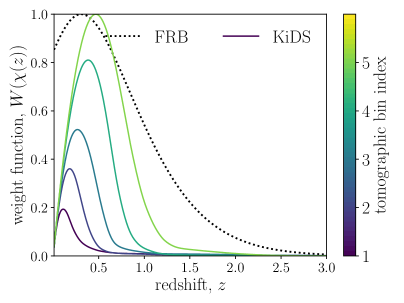
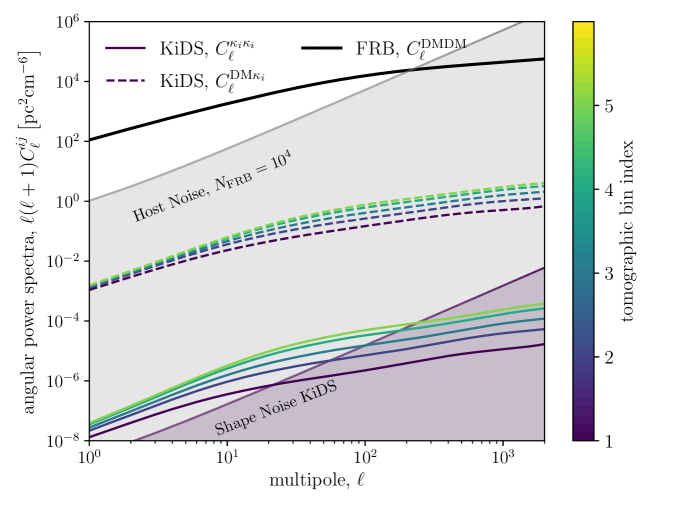
One of the key limitations of large-scale structure surveys of the current and future generation, such as Euclid, LSST-Rubin or Roman, is the influence of feedback processes on the distribution of matter in the Universe. This effect, called baryonic feedback, modifies the matter power spectrum on non-linear scales much stronger than any cosmological parameter of interest. Constraining these modifications is therefore key to unlocking the full potential of the upcoming surveys, and we propose to do so with the help of Fast Radio Bursts (FRBs). FRBs are short, astrophysical radio transients of extragalactic origin. Their burst signal is dispersed by the free electrons in the large-scale structure, leading to delayed arrival times at different frequencies characterised by the dispersion measure (DM). Since the dispersion measure is sensitive to the integrated line-of-sight electron density, it is a direct probe of the baryonic content of the Universe. We investigate how FRBs can break the degeneracies between cosmological and feedback parameters by correlating the observed Dispersion Measure with the weak gravitational lensing signal of a Euclid-like survey. In particular, we use a simple one-parameter model controlling baryonic feedback, but we expect similar findings for more complex models. Within this model, we find that $\sim 5 imes 10^4$ FRBs are sufficient to constrain the baryonic feedback significantly better than cosmic shear alone, tightening the constraints considerably (roughly by a factor of five). We also expect a 1.5-fold improvement in the sum of neutrino masses.
연구 동기 및 목표
- 미래의 약한 렌즈 설문에서 비선형 물질 스펙트럼에 영향을 미치는 복사성 피드백 효과로 인한 천체론적 제약 조건의 주요 불확실성을 해결하기 위해.
- 현재 대규모 구조 설문에서 정밀도를 제한하는 천체론적 매개변수와 피드백 모델 매개변수 간의 혼동을 깨뜨리기 위해.
- FRB의 분산 측정값(DM) 상관관계를 통해 대규모 구조 내 전자 분포를 새로운 독립적 탐사 도구로 제공할 수 있음을 입증하기 위해.
- 특히 피드백 강도와 중성미자 질량에 대해, 천체진동과 FRB DM 데이터를 결합했을 때의 매개변수 제약 조건 향상을 정량화하기 위해.
- FRB가 CMB 우선 조건에 의존하지 않고도 독립적이고 저 redshift 탐사 도구로서 복사성 구조를 제공할 수 있는지 보여주기 위해.
제안 방법
- 연구는 물질 스펙트럼, 전자 밀도, 그리고 약한 렌즈와의 교차상관관계에 대한 복사성 피드백의 영향을 시뮬레이션하기 위해 단일 매개변수 피드백 모델을 사용한다.
- 저자들은 FRB의 분산 측정값(DM)을 자유 전자 밀도의 선형 경로 통합 측정도구로 모델링하여 대규모 구조 내 복사성 구성 요소에 민감함을 설명한다.
- 저자들은 FRB의 DM 각도 스펙트럼을 Euclid 유사 설문의 천체진동 스펙트럼과 교차상관시켜 매개변수 공간의 혼동을 깨뜨린다.
- 저자들은 노이즈 없는 데이터 벡터와 emcee를 통한 MCMC 샘플링을 사용하여 천체론적 및 피드백 매개변수의 사후 분포를 추정하기 위해 피셔 행렬 예측을 사용한다.
- 모델의 보정 범위를 초월하는 외삽을 방지하기 위해 천체론적 매개변수에 우선 조건을 적용하여 매개변수 추정의 강건성을 확보한다.
- 분석은 천체진동만으로의 제약 조건과 천체진동에 더해 FRB DM 상관관계를 결합한 경우를 비교하며, 피드백 강도, 허블 상수, 복사성 밀도, 중성미자 질량에 집중한다.
실험 결과
연구 질문
- RQ1FRB의 분산 측정값은 약한 렌즈 설문에서 천체론적 매개변수와 복사성 피드백 매개변수 간의 혼동을 깰 수 있는가?
- RQ2천체진동만으로의 제약 조건에 비해 FRB DM 데이터를 추가했을 때 피드백 강도의 제약 조건은 얼마나 향상되는가?
- RQ3FRB 기반의 DM 상관관계는 중성미자 질량 합에 대한 제약 조건을 얼마나 향상시킬 수 있는가?
- RQ4FRB DM 상관관계의 적색편이 가중 함수는 tSZ 효과와 어떻게 다를 수 있으며, 이는 시스템틱스와 보완성에 어떤 함의를 갖는가?
- RQ5FRB는 CMB 우선 조건에 의존하지 않고도 독립적이고 저 redshift 탐사 도구로서 복사성 구조를 제공할 수 있는가?
주요 결과
- 약 10⁴개의 FRB를 사용할 경우, 천체진동만으로의 경우에 비해 복사성 피드백 강도에 대한 제약 조건이 한 단계 향상된다.
- FRB 데이터를 추가함으로써 중성미자 질량 합에 대한 불확실성이 50–100 % 감소하여 이 핵심 천체론적 매개변수에 대한 제약 조건이 크게 강화된다.
- FRB DM 상관관계는 허블 상수 및 복사성 밀도와 같은 천체론적 매개변수와 피드백 매개변수 간의 혼동을 깨뜨린다.
- 이 방법은 tSZ 효과와 보완적인 탐사 도구를 제공하며, 다른 적색편이 민감도와 시스템틱스를 지녀 천체론적 추론의 강건성을 향상시킨다.
- 보수적인 우선 조건과 단순한 피드백 모델을 사용하더라도, FRB 데이터의 포함은 특히 피드백 및 중성미자 질량 매개변수에서 상당한 향상을 이룬다.
- 예측에서 사용된 신호 대 잡음 비율은 현재 및 향후 계획된 FRB 설문(예: CHIME, ASKAP, SKA)을 고려할 때 다음 10년 내로 구현 가능하다.
더 나은 연구,지금 바로 시작하세요
논문 읽기부터 검토까지, 연구 시간을 획기적으로 줄여보세요.
카드 등록 없음 · 무료 플랜 제공
이 리뷰는 AI가 만들고, 인간 에디터가 검토했습니다.