
[논문 리뷰] Can neutrino-assisted early dark energy models ameliorate the $H_0$ tension in a natural way?
이 논문은 히스버론 토론을 해결하기 위해 뉴트리노 보조 조기 어두운 에너지(νEDE) 모델을 조사한다. 뉴트리노와 스칼라 장 간의 결합이 물질-복사 평형 시점에서 자연스럽게 EDE를 유도할 수 있음을 제안한다. 뉴트리노 전이에 의해 EDE 에너지 밀도에 특이점이 생성되지만, 고려된 매개변수 범위에서 EDE 기여도가 충분히 크지 않아($f_{\text{EDE}} \approx 10\%$) 히스버론 토론을 완화하지 못함을 확인하여, 이 특정 실현에서 자연스러움의 한계를 보여준다.
The idea of neutrino-assisted early dark energy ($ν$EDE), where a coupling between neutrinos and the scalar field that models early dark energy (EDE) is considered, was introduced with the aim of reducing some of the fine-tuning and coincidence problems that appear in usual EDE models. In order to be relevant in ameliorating the $H_0$ tension, the contribution of EDE to the total energy density ($f_ ext{EDE}$) should be around 10\% near the redshift of matter-radiation equality. We verify under which conditions $ν$EDE models can fulfill these requirements for a model with a quartic self-coupling of the EDE field and an exponential coupling to neutrinos. We find that in the situation where the EDE field is frozen initially, the contribution to $f_ ext{EDE}$ can be significant but it is not sensitive to the neutrino-EDE coupling and does not address the EDE coincidence problem. On the other hand, if the EDE field starts already dynamical at the minimum of the effective potential, it tracks this time-dependent minimum that presents a feature triggered by the neutrino transition from relativistic to nonrelativistic particles. This feature generates $f_ ext{EDE}$ in a natural way at around this transition epoch, that roughly coincides with the matter-radiation equality redshift. For the set of parameters that we considered we did not find values that satisfy the requirements on the background cosmological evolution to mitigate the Hubble tension in a natural way in this particular $ν$EDE model.
연구 동기 및 목표
- 초기 조건의 정밀 조정 없이 뉴트리노 보조 조기 어두운 에너지(νEDE) 모델이 히스버론 토론을 자연스럽게 완화할 수 있는지 평가하기 위해.
- 뉴트리노가 상대론적에서 비상대론적 상태로 전이되는 과정이 물질-복사 평형 시점($z \sim 3.5$)에서 자연스럽게 EDE를 유도할 수 있는지 조사하기 위해.
- EDE 스칼라 장과 뉴트리노 간의 결합이 히스버론 토론을 완화하기 위해 필요한 에너지 밀도 기여도($f_{\text{EDE}} \approx 10\%$)를 충분히 크게 및 적절한 타이밍에 기여하는지 결정하기 위해.
- 두 초기 조건 시나리오를 비교하기 위해: EDE 장이 처음에 고결되어 있는 경우와 효과적 포텐셜의 최소점에서 시작하는 경우.
- CAMB를 사용하여 배경 수준에서 모델의 타당성을 평가하며, $f_{\text{EDE}}$의 진화와 뉴트리노-EDE 결합의 역할을 중점적으로 다루기 위해.
제안 방법
- CAMB에서 배경 수준에서 νEDE 모델을 구현하였으며, 4차 자기결합 포텐셜($V \propto \phi^4$)과 지수형 뉴트리노 결합($A(\phi) = \exp(\beta\phi/M_{\text{Pl}})$)를 사용하였다.
- 아인슈타인 프레임에서 스칼라 장 진동 방정식을 해결하였으며, 효과적 포텐셜의 시간에 따라 변화하는 최소값을 추적하여 장의 역학을 모델링하였다.
- 두 가지 초기 조건 영역을 분석하였다: (1) 허블 마찰로 인해 장이 임의의 초기 값에서 고결되어 있는 경우, (2) 장이 효과적 포텐셜의 최소점에서 시작하는 경우.
- EDE 에너지 밀도 기여도 $f_{\text{EDE}}$와 편차 파라미터 $\Delta$를 계산하여 뉴트리노-EDE 결합의 영향을 정량화하였다.
- 해석적 근사치(식 20)를 사용하여 $f_{\text{EDE}}$를 예측하고, 수치 결과와 비교하였다.
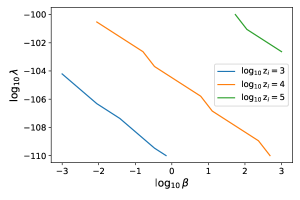
- 파arameter 스캔을 수행하여 $f_{\text{EDE}}$가 결합 강도 $\beta$와 자기결합 강도 $\lambda$에 얼마나 민감한지 평가하였으며, 다른 천체물리적 매개변수를 고정하였다.
실험 결과
연구 질문
- RQ1뉴트리노가 상대론적에서 비상대론적 상태로 전이되는 과정이 물질-복사 평형 시점에서 자연스럽게 EDE 장을 유도할 수 있는가?
- RQ2νEDE 모델이 $z \sim 3.5$에서 히스버론 토론을 완화하기에 충분히 큰 $f_{\text{EDE}} \approx 10\%$를 생성하는가?
- RQ3장이 효과적 포텐셜의 최소점에서 시작할 경우, νEDE 모델에서 EDE 공진 문제는 해결되는가?
- RQ4뉴트리노-EDE 결합($\beta$)은 장 최소점 초기 조건 시나리오에서 $f_{\text{EDE}}$의 진화에 어떤 영향을 미치는가?
- RQ5초기 장 값이나 스칼라 장 매개변수를 정밀 조정 없이도 모델이 의미 있는 $f_{\text{EDE}}$를 달성할 수 있는가?
주요 결과
- EDE 장이 초기에 임의의 값에서 고결되어 있을 경우, $f_{\text{EDE}}$는 천체물리학적으로 의미 있는 수준에 도달할 수 있지만, 이 행동은 뉴트리노-EDE 결합에 민감하지 않으며 EDE 공진 문제를 해결하지 못한다.
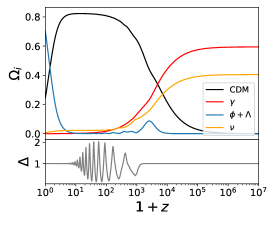
- 장이 효과적 포텐셜의 최소점에서 시작할 경우, 장은 시간에 따라 변화하는 최소값을 자연스럽게 따라가며, 뉴트리노 전이로 인해 $z \sim 3.5$에서 $f_{\text{EDE}}$에 돌출부가 발생한다. 이는 해석적으로 예측된 바와 일치한다.
- 뉴트리노-EDE 결합은 장 최소점 초기 조건 시나리오에서 무시할 수 없는 역할을 하며, $f_{\text{EDE}}$가 $\beta$에 따라 크게 변하는 것으로 나타났다. 그림 7에서 이를 확인할 수 있다.
- 결합의 영향에도 불구하고, 장 최소점 초기 조건 시나리오에서 도달하는 최대 $f_{\text{EDE}}$는 히스버론 토론을 완화하기 위한 $f_{\text{EDE}} \approx 10\%$ 요구 조건을 충족하지 못할 정도로 낮다.
- 자기결합 강도 $\lambda$를 증가시켜 $f_{\text{EDE}}$를 높이려는 尝시도는 장이 더 오랫동안 고결되어 있는 것으로 이어져, 결과적으로 첫 번째(비자연스러운) 초기 조건 영역으로 모델이 이동하게 된다.
- 큰 결합 강도($\beta = 1000$)를 사용한 경우에도 모델은 의미 있는 $f_{\text{EDE}}$를 생성하지 못하며, 이는 이 특정 νEDE 실현에서의 근본적인 한계를 보여준다.
이 논문 읽기
누빈트 뷰어에서 원문을 열고, 읽으면서 궁금한 곳을 바로 물어보세요.
누빈트에서 이 논문 읽기이 리뷰는 AI가 논문 원문을 바탕으로 만들었습니다. 인용하기 전에 원문을 확인해 주세요.