
[논문 리뷰] Canonical Hubble-Tension-Resolving Early Dark Energy Cosmologies are Inconsistent with the Lyman-$α$ Forest
이 논문은 허블 장력 문제를 해결하기 위해 제안된 캐논리컬 초기 어두운 에너지(EDE) 모델이 라이만-알파 숲 데이터와 일관되지 않음을 보여준다. SDSS eBOSS 및 X-Shooter/MIKE에서의 라이만-알파 숲 투과율 스펙트럼 측정을 이용해, EDE 모델은 라이만-알파 데이터에서 선호되는 것보다 더 높은 스칼라 스펙트럼 지수 $n_s$ 가 필요로 하며, 이로 인해 $H_0 = 67.9^{+0.4}_{-0.4}$ km/s/Mpc (68% 신뢰수준)가 되며, 이는 SH0ES 측정치와 >4σ의 불일치를 보인다.
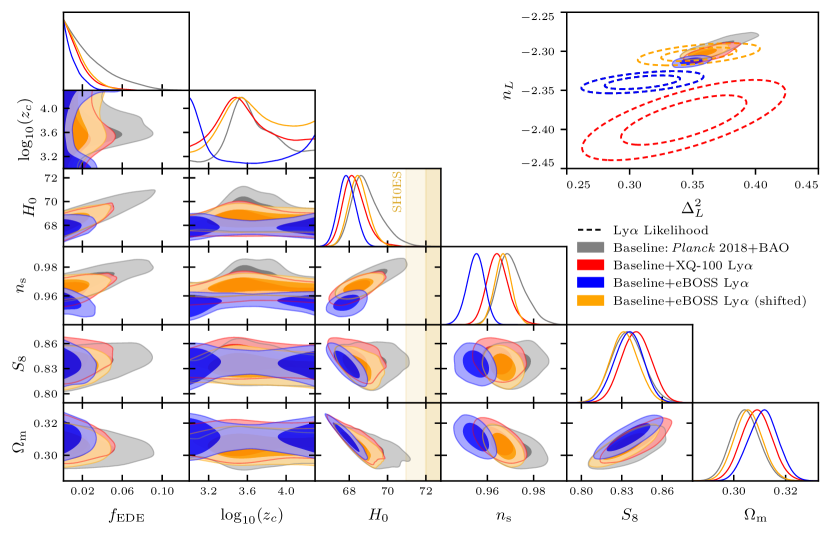
Current cosmological data exhibit discordance between indirect and some direct inferences of the present-day expansion rate, $H_0$. Early dark energy (EDE), which briefly increases the cosmic expansion rate prior to recombination, is a leading scenario for resolving this "Hubble tension" while preserving a good fit to cosmic microwave background (CMB) data. However, this comes at the cost of changes in parameters that affect structure formation in the late-time universe, including the spectral index of scalar perturbations, $n_s$. Here, we present the first constraints on axion-like EDE using data from the Lyman-$α$ forest, i.e., absorption lines imprinted in background quasar spectra by neutral hydrogen gas along the line of sight. We consider two independent measurements of the one-dimensional Ly$α$ forest flux power spectrum, from the Sloan Digital Sky Survey (SDSS eBOSS) and from the MIKE/HIRES and X-Shooter spectrographs. We combine these with a baseline dataset comprised of Planck CMB data and baryon acoustic oscillation (BAO) measurements. Combining the eBOSS Ly$α$ data with the CMB and BAO dataset reduces the 95% confidence level (CL) upper bound on the maximum fractional contribution of EDE to the cosmic energy budget, $f_{ m EDE}$, from 0.07 to 0.03 and constrains $H_0=67.9_{-0.4}^{+0.4}$ km/s/Mpc (68% CL), with maximum a posteriori value $H_0=67.9$ km/s/Mpc. Similar results are obtained for the MIKE/HIRES and X-Shooter Ly$α$ data. Our Ly$α$-based EDE constraints yield $H_0$ values that are in $>4σ$ tension with the SH0ES distance-ladder measurement and are driven by the preference of the Ly$α$ forest data for $n_s$ values lower than those required by EDE cosmologies that fit Planck CMB data. Taken at face value, the Ly$α$ forest severely constrains canonical EDE models that could resolve the Hubble tension.
연구 동기 및 목표
- 재결합 이전에 팽창률을 높여 허블 장력을 해결하는 캐논리컬 초기 어두운 에너지(EDE) 모델이 라이만-알파 숲 데이터와 일치하는지 테스트하기.
- 고정밀 라이만-알파 숲 투과율 스펙트럼 측정치를 이용해 EDE의 최대 분수 에너지 기여도 $f_{\text{EDE}}$를 제약하기.
- 라이만-알파 데이터가 낮은 $n_s$ 값을 선호하는 데 반해, Planck CMB 데이터를 적합하기 위해 EDE 모델이 요구하는 더 높은 $n_s$ 값과의 충돌 여부 평가하기.
- 라이만-알파 데이터를 고려할 때, EDE가 선호하는 $H_0$ 값과 SH0ES 직접 측정치 사이의 불일치가 어떻게 영향을 받는지 평가하기.
제안 방법
- EDE 모델을 $n=3$인 아키온-유사 잠재에너지로 모델링하고, $f_{\text{EDE}}$, $z_c$, $\theta_i$로 매개변수화하며, 배경 및 선형 페르투르베이션 진화를 계산하기 위해 CLASS_EDE 코드를 사용한다.
- 기준값 $k_p = 0.009$ s/km 및 $z_p = 3$에서 선형 스펙트럼의 진폭 $\Delta_L^2$와 기울기 $n_L$을 기반으로 압축된 가능도를 사용하며, 천체물리적 불확실성을 평균화한다.
- eBOSS 및 X-Shooter/MIKE의 라이만-알파 데이터를 Planck 2018 CMB 데이터(TTTEEE, lowl+lowE, 렌즈) 및 BOSS, SDSS MGS, 6dFGS의 BAO 측정치와 융합한다.
- 마르코프 체인 몬테카를로를 사용해 베이지안 매개변수 추론을 수행하여 $f_{\text{EDE}}$, $H_0$, $n_s$ 및 기타 천체물리적 매개변수에 대한 사후 제약을 도출한다.
- 특히 $n_s$ 및 $H_0$의 불일치에 중점을 두고, 사후 비교 및 통계적 지표를 사용해 데이터 간의 불일치를 정량화한다.
![Figure 1: Comparison of the best-fit linear matter power spectrum at $z_{p}=3$ from the EDE (grey) and $\Lambda$ CDM (orange) fits to the baseline CMB + BAO dataset with the best-fit $\Lambda$ CDM cosmologies for the eBOSS (blue) [ 30 ] and XQ-100 (red) Ly $\alpha$ forest datasets. Shaded bands indi](https://ar5iv.labs.arxiv.org/html/2303.00746/assets/x1.png)
실험 결과
연구 질문
- RQ1허블 장력을 해결하는 캐논리컬 EDE 모델이 라이만-알파 숲 데이터와 일치할 수 있는가?
- RQ2라이만-알파 숲 데이터를 천체물리 분석에 포함했을 때 $f_{\text{EDE}}$의 상한은 얼마인가?
- RQ3라이만-알파 숲 데이터가 EDE 모델이 CMB 데이터를 적합하기 위해 요구하는 더 높은 $n_s$ 값과 충돌하는 낮은 $n_s$ 값을 선호하는가?
- RQ4라이만-알파 데이터를 포함했을 때, $H_0$의 추정치는 어떻게 변화하며, 이는 SH0ES 측정치와의 불일치에 어떤 영향을 미치는가?
주요 결과
- eBOSS 라이만-알파 숲 데이터를 포함함으로써 $f_{\text{EDE}}$의 95% 신뢰수준 상한은 0.07에서 0.03으로 감소한다.
- 사후 평균 $H_0$ 제약은 $67.9^{+0.4}_{-0.4}$ km/s/Mpc (68% 신뢰수준)이며, 최대 사후 밀도 값은 67.9 km/s/Mpc이다.
- MIKE/HIRES 및 X-Shooter 라이만-알파 데이터를 사용한 결과 동일한 제약 조건이 도출되어, 독립적인 데이터 세트 간의 강건성을 확인한다.
- 라이만-알파 데이터는 EDE 모델이 Planck CMB 데이터를 적합하기 위해 요구하는 것보다 낮은 $n_s$를 선호하며, 이는 근본적인 불일치를 야기한다.
- 결과적으로 도출된 $H_0$ 값은 SH0ES의 직접 측정치인 $73.04 \pm 1.04$ km/s/Mpc와 >4\sigma의 불일치를 보인다.
- eBOSS 분석에서 $\log_{10}(z_c)$의 이중모드 사후 분포는 $n_s$와 $f_{\text{EDE}}$ 간의 상충관계로 인해 발생하며, 낮은 $z_c$ 값이 낮은 $n_s$를 더 잘 수용한다.
더 나은 연구,지금 바로 시작하세요
논문 읽기부터 검토까지, 연구 시간을 획기적으로 줄여보세요.
카드 등록 없음 · 무료 플랜 제공
이 리뷰는 AI가 만들고, 인간 에디터가 검토했습니다.