
[논문 리뷰] CatTSunami: Accelerating Transition State Energy Calculations with Pre-trained Graph Neural Networks
본 논문은 OC20의 사전학습 그래프 신경망을 이용해 전이상 에너지에 대한 NEB 계산을 가속하는 프레임워크 CatTSunami를 제시한다. DFT와의 차이가 0.1 eV 이내인 성공률 약 91%와 최대 28배의 속도 증가를 달성했으며, OC20NEB와 두 개의 촉매 사례 연구에서 시연된다.
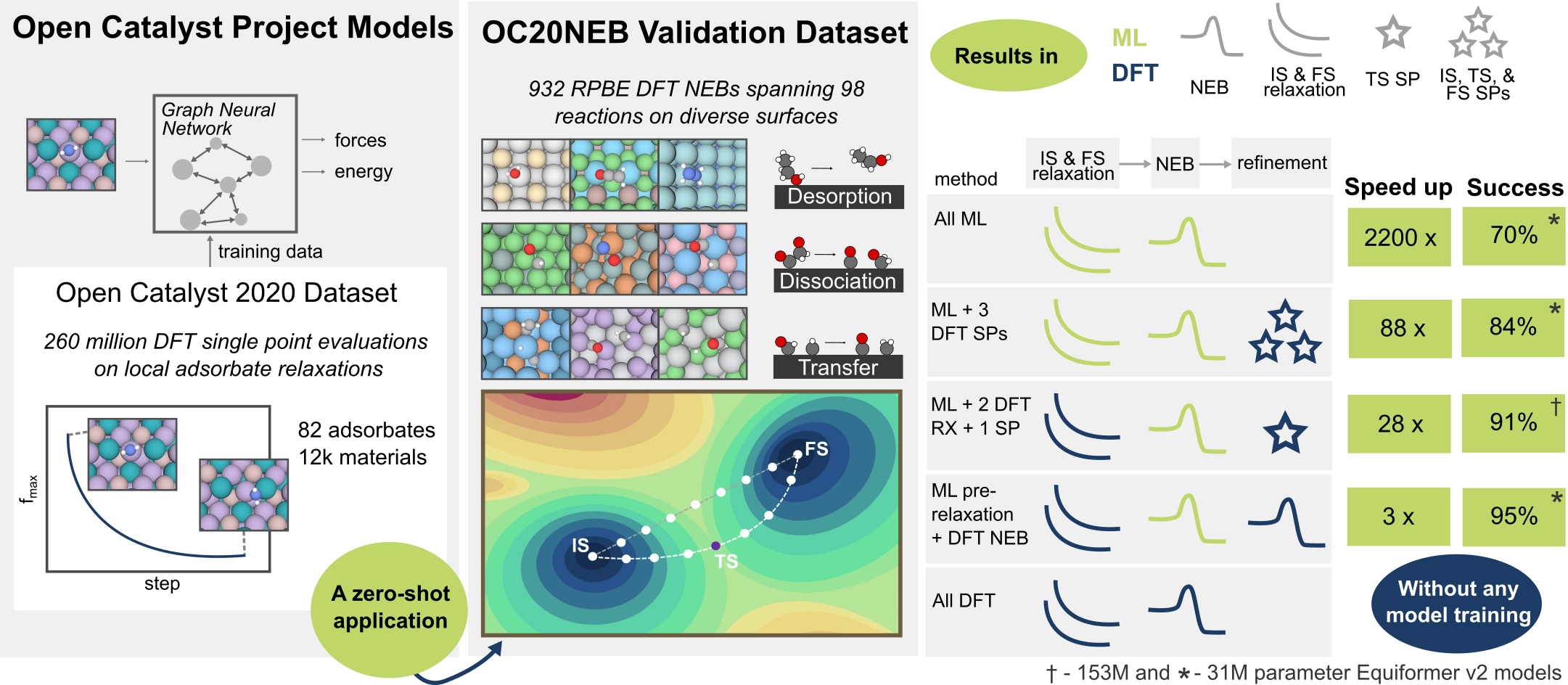
Direct access to transition state energies at low computational cost unlocks the possibility of accelerating catalyst discovery. We show that the top performing graph neural network potential trained on the OC20 dataset, a related but different task, is able to find transition states energetically similar (within 0.1 eV) to density functional theory (DFT) 91% of the time with a 28x speedup. This speaks to the generalizability of the models, having never been explicitly trained on reactions, the machine learned potential approximates the potential energy surface well enough to be performant for this auxiliary task. We introduce the Open Catalyst 2020 Nudged Elastic Band (OC20NEB) dataset, which is made of 932 DFT nudged elastic band calculations, to benchmark machine learned model performance on transition state energies. To demonstrate the efficacy of this approach, we replicated a well-known, large reaction network with 61 intermediates and 174 dissociation reactions at DFT resolution (40 meV). In this case of dense NEB enumeration, we realize even more computational cost savings and used just 12 GPU days of compute, where DFT would have taken 52 GPU years, a 1500x speedup. Similar searches for complete reaction networks could become routine using the approach presented here. Finally, we replicated an ammonia synthesis activity volcano and systematically found lower energy configurations of the transition states and intermediates on six stepped unary surfaces. This scalable approach offers a more complete treatment of configurational space to improve and accelerate catalyst discovery.
연구 동기 및 목표
- Motivate faster access to transition state energies to accelerate catalyst discovery.
- Assess zero-shot transferability of OC20 pre-trained models to NEB-based transition state calculations.
- Introduce OC20NEB as a benchmark dataset for ML-accelerated NEB performance.
- Demonstrate scalability via large reaction networks and microkinetic volcano analyses.
제안 방법
- Use off-the-shelf OC20 pre-trained models (zero-shot) to perform NEB calculations.
- Create OC20NEB dataset of 932 RPBE DFT NEBs for benchmarking.
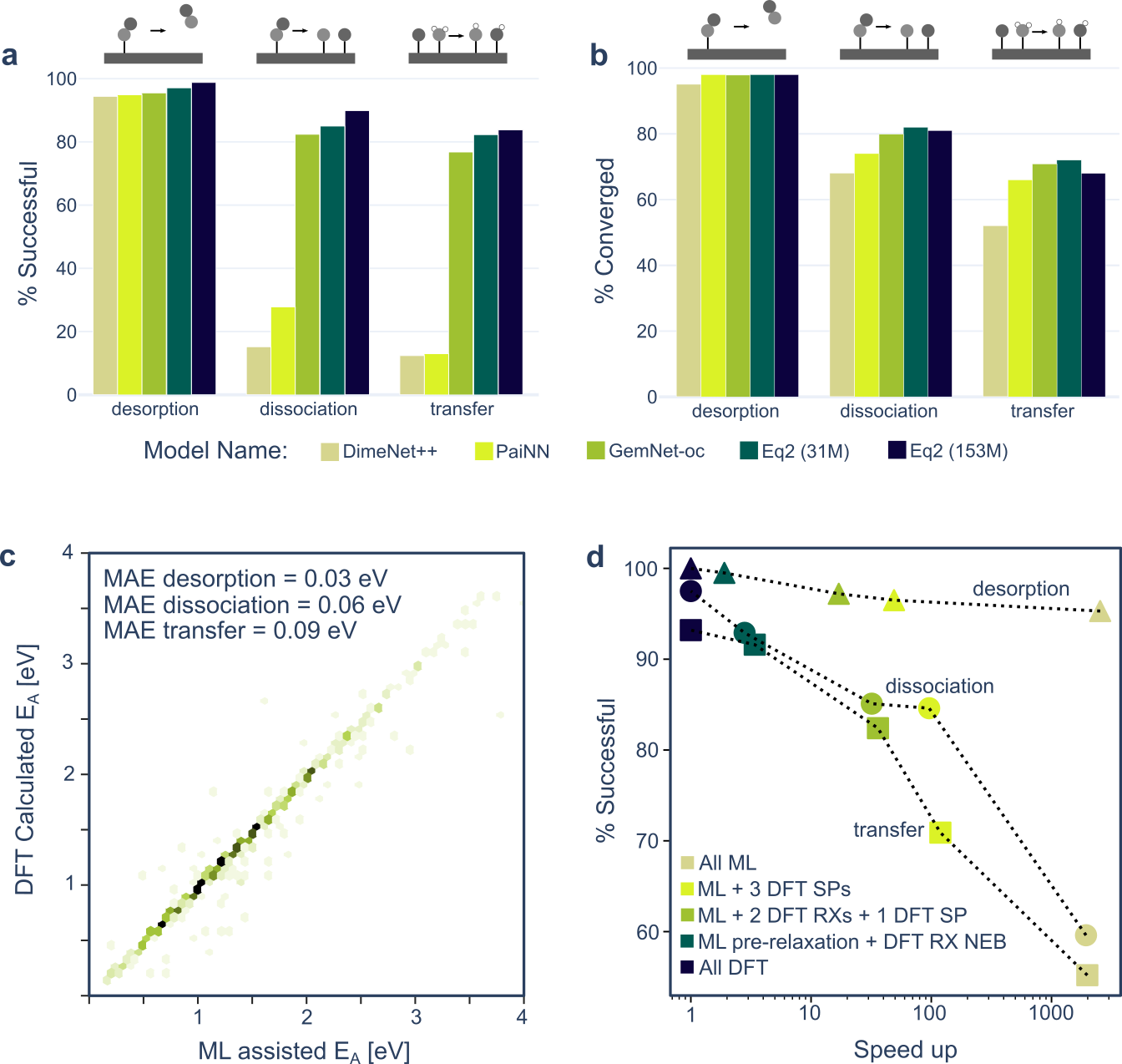
- Evaluate five ML models (Eqiformer v2 153M and 31M, GemNet-OC, PaiNN, DimeNet++) on NEB acceleration.
- Report success as proportion of ML NEBs with activation energy within 0.1 eV of DFT.
- Demonstrate four ML+DFT hybrid NEB strategies (All ML, ML+3 DFT SPs, ML+2 RX+1 SP, ML pre-relax + DFT RX NEB) for speed-accuracy tradeoffs.
- Ground comparisons with DFT NEB to ensure fair benchmarking.
실험 결과
연구 질문
- RQ1Can zero-shot pre-trained OC20 models accurately locate transition states for NEB calculations compared to DFT?
- RQ2What is the achievable speedup and accuracy tradeoff when accelerating NEB with ML across different reaction classes (desorption, dissociation, transfer)?
- RQ3How does OC20NEB benchmark reflect model generalization to NEB tasks not seen during training?
- RQ4Can ML-accelerated NEB enable exhaustive exploration of reaction networks and microkinetic models with substantially reduced compute?
- RQ5Do ML-accelerated results qualitatively alter known kinetic insights (e.g., BEP-relations, ammonia synthesis volcano) when re-evaluated?
주요 결과
- ML NEB using OC20 pre-trained models achieves 91% success in finding energetically similar transition states within 0.1 eV of DFT.
- An average 28x speedup is realized across reactions when ML accelerates NEB calculations.
- OC20NEB comprises 932 RPBE DFT NEBs spanning desorption, dissociation, and transfer, with ID/OOD materials showing comparable performance.
- Using ML for all force/energy evaluations can yield up to 2200x speedups, with 70% success; combining ML relaxations with limited DFT steps improves accuracy (88x speedup, 88% accuracy).
- ML pre-relaxation plus a few DFT evaluations can identify low-energy transition states not always found by pure DFT, aiding discovery of lower-energy pathways.
- In case studies, ML-accelerated NEBs on CO hydrogenation and ammonia synthesis achieve lower MAE (0.04 eV) than BEP-based approaches (0.20 eV) in a 1500x faster workflow; a large 61-intermediate, 174-reaction network was reproduced in 12 GPU days versus 52 GPU years with DFT.
더 나은 연구,지금 바로 시작하세요
논문 읽기부터 검토까지, 연구 시간을 획기적으로 줄여보세요.
카드 등록 없음 · 무료 플랜 제공
이 리뷰는 AI가 만들고, 인간 에디터가 검토했습니다.