
[논문 리뷰] CECM: A continuous empirical cubature method with application to the dimensional hyperreduction of parameterized finite element models
이 논문은 매개변수화된 벡터값 함수의 적분을 위한 최소 크기이면서 양수 가중치를 갖는 쿠바처 규칙을 구성하는 이중 단계 알고리즘인 연속적 경험 쿠바처 방법(CECM)을 소개한다. 초기 점 선택과 점의 위치와 가중치를 동시에 최적화하는 반복적 희소화를 결합함으로써, CECM는 전통적 방법보다 훨씬 적은 수의 점으로도 높은 정확도의 적분을 달성한다. 다항식 및 지수삼각함수 함수에서 최적의 성능을 보이며, 초차원 유한요소 모델에서 상당한 계산 성능 향상을 보였다.
We present the Continuous Empirical Cubature Method (CECM), a novel algorithm for empirically devising efficient integration rules. The CECM aims to improve existing cubature methods by producing rules that are close to the optimal, featuring far less points than the number of functions to integrate. The CECM consists on a two-stage strategy. First, a point selection strategy is applied for obtaining an initial approximation to the cubature rule, featuring as many points as functions to integrate. The second stage consists in a sparsification strategy in which, alongside the indexes and corresponding weights, the spatial coordinates of the points are also considered as design variables. The positions of the initially selected points are changed to render their associated weights to zero, and in this way, the minimum number of points is achieved. Although originally conceived within the framework of hyper-reduced order models (HROMs), we present the method's formulation in terms of generic vector-valued functions, thereby accentuating its versatility across various problem domains. To demonstrate the extensive applicability of the method, we conduct numerical validations using univariate and multivariate Lagrange polynomials. In these cases, we show the method's capacity to retrieve the optimal Gaussian rule. We also asses the method for an arbitrary exponential-sinusoidal function in a 3D domain, and finally consider an example of the application of the method to the hyperreduction of a multiscale finite element model, showcasing notable computational performance gains. A secondary contribution of the current paper is the Sequential Randomized SVD (SRSVD) approach for computing the Singular Value Decomposition (SVD) in a column-partitioned format. The SRSVD is particularly advantageous when matrix sizes approach memory limitations.
연구 동기 및 목표
- 매개변수화된 벡터값 함수의 적분을 이론적으로 최적의 정확도로 근사하는 최소 크기이면서 양수 가중치를 갖는 새로운 알고리즘을 개발하는 것.
- 정확도를 유지하면서도 안정성을 확보하기 위해 양수 가중치를 갖는 조건 하에 초차원 순환 모델(HROMs)에서 적분 점의 수를 최소화하는 문제를 해결하는 것.
- 특히 다스케일 및 비선형 설정에서의 매개변수화된 유한요소 문제의 축소 모델링에서 효율적인 적분을 가능하게 하는 것.
- 메모리 제약 조건 하에서 대규모 행렬에 대해 열 분할 형식으로 부분 특이값 분해를 효율적으로 계산할 수 있도록 하는 새로운 랜덤화 SVD 방법(SRSVD)을 제안하는 것.
- 다양한 테스트 케이스, 즉 단변수 및 다변수 다항식, 임의의 3차원 함수, 그리고 복잡한 다스케일 유한요소 모델을 포함한 다양한 시나리오에서 방법의 유효성을 검증하는 것.
제안 방법
- CECM는 이중 단계 전략을 사용한다: 첫 번째 단계에서, 통합할 함수의 수와 동일한 수의 점을 갖는 초기 쿠바처 규칙을 점 선택 방법을 통해 구성한다.
- 두 번째 단계에서, 점의 공간 좌표, 가중치, 인덱스를 설계 변수로 간주하고, 알고리즘이 점들을 반복적으로 재배치하여 가중치를 0으로 유도함으로써 활성 점의 수를 최소화한다.
- 이 방법은 점의 위치와 가중치를 동시에 조정하여 최소 크기이면서 양수 가중치를 갖는 쿠바처 규칙을 도출하는 비선형 최적화 프레임워크를 사용한다.
- 이 접근법은 일반적으로 벡터값 함수에 대해 제안되어 있어, HROMs를 넘어서 적분 및 수치적 적분 응용 분야에도 적용 가능하다.
- 대규모 행렬에서 부분 특이값 분해를 효율적으로 계산하기 위해 열 분할 형식으로 부분 특이값 분해를 수행할 수 있는 새로운 순차적 랜덤화 SVD(SRSVD)를 제안한다.
- SRSVD는 적응형 랭크 증가와 재직렬화를 통한 점진적 랜덤화 직교화를 사용하여 수치 정확도를 유지하면서도 행렬 크기와 선형 비례하는 스케일링 성능을 달성한다.
![Figure 1: Location of the points and magnitude of the weights of the integration rules for polynomial of order $P=5$ in $\Omega{}=[-1,1]$ provided by the: a) Linear programming-based strategy (LP); b) Discrete Empirical Cubature Method (DECM); c) Non-negative least-squares (NNLS). d) Normalized iter](https://ar5iv.labs.arxiv.org/html/2308.03877/assets/x1.png)
실험 결과
연구 질문
- RQ1매개변수화된 벡터값 함수에 대해 최소 크기이면서 양수 가중치를 갖는 연속적 경험 쿠바처 방법을 개발할 수 있는가?
- RQ2다항식 적분 함수에 대해 CECM 방법이 최적의 가우스 구분법에 비해 정확도와 점의 수 측면에서 어떻게 비교되는가?
- RQ3CECM는 정확도와 안정성을 유지하면서도 초차원 유한요소 모델의 계산 비용을 효과적으로 줄일 수 있는가?
- RQ4대규모 열 분할 행렬의 부분 특이값 분해를 계산할 때 제안된 SRSVD 방법의 속도 및 메모리 효율성은 어떠한가?
- RQ5SRSVD 방법은 행렬 크기와 함께 선형적으로 스케일링되면서도 표준 SVD와 비교해 수치 정확도를 유지하는가?
주요 결과
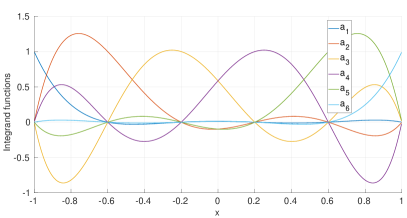
- CECM는 단변수 및 다변수 라그랑주 다항식에 대해 이론적으로 최적의 가우스 쿠바처 규칙을 성공적으로 복원하여, 이론적 최적성 달성을 입증한다.
- 3차원 지수삼각함수 함수에 대해 CECM는 표준 가우스 구분법보다 훨씬 적은 수의 점으로도 높은 정확도의 적분을 달성하여, 임의의 함수에 대한 강건성을 확인한다.
- 다스케일 유한요소 모델에서 CECM는 전체 가우스 구분법 대비 적분 점의 수를 90% 이상 감소시켜 상당한 계산 속도 향상을 이룬다.
- 16GB 크기의 행렬에 대해 SRSVD는 표준 SVD보다 약 7배 빠른 속도를 기록했으며, 표준 SVD가 메모리 제한으로 실패한 33GB 행렬도 성공적으로 처리했다.
- SRSVD는 열의 수에 따라 약 선형 스케일링을 보이며 대규모 문제에 대한 효율성을 확인했고, 표준 SVD와 비교해 특이값의 상대적 차이가 극히 미미했다.
- SRSVD의 반복 수는 행렬 분할 수가 증가함에 따라 1로 수렴하였으며, 이는 각 블록의 랭크가 다음 블록의 직교 보완의 랭크에 대한 신뢰할 수 있는 상한선를 제공한다는 것을 시사한다.
더 나은 연구,지금 바로 시작하세요
논문 읽기부터 검토까지, 연구 시간을 획기적으로 줄여보세요.
카드 등록 없음 · 무료 플랜 제공
이 리뷰는 AI가 만들고, 인간 에디터가 검토했습니다.