
[논문 리뷰] CHGNet: Pretrained universal neural network potential for charge-informed atomistic modeling
CHGNet은 Materials Project Trajectory Dataset에서 사전 학습된 그래프 신경망 원자 간 포텐셜로 자성 모멘트를 원자 전하의 대리로 포함하여 이종, 전하 가변 시스템의 전하 정보가 반영된 MD 및 상 다이어그램 계산을 가능하게 한다.
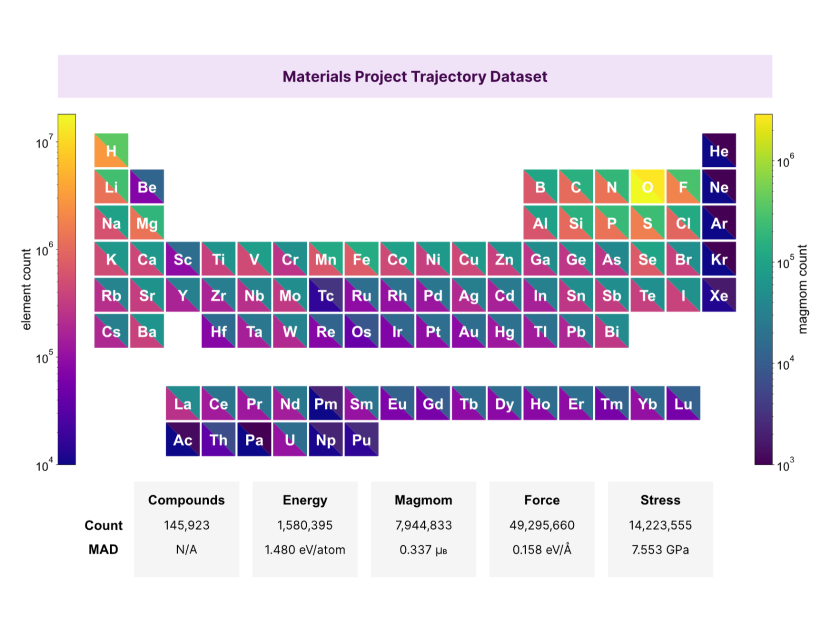
The simulation of large-scale systems with complex electron interactions remains one of the greatest challenges for the atomistic modeling of materials. Although classical force fields often fail to describe the coupling between electronic states and ionic rearrangements, the more accurate extit{ab-initio} molecular dynamics suffers from computational complexity that prevents long-time and large-scale simulations, which are essential to study many technologically relevant phenomena, such as reactions, ion migrations, phase transformations, and degradation. In this work, we present the Crystal Hamiltonian Graph neural Network (CHGNet) as a novel machine-learning interatomic potential (MLIP), using a graph-neural-network-based force field to model a universal potential energy surface. CHGNet is pretrained on the energies, forces, stresses, and magnetic moments from the Materials Project Trajectory Dataset, which consists of over 10 years of density functional theory static and relaxation trajectories of $\sim 1.5$ million inorganic structures. The explicit inclusion of magnetic moments enables CHGNet to learn and accurately represent the orbital occupancy of electrons, enhancing its capability to describe both atomic and electronic degrees of freedom. We demonstrate several applications of CHGNet in solid-state materials, including charge-informed molecular dynamics in Li$_x$MnO$_2$, the finite temperature phase diagram for Li$_x$FePO$_4$ and Li diffusion in garnet conductors. We critically analyze the significance of including charge information for capturing appropriate chemistry, and we provide new insights into ionic systems with additional electronic degrees of freedom that can not be observed by previous MLIPs.
연구 동기 및 목표
- 이온 및 전자 자유도 모두를 포착하는 정확하고 대규모 원자 수준 모델링의 필요성을 제고한다.
- 잠재 공간을 정규화하기 위해 자성 모멘트를 통해 전하 정보를 통합하는 보편 MLIP를 개발한다.
- CHGNet을 통해 전하 전달 현상, 상 다이어그램, 고체 상태 물질의 이온 확산을 시연한다.
- 전하 정보를 포텐셜에 명시적으로 포함시키는 것이 현실적인 화학 및 상 거동 포착에 미치는 영향을 평가한다.
제안 방법
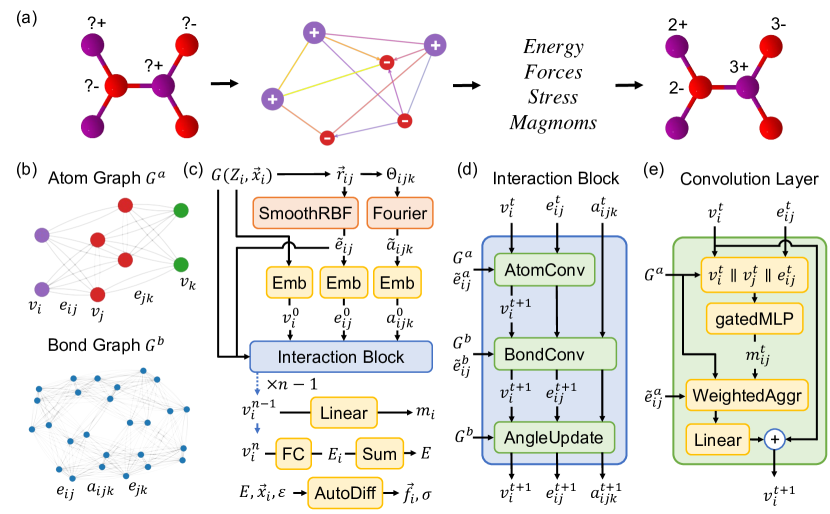
- 결정 구조를 원자 그래프로 처리하는 그래프 신경망(GNN) 아키텍처를 사용하여 원자, 결합, 각도 특성을 다룬다.
- Materials Project Trajectory Dataset(MPtrj)에서 에너지, 힘, 응력, 자성 모멘트로 CHGNet을 사전 학습하여 보편 포텐셜 에너지 면을 학습한다.
- 잠재 공간을 규제하고 에너지/힘 예측을 제약하기 위해 자성 모멘트를 전하 상태 제약으로 도입한다.
- 롱-레인지 상호작용을 위한 SmoothRBF 및 Fourier 기저 확장을 사용하여 쌍거리(r_ij)와 각도(theta_ijk)을 통해 입력 특징을 구성한다.
- 상호 작용 블록 기반 메세지 전달 체계를 활용하여 원자, 결합, 각도 특성을 업데이트하고 전하 정보를 반영한 출력(에너지, 힘, 응력, magmoms)을 산출한다.
- CHGNet을 MD 시뮬레이션과 고처리량 안정성 벤치마크에서 검증하고 DFT/AIMD 참조와 비교한다.
실험 결과
연구 질문
- RQ1자성 모멘트를 이용해 사전 학습된 GNN 기반 MLIP가 원자 전하 상태를 추론하고 전하 전달 현상에 대한 정확도를 높일 수 있는가?
- RQ2magmoms를 통한 전하 정보 포함이 이종 이온 시스템에서 신뢰 가능한 전하 정보 반영 MD, 상 다이어그램 계산, 확산 예측을 가능하게 하는가?
- RQ3CHGNet은 분포 밖 재료 안정성 작업 및 DFT/AIMD 파생 특성 재현에서 어떤 성능을 보이는가?
- RQ4잠재력에 전하 정보를 명시적으로 도입할 때 전자 자유도를 갖는 이온 시스템에 대한 고유의 통찰이 무엇인가?
- RQ5magmoms를 통한 잠재 공간 정규화가 원자가 상태 의존 화학 성질 포착에 결정적인가?
주요 결과
- CHGNet은 magmoms를 사용해 학습한 경우(MPtrj 테스트 세트에서 예: 에너지 30 meV/원자 vs magmoms 없이 33 meV/원자) MAE가 동등하거나 더 나은 성능을 달성한다.
- 모델은 8개 경쟁 모델 중 Inorganic Crystal Discovery의 Matbench Discovery에서 최첨단 성능의 안정적 무기 화합물 발견을 달성한다.
- CHGNet을 사용한 MD 시뮬레이션은 Li-초이온성 도체의 실온 전도도와 활성에너지를 AIMD 오차 바 내에서 재현하고 더 빠른 도체와 느린 도체를 구분한다.
- magmoms를 통한 전하 제약은 CHGNet이 Li_xFePO4의 Fe2+/Fe3+ 및 Na4V2(PO4)3의 V3+/V4+와 같은 원자가 상태를 구분하고, magmoms와 연관된 잠재 공간 클러스터링을 드러낸다.
- CHGNet은 LiMnO2에서의 전하 비대칭화로 인한 상 변환을 포착하고 구조적 변화(XRD)와 전자 상태 변화 간의 상관성을 보이며 DFT magmoms와의 일치를 보인다.
- Li_xFePO4 상 다이어그램에서 전자 엔트로피를 전하 장식으로 포함시키면 경험적 상 거동과 질적으로 일치하는 반면, 비전하 장식 모델과는 차이를 보인다.
더 나은 연구,지금 바로 시작하세요
논문 읽기부터 검토까지, 연구 시간을 획기적으로 줄여보세요.
카드 등록 없음 · 무료 플랜 제공
이 리뷰는 AI가 만들고, 인간 에디터가 검토했습니다.