
[논문 리뷰] Classical benchmarking of zero noise extrapolation beyond the exactly-verifiable regime
이 논문은 제로 노이즈 외삽(ZNE)을 Kick된 Ising 회로의 다양한 고전 시뮬레이션과 벤치마킹하며 ZNE가 검증 가능한 영역을 넘어 여전히 정확하며 여러 고전 방법을 비교한다.
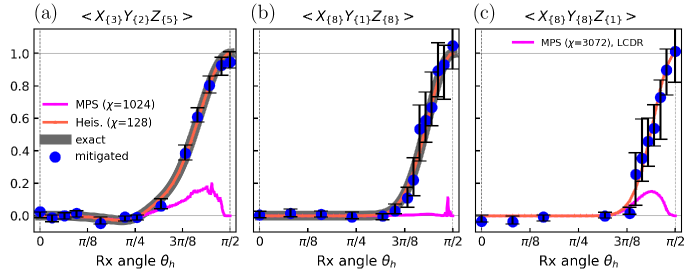
In a recent work a quantum error mitigation protocol was applied to the expectation values obtained from circuits on the IBM Eagle quantum processor with up $127$ - qubits with up to $60 \; - \; \mbox{CNOT}$ layers. To benchmark the efficacy of this quantum protocol a physically motivated quantum circuit family was considered that allowed access to exact solutions in different regimes. The family interpolated between Clifford circuits and was additionally evaluated at low depth where exact validation is practical. It was observed that for highly entangling parameter regimes the circuits are beyond the validation of matrix product state and isometric tensor network state approximation methods. Here we compare the experimental results to matrix product operator simulations of the Heisenberg evolution, find they provide a closer approximation than these pure-state methods by exploiting the closeness to Clifford circuits and limited operator growth. Recently other approximation methods have been used to simulate the full circuit up to its largest extent. We observe a discrepancy of up to $20\%$ among the different classical approaches so far, an uncertainty comparable to the bootstrapped error bars of the experiment. Based on the different approximation schemes we propose modifications to the original circuit family that challenge the particular classical methods discussed here.
연구 동기 및 목표
- 양자 오차 완화(QEM) 기법인 제로 노이즈 외삽(ZNE)과 같이 회로가 정확한 고전 검증 영역을 초과하는 경우를 평가하는 동기를 부여한다.
- 실험상의 ZNE 결과를 히젠베르크 진화 또는 상태 역학을 근사하는 다양한 고전 시뮬레이션 방법과 비교한다.
- 검증 가능 영역은 물론 그 이후의 영역에서도 ZNE 보정 관측값을 가장 잘 재현하는 고전적 접근법을 평가한다.
- 고전 방법의 한계와 제한을 밝히고, 고전 방법을 도전시키는 회로 변형 및 모델링 확장을 제안한다.
제안 방법
- 관측값의 히젠베르크 진화를 MPO(매트릭스-프로덕트 연산자) 표현으로 근사하여 O(D) = (U†)D O U^D 동역학을 시뮬레이션한다.
- 2D heavy-hex 격자를 1D 체인으로 스네이크 순서를 사용해 매핑하고 계층 사이에서 가변적인 MPO 압축을 통해 간헐적으로 단위ary 컨주게이션을 수행한다.
- 고정 결합 차원 χ를 사용해 절단 오차를 제어하고 주어진 초기 곱 상태에 대해 D 스텝 후 기댓값을 계산한다.
- MPO-히젠베르크 결과를 정확한 계산, 순수 상태 MPS 역학, 등거리 텐서 네트워크(isoTNS), BP-TNS, CPT, 더 작은 디바이스 시뮬레이션과 비교한다.
- OEE(연산자 엔트로피) 및 OTOC를 통해 연산자 성장과 MPO 효율성 및 라이트콘(빛의 경계) 확산을 이해한다.
![Figure 1: Comparison of classical approximations for $\langle Z_{62}\rangle$ at Trotter depth $D=20$ against experimental ZNE results: (1) matrix-product-state (MPS) representation of the pure state within a lightcone-reduced volume [ 3 ] ; (2) extrapolation of the MPS results with respect to the es](https://ar5iv.labs.arxiv.org/html/2306.17839/assets/x1.png)
실험 결과
연구 질문
- RQ1ZNE가 고전적 검증이 가능한 영역에서 정확한 결과를 얼마나 잘 재현하는가?
- RQ2대체 고전 방법들(MPS, MPO, BP-TNS, CPT)은 검증 가능한 영역 너머에서도 정확히 확장되는가, 그리고 ZNE와의 비교는 어떠한가?
- RQ3heavy-hex 격자에서 큰 깊이, 높은 얽힘 회로에 대한 MPO 기반 히젠베르크 진화의 한계와 확장성은 어떻게 되는가?
- RQ4비 Clifford 게이트, 비교적 비대칭 게이트 계층과 같은 회로 변형이 ZNE와 고전 시뮬레이션의 성능 및 비교에 어떤 영향을 미치는가?
- RQ5연산자 기반의 고전 시뮬레이션이 현장형(near-term) 디바이스에서 ZNE 결과를 예측하는 신뢰할 수 있는 벤치마크나 개선책을 제시할 수 있는가?
주요 결과
- ZNE는 고전적 방법으로 검증 가능한 영역에서 부트스트랩 오차 바 안에서 정확한 결과를 재현한다.
- MPS 및 2D isoTNS 순수상태 방법은 파라미터의 전 범위에 걸쳐 관측치를 재현하는 데 어려움을 겪으며, 특히 Clifford 포인트에서 멀어질수록 그렇다.
- 히젠베르크 MPO 진동은 정확한 검증의 범위를 넘어서는 파라워 범위에서 ZNE 결과와 일치하며, 최대 20 스텝의 트로터 단계까지 일치한다(60 CNOT 레이어).
- 다른 고전적 접근법은 특정 영역 근처에서 약 20% 내에서 일치하는 경향이 있으며, 이는 ZNE 오차 바와 비교 가능한 확산으로 남은 고전적 불확실성을 시사한다.
- 연산자 성장 속도는 최악의 경우 기대보다 느리며, OEE가 깊이에서 이차적으로 증가하고 OTOC가 라이트콘 한계 내 확산을 나타내어 MPO 효율성을 돕는다; BP-TNS는 큰 깊이와 루프 모양의 얽힘에서 한계를 보인다.
더 나은 연구,지금 바로 시작하세요
논문 읽기부터 검토까지, 연구 시간을 획기적으로 줄여보세요.
카드 등록 없음 · 무료 플랜 제공
이 리뷰는 AI가 만들고, 인간 에디터가 검토했습니다.