
[논문 리뷰] Cloud Atlas: Navigating the Multiphase Landscape of Tempestuous Galactic Winds
이 논문은 군집된 초신성에 의해 유도되는 은하풍에 대한 3차원 자기유체역학적 시뮬레이션을 제시하며, 난류 방사 혼합층 이론이 다상태 유동에서 냉각 구름의 형성, 형태, 성장을 성공적으로 모델링할 수 있음을 보여준다. 주요 결과로는 구름 크기 분포가 멱법칙을 따른다(dN/dm ∝ −2) 하고, 난류 압력이 중요한 지지력을 제공함으로써 실제 자기장이 있는 난류 유동에서 관측된 구름의 생존 및 성장 속도와 일치한다.
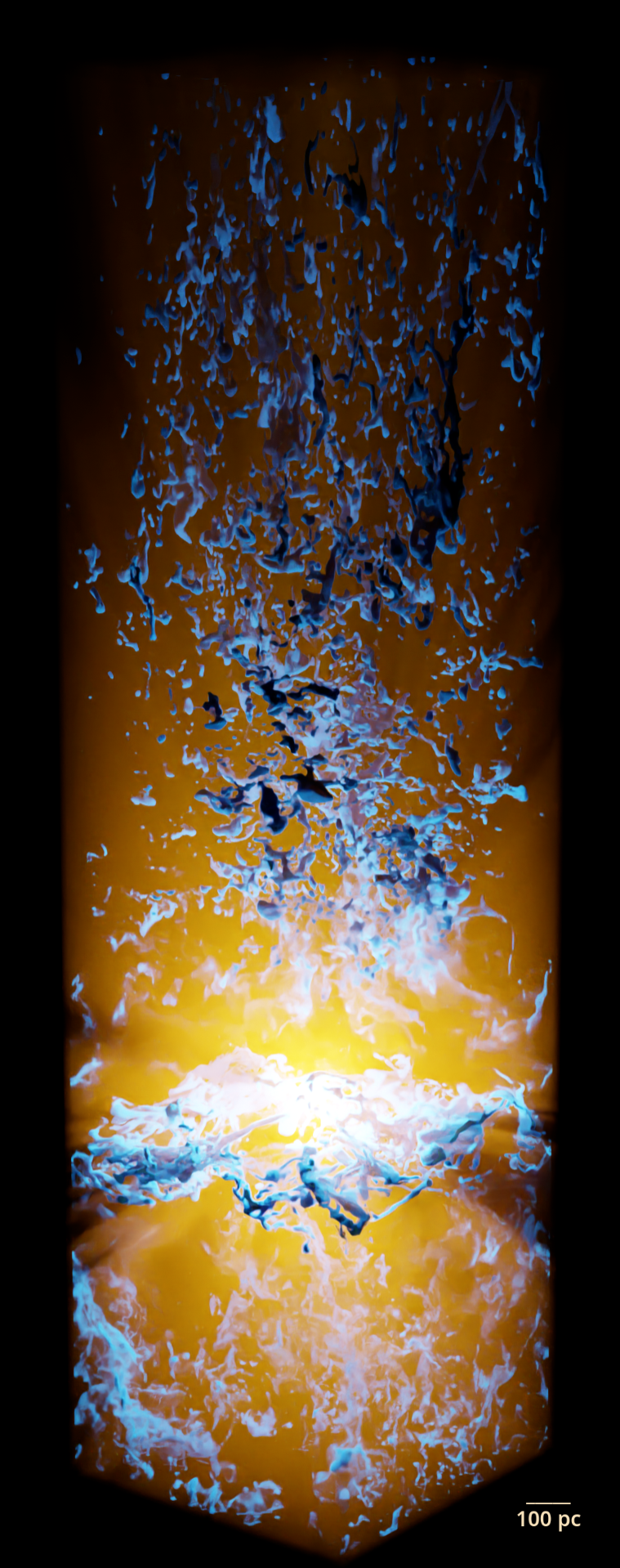
Galaxies comprise intricate networks of interdependent processes which together govern their evolution. Central among these are the multiplicity of feedback channels, which remain incompletely understood. One outstanding problem is the understanding and modeling of the multiphase nature of galactic winds, which play a crucial role in galaxy formation and evolution. We present the results of three dimensional magnetohydrodynamical tall box interstellar medium patch simulations with clustered supernova driven outflows. Fragmentation of the interstellar medium during superbubble breakout seeds the resulting hot outflow with a population of cool clouds. We focus on analyzing and modeling the origin and properties of these clouds. Their presence induces large scale turbulence, which in turn leads to complex cloud morphologies. Cloud sizes are well described by a power law distribution and mass growth rates can be modelled using turbulent radiative mixing layer theory. Turbulence provides significant pressure support in the clouds, while magnetic fields only play a minor role. We conclude that many of the physical insights and analytic scalings derived from idealized small scale simulations translate well to larger scale, more realistic turbulent magnetized winds, thus paving a path towards their necessary yet challenging inclusion in global-scale galaxy models.
연구 동기 및 목표
- 군집된 초신성에 의해 유도되는 난류적이고 자기장이 있는 은하풍에서 냉각되고 다상태인 구름의 기원과 진화를 이해하기 위해.
- 이dealized 소규모 난류 혼합층 시뮬레이션에서 유도된 분석적 척도가 대규모이고 현실적인 은하풍 환경에 적용 가능한지 여부를 규명하기 위해.
- 은하 및 천체역학적 시뮬레이션에서 해결되지 않은 냉각 구름을 위한 물리 기반의 미세구조 모델을 개발하기 위해.
- 난류, 자기장, 기울기의 역할이 구름의 생존, 형태, 질량 증가에 어떻게 기여하는지 정량화하기 위해.
제안 방법
- 군집된 초신성 피드백이 작용하는 높은 상자 형태의 은하간성매질(ISM) 영역에 대한 3차원 자기유체역학(MHD) 시뮬레이션을 수행하였다.
- 주로 뜨거운 유출 유동에 냉각 구름을 조기 형성시키는 초저속버블의 붕괴 과정에서 발생하는 ISM의 역학적 분열을 추적하였다.
- 표면적 대 부피 비율(A_cl ∝ V^{5/6})과 유입 속도(v_in)를 사용하여 난류 방사 혼합층 이론을 적용해 구름 질량 증가율을 모델링하였다.
- 관측된 시뮬레이션 출력의 통계적 분석과 r_crit,shear와 같은 이론적 기준과의 비교를 통해 구름의 형태, 크기 분포, 생존 능력을 정량화하였다.
- 난류의 역할을 평가하기 위해 구름과 뜨거운 바람 내에서 난류 마하 수를 측정하고 비열역학적 압력 지지력을 평가하였다.
- 데이터 분석 및 시각화에 yt, matplotlib, numpy를 사용하였고, 구름 구조의 3차원 렌더링에는 Blender를 사용하였다.
실험 결과
연구 질문
- RQ1군집된 초신성에 의해 유도되는 난류적이고 자기장이 있는 은하풍에서 냉각 구름은 어떻게 형성되고 진화하는가?
- RQ2이dealized 혼합층 모델에서 유도된 분석적 척도가 대규모이고 현실적인 다상태 유출에 얼마나 적용 가능한가?
- RQ3난류적 은하풍에서 냉각 구름의 크기 분포와 생존 능력은 무엇에 의해 결정되는가?
- RQ4난류, 자기장, 기울기는 어떻게 구름의 형태 복잡성과 질량 증가에 기여하는가?
- RQ5냉각 구름이 중력 및 램 압력에 대비해 지지되는 데 있어 열압력 대비 난류 압력의 상대적 중요도는 무엇인가?
주요 결과
- 냉각 구름은 초저속버블 붕괴 기간 동안 ISM의 역학적 분열을 통해 형성되며, 이 과정에서 뜨거운 유출 유동에 다상태 구조의 집단을 조기 형성시킨다.
- 구름 크기 분포는 dN/dm ∝ −2의 멱법칙을 따르며, 자기장 유무에 관계없이 일관되며, 구름 생존 반경과 디스크 스케일 높이가 물리적 절단점으로서 일치한다.
- 구름 내부의 난류 마하 수는 약 1로, 초기 ISM의 β ∼ 1임을 감안할 때 난류 압력이 열역학적 압력과 유사한 지지를 제공함을 시사한다.
- 구름 생존은 t_cool,mix < t_shear 조건에 의해 지배되며, 임계 반경 r_crit,shear는 관측된 생존 임계값과 일치한다.
- 질량 증가율은 난류 방사 혼합층 이론에 의해 잘 예측되며, 모델 예측 척도와 추정된 ṁ이 시뮬레이션 결과와 일치한다.
- 유입 이후, 난류는 기울기보다 냉각 또는 냉각 유도 펄서레이션에 의해 유지되며, KHI는 혼합의 주요 원동력이 아니다.
더 나은 연구,지금 바로 시작하세요
논문 읽기부터 검토까지, 연구 시간을 획기적으로 줄여보세요.
카드 등록 없음 · 무료 플랜 제공
이 리뷰는 AI가 만들고, 인간 에디터가 검토했습니다.