
[논문 리뷰] CO2 storage in deep saline aquifers: evaluation of geomechanical risks using integrated modeling workflow
이 논문은 MUFITS와 FLAC3D를 결합하여 심층 염수대에 주입되는 CO2 과정에서 지질역학적 위험(단층 활성화, 침투성 변화 및 잠재적 CO2 누출)을 평가하기 위해 순차적으로 결합된 수리지오메카니컬 모델링 워크플로우를 개발한다.
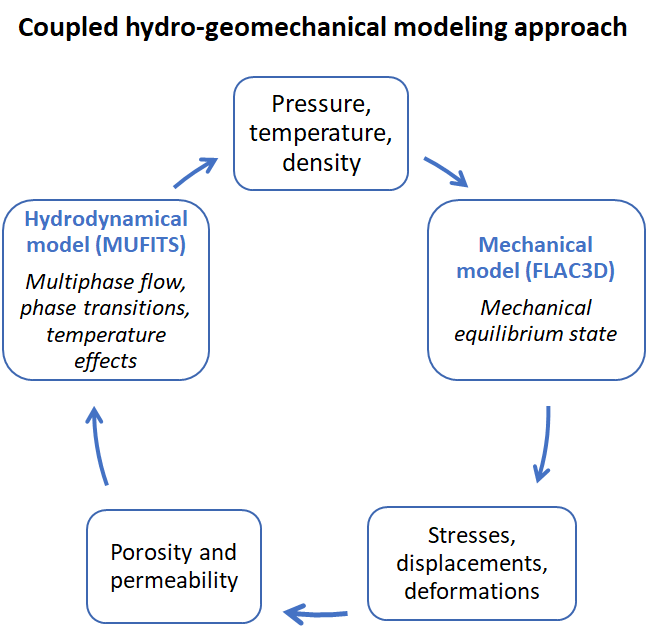
CO2 injection into a saline aquifer crossed by a tectonic fault is studied with coupled fluid mechanics - geomechanics modeling. The simulation approach is based on coupling of the MUFITS reservoir simulator and the FLAC3D mechanical simulator via an in-house API (i.e., an algorithm for data transfer between simulators). MUFITS simulates the non-isothermal multiphase flow of CO2 and brine in rock formation accounting for phase transitions and thermal effects. The modeling workflow is sequential, so that hydrodynamical simulations are carried out at a certain time interval, after which pressure, temperature, and density distributions are passed to FLAC3D, which calculates the equilibrium mechanical state. Computed deformations and stresses are utilized to update the porosity and permeability fields for the subsequent hydrodynamic modeling. In particular, we focus on the tectonic fault and its behavior during CO2 injection. We distinguish the damage zone and core inside the fault and derive the closure relations for their permeability alteration analytically. The coupled approach developed here is applied to simulate CO2 injection into synthetic and realistic reservoir models. For the former one, we study the effect of formation depth and presence of the tectonic stresses at the initial mechanical state, while for the latter, we consider different injection modes (bottomhole pressure). In each numerical experiment, we describe the evolution of the fault permeability due to the slip along its plane and the development of plastic deformations leading to the loss of reservoir integrity and CO2 leakage. Sensitivity analysis of the coupled model to realistic values of input parameters to assess the fault stability is carried out.
연구 동기 및 목표
- 깊은 염수대에 CO2 저장 중 지질역학적 위험을 동기 부여하고 다루는 것.
- 유체 흐름과 역학을 통합한 순차적으로 결합된 수리지오메카니컬 모델링 워크플로우를 개발한다.
- CO2 주입 하에서 지각단층대의 투과도 진화를 특성화한다.
- 합성 및 현실적 저수지를 통해 단층 활성화, 소성 변형 및 CO2 누출 시나리오를 평가한다.
제안 방법
- 비등온, 다상 CO2–염수 흐름을 위한 MUFITS와 기계적 평형을 위한 FLAC3D를 이용한 수리지오메카니컬 모델링의 결합.
- 사내 API를 통한 MUFITS와 FLAC3D 간 데이터 전송으로 순차 결합.
- 총 체적 변형과 거듭제곱 법칙(permeability relation)에 의해 다공성 및 침투율 업데이트가 계산된다.
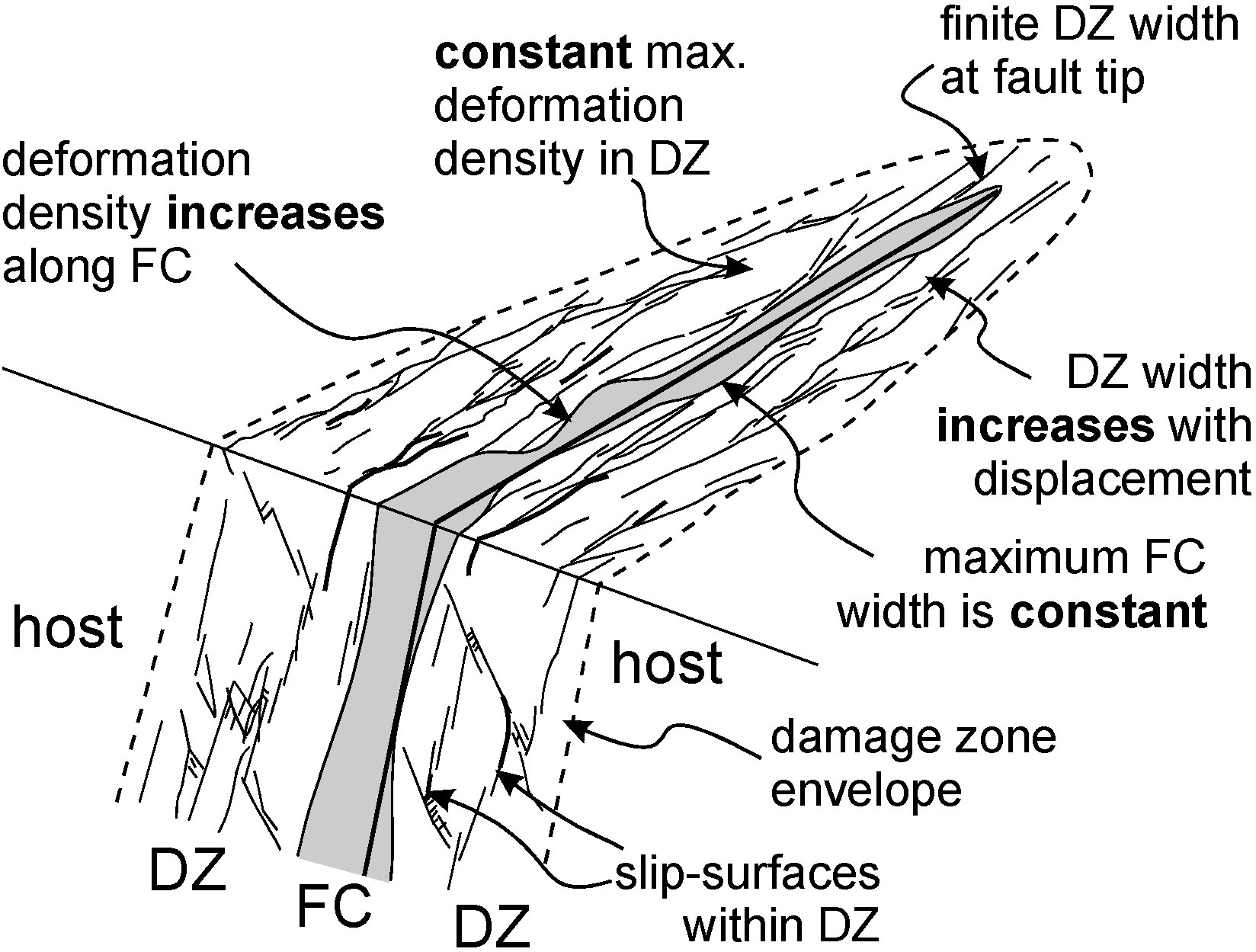
- 단층 손상대와 단층 핵에서의 침투도 진화를 위한 해석적 닫힘 관계가 도출된다.
- 단층대 침투도 변화에 대한 해석적 모델이 워크플로우에 내재화되어 있다.
- 단층 안정성에 영향을 주는 매개변수 값을 탐색하기 위한 민감도 분석이 수행된다.
실험 결과
연구 질문
- RQ1깊은 염수대에 CO2 주입이 저수지를 교차하는 지질학적 단층의 기계적 상태에 어떤 영향을 미치는가?
- RQ2공극압력과 온도 변화가 탄성 및 소성 변형을 통해 단층 침투성에 어떤 변화를 일으키는가?
- RQ3주입 모드와 저수지 구성의 어떤 영역이 단층 미끄럼, 손상대 침투도 변화, 또는 CO2 누출 경로로 이어지는가?
- RQ4주입 중 단층대의 다공성 및 침투도 진화를 예측할 수 있는 통합 수리지오메카니컬 모델이 있는가?
주요 결과
- 결합된 MUFITS–FLAC3D 워크플로우는 압력, 온도, 밀도 분포 및 이들이 다공성 및 침투도에 미치는 영향을 시뮬레이션할 수 있다.
- 단층대는 단층면을 따라 미끄럼과 소성 변형으로 인해 침투도가 진화하여 누출 도관을 생성할 가능성이 있다.
- 손상대 및 단층 핵에서의 침투도 변화를 정량화하기 위해 침투도 변화의 해석적 설명이 워크플로우에 통합되어 있다.
- 민감도 분석은 입력 매개변수가 단층 안정성 및 CO2 누출 위험에 어떤 영향을 미치는지 보여준다.
- 본 연구는 합성 저수지 모델과 현실적 저수지 모델 모두를 평가하여 서로 다른 주입 모드가 지질역학적 위험에 어떤 영향을 미치는지 설명한다.
더 나은 연구,지금 바로 시작하세요
논문 읽기부터 검토까지, 연구 시간을 획기적으로 줄여보세요.
카드 등록 없음 · 무료 플랜 제공
이 리뷰는 AI가 만들고, 인간 에디터가 검토했습니다.