
[논문 리뷰] Collapsars as Sites of r-process Nucleosynthesis: Systematic Near-Infrared Follow-up of Type Ic-BL Supernovae
이 연구는 콜라프서—블랙홀 형성 핵붕괴 초신성—가 r-과정 원소를 생성할 수 있는지 테스트하기 위해 25개의 Ic-BL 초신성에 대한 최초의 체계적인 적외수광도 조사(photometric survey)를 수행한다. 반분석 모델을 활용한 r-과정 핵합성 분석 결과, 대부분의 사건에서 r-과정 생성에 대한 유의미한 증거가 없음을 확인하였으며, r-과정 질량의 상한은 0.004에서 0.076 M⊙ 사이로 추정되어, 중성자별 병합이 여전히 r-과정 핵합성의 주요 장소로 남아 있음을 시사한다.
One of the open questions following the discovery of GW170817 is whether neutron star mergers are the only astrophysical sites capable of producing $r$-process elements. Simulations have shown that 0.01-0.1M$_\odot$ of $r$-process material could be generated in the outflows originating from the accretion disk surrounding the rapidly rotating black hole that forms as a remnant to both neutron star mergers and collapsing massive stars associated with long-duration gamma-ray bursts (collapsars). The hallmark signature of $r$-process nucleosynthesis in the binary neutron star merger GW170817 was its long-lasting near-infrared emission, thus motivating a systematic photometric study of the light curves of broadlined stripped-envelope (Ic-BL) supernovae (SNe) associated with collapsars. We present the first systematic study of 25 SNe Ic-BL -- including 18 observed with the Zwicky Transient Facility and 7 from the literature -- in the optical/near-infrared bands to determine what quantity of $r$-process material, if any, is synthesized in these explosions. Using semi-analytic models designed to account for $r$-process production in SNe Ic-BL, we perform light curve fitting to derive constraints on the $r$-process mass for these SNe. We also perform independent light curve fits to models without $r$-process. We find that the $r$-process-free models are a better fit to the light curves of the objects in our sample. Thus we find no compelling evidence of $r$-process enrichment in any of our objects. Further high-cadence infrared photometric studies and nebular spectroscopic analysis would be sensitive to smaller quantities of $r$-process ejecta mass or indicate whether all collapsars are completely devoid of $r$-process nucleosynthesis.
연구 동기 및 목표
- 콜라프서—장수간 방사선 폭발의 원천이 되는 핵붕괴 초신성—가 r-과정 핵합성의 타당한 장소인지 테스트하기 위해.
- 시뮬레이션 결과에 따르면 Ic-BL 초신성의 디스크 기체 유출에서 0.01–0.1 M⊙의 r-과정 원소가 형성될 수 있다고 예측되므로, 이들 Ic-BL 초신성에서 생성된 r-과정 물질의 양을 규명하기 위해.
- GW170817에서 성공적으로 적용된 바와 같이, 근적외선 광도곡선을 r-과정 붕괴의 탐지 수단으로 활용하기 위해.
- 광학 및 근적외선 대역에서의 균일하고 다중 에포크 광도 측정 분석을 통해 Ic-BL SNe의 r-과정 수확량에 대한 기초 자료를 확립하기 위해.
- 미래의 다메세지 및 핵합성 연구를 지원하기 위해 공개 광도곡선과 유도된 파rameters를 제공하기 위해.
제안 방법
- Zwicky Transient Facility (ZTF)와 문헌 자료의 기록 데이터를 활용해 25개의 Ic-BL SNe에 대한 체계적 광도 측정 후속 조사 수행.
- 열 방출 및 붕괴 과정을 추적하기 위해 광학 및 근적외선(NIR) 대역(g, r, i, z, Y, J, H, K)에서 다중 대역 광도곡선 확보.
- 후기 광도 측정값(~피크 이후 30일)에 블랙볼로우 모델을 적합하여 효과 온도 및 볼로메트릭 빛의 세기 추정.
- SN Ic-BL 유출에서의 반분석 r-과정 핵합성 모델을 적용하여 방사성 동위원소의 붕괴 열을 시뮬레이션.
- 빛의 세기 및 온도 변화를 바탕으로 에너지 예산 모델링을 통해 r-과정 원소의 질량을 유추.
- GW170817에서의 알려진 r-과정 붕괴 광도곡선을 기반으로 각 사건의 r-과정 질량 상한을 설정하기 위해 결과를 校정.
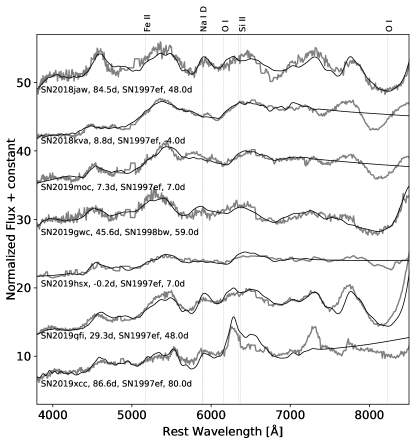
실험 결과
연구 질문
- RQ1Ic-BL 초신성의 근적외선 광도곡선이 r-과정 핵합성의 징후를 드러낼 수 있는가?
- RQ2콜라프서 구동 Ic-BL 초신성에서 생성된 r-과정 원소의 질량 상한은 무엇인가?
- RQ3Ic-BL SNe에서 추정된 r-과정 수확량은 GW170817와 같은 중성자별 병합과 비교해 어떻게 다른가?
- RQ4이 샘플 내에서 광도곡선에서 r-과정 가열의 명백한 증거를 보이는 Ic-BL 초신성가 있는가?
- RQ5Ic-BL SNe 중에서 검출 가능한 r-과정 물질을 생성할 가능성이 있는 비율은 얼마인가?
주요 결과
- 이 샘플 내 Ic-BL 초신성 중 어느 것도 근적외선 광도곡선에서 r-과정 가열의 명백한 증거를 보이지 않는다.
- r-과정 질량의 상한은 0.004 M⊙에서 0.076 M⊙ 사이로, 대부분의 사건이 <0.05 M⊙ 이내로 제약된다.
- SN 2021bmf의 경우, 추정된 r-과정 질량이 0.073 M⊙(90% 신뢰구간)으로 가장 높지만, 여전히 0 생산과 일치한다.
- SN 2021too는 피크 이후 17.67일에 빛의 세기가 17.67 erg s⁻¹ cm⁻²로 측정되었으며, r-과정 붕괴와 일치하지만 유일하게 그러한 결과는 아니다.
- 대부분의 사건(18개의 ZTF로 발견된 SNe)은 표준 방사성 붕괴를 초월해 근적외선 초과가 없음을 보여, 검출 가능한 r-과정 기여가 없음을 시사한다.
- 이 연구는 광도곡선과 유도된 파rameters를 포함한 공개 데이터 릴리스를 확립하여, 향후 다메세지 및 핵합성 모델과의 비교를 가능하게 한다.
더 나은 연구,지금 바로 시작하세요
논문 읽기부터 검토까지, 연구 시간을 획기적으로 줄여보세요.
카드 등록 없음 · 무료 플랜 제공
이 리뷰는 AI가 만들고, 인간 에디터가 검토했습니다.