
[논문 리뷰] Confirmation and refutation of very luminous galaxies in the early universe
JWST/NIRSpec 분광학은 두 개의 z>11 은하를 확인하고 z~16 후보를 z=4.9의 간섭체로 밝혀 고유의 광학적 고-z 후보에 대한 분광 검증의 필요성과 초기 우주 은하 형성에 대한 시사점을 부각한다.
During the first 500 million years of cosmic history, the first stars and galaxies formed, seeding the Universe with heavy elements and eventually reionizing the intergalactic medium. Observations with JWST have uncovered a surprisingly high abundance of candidates for early star-forming galaxies, with distances (redshifts, $z$), estimated from multi-band photometry, as large as $z\approx 16$, far beyond pre-JWST limits. While generally robust, such photometric redshifts can suffer from degeneracies and occasionally catastrophic errors. Spectroscopic measurement is required to validate these sources and to reliably quantify physical properties that can constrain galaxy formation models and cosmology. Here we present JWST spectroscopy that confirms redshifts for two very luminous galaxies with $z > 11$, but also demonstrates that another candidate with suggested $z\approx 16$ instead has $z = 4.9$, with an unusual combination of nebular line emission and dust reddening that mimics the colors expected for much more distant objects. These results reinforce evidence for the early, rapid formation of remarkably luminous galaxies, while also highlighting the necessity of spectroscopic verification. The large abundance of bright, early galaxies may indicate shortcomings in current galaxy formation models, or deviation from physical properties (such as the stellar initial mass function) that are generally believed to hold at later times.
연구 동기 및 목표
- JWST 분광학으로 광학적 고적대(z>11) 은하 후보를 검증한다.
- 제안된 초기 우주 소스의 분광적 적색편향을 측정하고 주요 발광선을 통해 확인하거나 반박한다.
- 확인된 z>11 은하의 물리적 특성을 추정하고 이들을 이론적 기대와 비교한다.
제안 방법
- 저해상도이면서 넓은 파장 범위(0.6–5.3 μm)를 갖는 JWST NIRSpec 프리즘 분광으로 연속체 붕괴 및 방출선을 탐지한다.
- Lyα 붕괴 및 [O II] 와 같은 방출선을 식별하여 적색편향을 결정한다.
- 광학 데이터 처리 및 분광 플럭스 보정은 NIRCam 광측정과 교차 검증한다.
- 스펙트럼과 광측정 데이터를 함께 이용해 별 집단 모델링을 수행하여 질량(M STAR), SFR, A_V, 그리고 sSFR를 도출한다.
- CEERS-93316 위치의 관련 먼지 방출 여부를 평가하기 위해 NOEMA 1.1 mm 관측을 사용하되 대상 위치에서의 검출은 없음.
- 관측 특성을 이전 문헌과 비교하여 초기 은하 형성 맥락에 배치한다.
실험 결과
연구 질문
- RQ1JWST 광학적 고-z 후보가 스펙트로스코픽 확인 후 실제 은하를 대표하는가?
- RQ2밝은 z>11 후보들(Maisie’s Galaxy, CEERS2_588, CEERS-93316)의 분광적 적색편향은 무엇이며 이것이 광학적 추정과 어떻게 비교되는가?
- RQ3확인된 z>11 은하의 물리적 특성(질량, SFR, 먼지 소멸)은 초기 은하 형성 모델에 어떤 정보를 제공하는가?
- RQ4z>9에서 극단적 대-band 광색이 낮은 적색의 더 먼 후보들로도 모사될 수 있는가? 분광학은 이를 어떻게 구분하는가?
- RQ5z>>10에서 밝은 은하의 보편성은 은하 형성 이론 및 IMF 가정에 어떤 시사점을 갖는가?
주요 결과
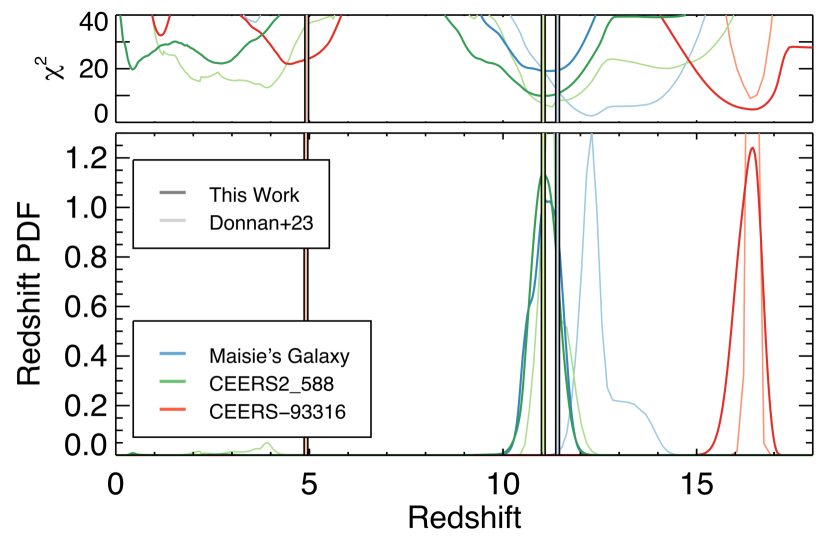
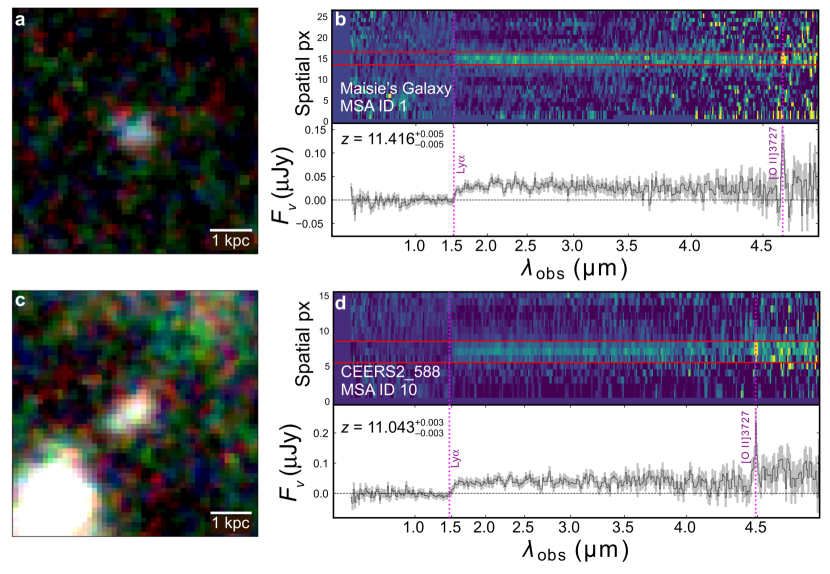
- 두 은하는 분광 적색편향이 각각 z=11.416±0.005 및 z=11.043±0.003으로 확인되었다(Maisie’s Galaxy 및 CEERS2_588).
- 세 번째 후보인 CEERS-93316은 z~16으로 추정되었으나 분광적으로 z=4.912±0.001이며 강한 성운선과 먼지 적색화가 더 높은-z 색상을 모방한다.
- Maisie’s Galaxy와 CEERS2_588는 z>11에서 알려진 가장 UV 광도가 높은 은하로, 각각 M_UV = −20.1 및 −20.3이며 두 은하 모두 Lyα 붕괴를 보이고 [O II]의 약한 검출이 나타난다.
- CEERS-93316은 z=4.912에서 강한 Hα, [NII], [O III] 선을 보이며 큰 Balmer 감소(Hα/Hβ=5.2±0.5)로 nebular 적색화를 나타낸다(E(B−V)=0.60±0.10).
- NOEMA 1.1 mm 관측에서 CEERS-93316 위치에서 1.1 mm 연속을 검출하지 못했으나, 이전의 서미터(서브밀리미터) 탐지를 유력하게 설명하는 가까운 z~4.9 은하를 제시한다.
- 확인된 z>11 은하에 대해 스펙트로스코픽 적색편향을 고정한 상태의 별 집단 모델링 결과, 질량(M_star)≈10^8.6–10^8.7 M_sun, A_V≈0.1–0.2 mag, SFR≈2–10 M_sun/yr, sSFR≈−8.3 to −7.7 yr^−1로, 다른 z>11 은하들과 일관된 값을 보인다.
더 나은 연구,지금 바로 시작하세요
논문 읽기부터 검토까지, 연구 시간을 획기적으로 줄여보세요.
카드 등록 없음 · 무료 플랜 제공
이 리뷰는 AI가 만들고, 인간 에디터가 검토했습니다.