
[논문 리뷰] Constraining cosmology with the Gaia-unWISE Quasar Catalog and CMB lensing: structure growth
이 연구는 Gaia–unWISE Quasar 카탈로그(Quaia)와 Planck CMB 렌즈 맵 간의 교차상관을 이용하여 우주론적 파라미터를 제약하며, σ₈ = 0.766 ± 0.034 및 Ωₘ = 0.343⁺⁰.⁰¹⁷₋₀.⁰¹⁹를 측정한다. 결과는 약 1.4σ 수준에서 Planck와 일치하며, 고적색도 quasar에 의해 약간 낮아진 σ₈가 관측되는데, 이는 CMB 렌즈 맵의 CIB 배경 오염으로 인한 것으로 가능성이 있다.
We study the angular clustering of Quaia, a Gaia- and unWISE-based catalog of over a million quasars with an exceptionally well-defined selection function. With it, we derive cosmology constraints from the amplitude and growth of structure across cosmic time. We divide the sample into two redshift bins, centered at $z=1.0$ and $z=2.1$, and measure both overdensity auto-correlations and cross-correlations with maps of the Cosmic Microwave Background convergence measured by Planck. From these data, and including a prior from measurements of the baryon acoustic oscillations scale, we place constraints on the amplitude of the matter power spectrum $σ_8=0.766\pm 0.034$, and on the matter density parameter $Ω_m=0.343^{+0.017}_{-0.019}$. These measurements are in reasonable agreement with \planck at the $\sim$ 1.4$σ$ level, and are found to be robust with respect to observational and theoretical uncertainties. We find that our slightly lower value of $σ_8$ is driven by the higher-redshift sample, which favours a low amplitude of matter fluctuations. We present plausible arguments showing that this could be driven by contamination of the CMB lensing map by high-redshift extragalactic foregrounds, which should also affect other cross-correlations with tracers of large-scale structure beyond $z\sim1.5$. Our constraints are competitive with those from state-of-the-art 3$ imes$2-point analyses, but arise from a range of scales and redshifts that is highly complementary to those covered by cosmic shear data and most galaxy clustering samples. This, coupled with the unprecedented combination of volume and redshift precision achieved by Quaia allows us to break the usual degeneracy between $Ω_m$ and $σ_8$.
연구 동기 및 목표
- Quaia 카탈로그의 quasar들 간의 각도 클러스터링을 이용하여 우주의 시간에 걸쳐 우주론적 파라미터를 제약하는 것.
- CMB 렌즈 맵과 quasar 간의 교차상관을 통한 우주론적 제약의 탄력성을 시험하는 것.
- 특히 CMB 렌즈 맵의 배경 오염이 고적색도 quasar 교차상관에 영향을 미치는 잠재적 시스템적 오차를 조사하는 것.
- 정밀한 적색도 보정과 큰 체적을 가진 고적색도 quasar 샘플을 통해 Ωₘ와 σ₈ 간의 디게너러시를 깨는 것.
제안 방법
- Quaia 카탈로그는 백만 개 이상의 quasar를 포함하며, 명확한 선택 함수를 지닌다. 이는 z = 1.0과 z = 2.1을 중심으로 한 두 개의 적색도 밴드로 나뉜다.
- 다양한 각도 스케일에서 과밀도 자가상관과 Planck CMB 렌즈 맵의 수렴도(κ)와의 교차상관이 측정된다.
- 바리온 음향 진동(BCAO) 스케일의 사전 정보를 포함한 공동 우도 분석을 통해 우주론적 제약이 유도된다.
- 관측된 데이터 기반의 노울 모델과 PR3 및 PR4 CMB 렌즈 복원 맵(MV, Pol, TT)을 사용한 몬테카를로 시뮬레이션을 통해 시스템적 편향을 시험한다.
- 다른 렌즈 복원 방법 간의 밴드파워 이동(예: MV 대 비대칭 Pol)은 χ² 검정을 통해 통계적 변동과의 일치성을 평가한다.
- 렌즈 정규화 보정을 고려하고, quasar 과밀도 맵의 제약된 가우시안 실현을 사용하여 신호 및 노이즈 성분을 모델링한다.
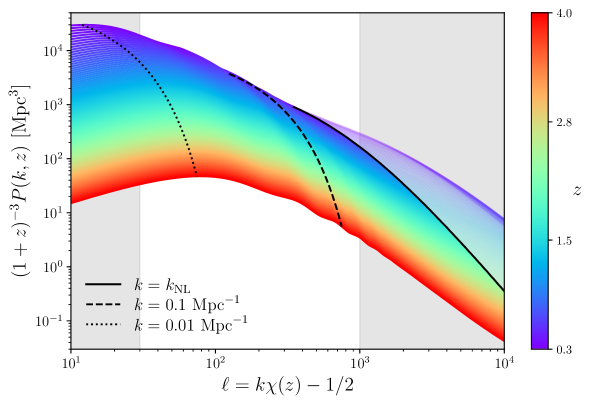
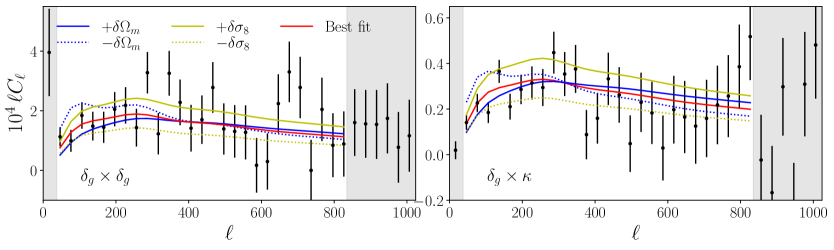
실험 결과
연구 질문
- RQ1고적색도 quasar와 CMB 렌즈 간의 교차상관은 σ₈와 Ωₘ에 대해 신뢰할 수 있는 제약을 제공하는가?
- RQ2유도된 σ₈ 값과 Planck의 값 간의 갈등은 CMB 렌즈 맵의 시스템적 오차로 인한 것인가?
- RQ3Quaia 카탈로그는 고적색도 정밀도와 큰 체적 덕분에 Ωₘ와 σ₈ 간의 디게너러시를 깰 수 있는가?
- RQ4은하간 배경 오염, 특히 우주 적외선 배경(CIB)이 z > 1.5에서 quasar–CMB 렌즈 교차상관에 어느 정도 영향을 미치는가?
- RQ5CMB 렌즈 복원 방법 간의 관측된 밴드파워 차이(MV 대 비대칭 Pol)는 통계적 변동과 일치하는가, 아니면 잔류 시스템적 오차의 징후인가?
주요 결과
- 분석 결과 σ₈ = 0.766 ± 0.034 및 Ωₘ = 0.343⁺⁰.⁰¹⁷₋₀.⁰¹⁹를 도출하였으며, 이는 약 1.4σ 수준에서 Planck 결과와 합리적인 일치를 보인다.
- 약간 낮아진 σ₈ 값은 주로 z ≈ 2.1에 위치한 고적색도 quasar 샘플에 의해 유도되며, 이는 물질 분포의 진폭이 낮다는 것을 지지한다.
- PR3 및 PR4 CMB 렌즈 맵을 사용한 일관성 테스트에서 전체 χ² 검정의 PTE는 6%로 나타나 약간의 갈등이 있지만 통계적 변동과의 불일치에 강력한 증거는 아니다.
- ℓ ≈ 100 및 ℓ ≈ 370의 영역에서는 PTE가 약 2%로 나타나 잠재적인 불일치가 있으며, 잔류 시스템적 오차의 징후일 수 있다.
- MV와 Pol 렌즈 복원 간의 관측된 밴드파워 이동은 통계적 변동과 일치하지만, CIB는 고적색도 quasar–CMB 렌즈 교차상관에 영향을 미치는 가장 가능성 높은 배경 오염원으로 규명된다.
- 결과는 관측적 및 이론적 불확실성에 대해 강건하며, Quaia 샘플은 3×2점 분석에서 우주선형 및 은하 클러스터링과 매우 보완적인 탐사 도구를 제공한다.
더 나은 연구,지금 바로 시작하세요
논문 읽기부터 검토까지, 연구 시간을 획기적으로 줄여보세요.
카드 등록 없음 · 무료 플랜 제공
이 리뷰는 AI가 만들고, 인간 에디터가 검토했습니다.