
[논문 리뷰] Constraints on the Faint End of the Galaxy Stellar Mass Function at z ~ 4-8 from Deep JWST Data
이 연구는 HUDF 및 UKIDSS UDS 영역의 깊은 JWST 데이터를 사용하여 $z \simeq 4$--$8$에서 $\sim10^8\,\mathrm{M_\odot}$까지의 고적색편이 은하에 대해 처음으로 신뢰할 수 있는 개별 항성 질량 추정치를 도출한다. 이는 $z \simeq 7$에서 $\alpha = -1.98 \pm 0.14$인 은하 항성 질량 함수의 기울어진 밝기 끝 부분 기울기와, 질량 및 적색편이에 따라 변화하는 오차 비대칭성을 고려한 새로운 에딩턴 편향 보정을 통해 $z \simeq 7$에서 $z \simeq 4$로의 밀도 130배 증가와 같은 정규화의 상당한 진화를 드러낸다.
We analyze a sample of 3300 galaxies between redshifts z~3.5 and z~8.5 selected from JWST images in the Hubble Ultra Deep Field (HUDF) and UKIDSS Ultra Deep Survey field, including objects with stellar masses as low as ~ 10^8 Msun up to z~8. The depth and wavelength coverage of the JWST data allow us, for the first time, to derive robust stellar masses for such high-z, low stellar-mass galaxies on an individual basis. We compute the galaxy stellar mass function (GSMF), after complementing our sample with ancillary data from CANDELS to constrain the GMSF at high stellar masses (M > M*). Our results show a steepening of the low stellar-mass end slope (a) with redshift, with a = -1.61 (+/-0.05) at z~4 and a = -1.98 (+/-0.14) at z~7. We also observe an evolution of the normalization phi* from z~7 to z~4, with phi*(z~4)/phi*(z~7)= 130 (+210/-50). Our study incorporates a novel method for the estimation of the Eddington bias that takes into account its possible dependence both on stellar mass and redshift, while allowing for skewness in the error distribution. We finally compute the resulting cosmic stellar mass density and find a flatter evolution with redshift than previous studies.
연구 동기 및 목표
- 저질량 은하에 대해 이전에 없던 깊이와 정확도로 고적색편이($z \simeq 4$--$8$)에서 은하 항성 질량 함수(GSMF)를 측정하기 위해.
- JWST의 깊은 중적외선 커버리지 덕분에 $z \simeq 8$에서 $\sim10^8\,\mathrm{M_\odot}$ 정도로 어두운 은하의 개별 항성 질량 추정치를 도출함으로써 이전 조사의 한계를 극복하기 위해.
- 항성 질량과 적색편이에 따라 변화하는 광학적 오차 분포의 비대칭성까지 고려한 새로운 에딩턴 편향 보정 방법을 개발하고 적용하기 위해.
- 은하 형성 모델에 대한 중요한 시험을 제공하기 위해, 우주 시간에 따라 GSMF의 어두운 끝 부분 기울기($\alpha$)와 정규화($\phi^*$)의 진화를 제약하기 위해.
- 이전 연구에서의 모순을 해결하기 위해 $z \simeq 4$에서 $z \simeq 8$로의 우주적 항성 질량 밀도 진화를 계산하기 위해.
제안 방법
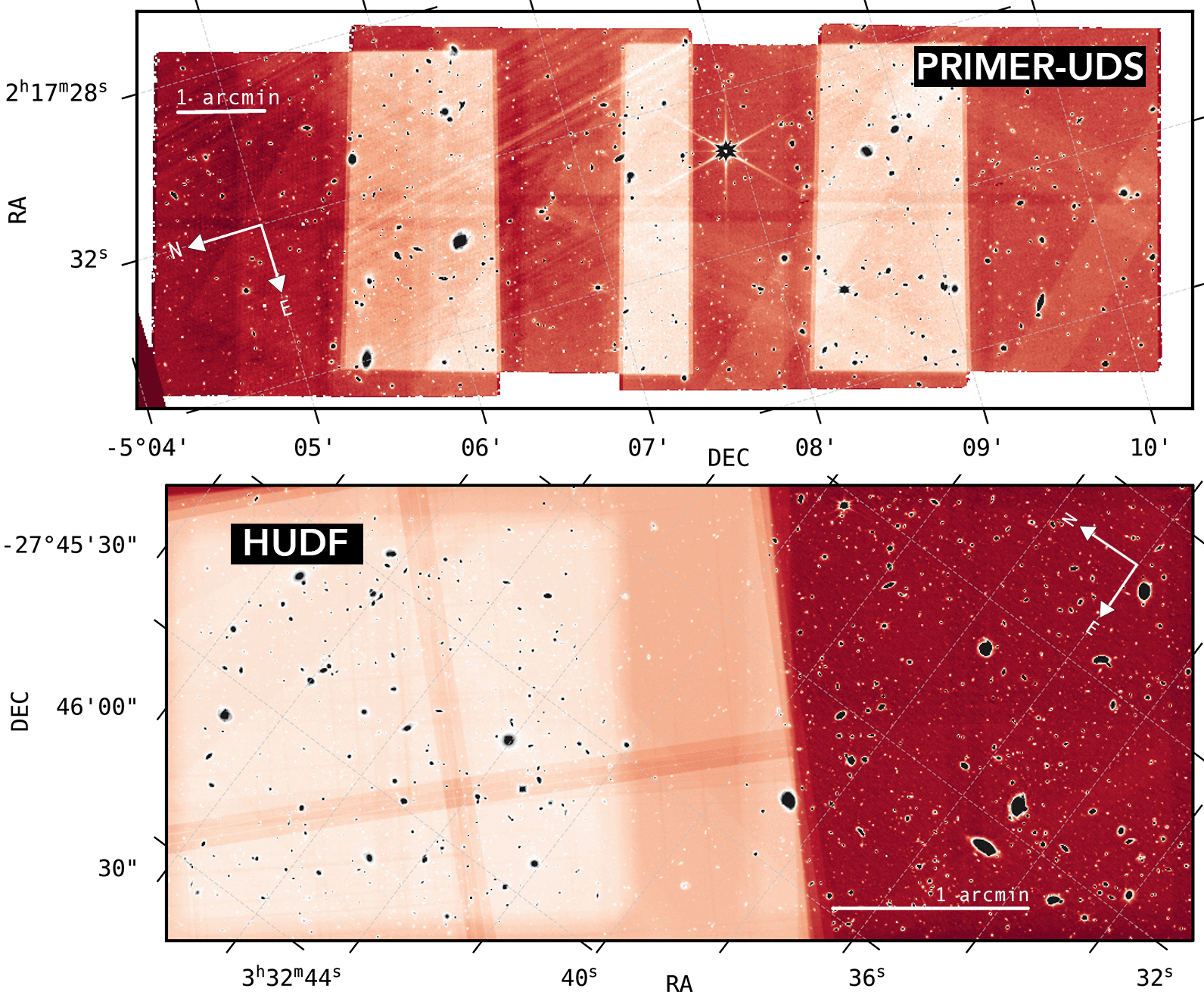
- 저자들은 HUDF 및 UKIDSS UDS 영역의 JWST 이미징 데이터에서 $3.5 \leq z \leq 8.5$ 범위와 $\sim10^8\,\mathrm{M_\odot}$까지의 항성 질량을 가진 3,300개의 은하 샘플을 분석한다.
- 항성 질량는 JWST가 제공하는 적외선에서 중적외선 파장까지의 광학 데이터를 포함한 SED 피팅을 통해 LePHARE를 사용하여 유도한다.
- 에딩턴 편향 보정을 위해 새로운 커널을 적용하며, 이 커널은 가우시안과 스트루던-티 분포의 곱으로 구성되어 있어 비대칭적이며 질량과 적색편이에 따라 변화하는 오차 분포를 허용한다.
- 이 커널은 무작위로 불확실성을 설정한 광학 데이터 30개의 실현을 통해 유도된 오차 분포에 적합되며, 질량과 적색편이에 따른 비대칭성과 산란의 진화를 포착한다.
- GSMF는 샤허레 함수로 모델링되며, 에딩턴 편향 보정 후 $\alpha$, $M^*$, $\phi^*$가 유도되며, 고질량 제약을 위해 CANDELS 데이터가 보완된다.
- 보정된 GSMF로부터 우주적 항성 질량 밀도가 계산되며, 이는 이전 연구와의 비교 및 적색편이 진화 평가에 기여한다.
실험 결과
연구 질문
- RQ1저조도편이 $z \simeq 4$--$8$에서 어두운 끝 부분의 은하 항성 질량 함수(GSMF) 형태는 어떻게 되며, 특히 $M \lesssim 10^8\,\mathrm{M_\odot}$인 은하의 경우 어떻게 되는가?
- RQ2GSMF의 어두운 끝 부분 기울기($\alpha$)는 $z \simeq 7$에서 $z \simeq 4$로의 진화가 어떻게 이루어지며, 이는 초기 은하 형성에 어떤 의미를 갖는가?
- RQ3GSMF의 정규화($\phi^*$)는 적색편이에 따라 어떻게 변화하며, 이는 우주적 항성 질량 밀도의 진화에 어떤 영향을 미치는가?
- RQ4광학적 불확실성과 그 비대칭성(비대칭성)은 관측된 GSMF에 어떤 영향을 미치며, 이를 어떻게 정확하게 보정할 수 있는가?
- RQ5질량과 적색편이에 따라 변화하는 오차 분포를 포함함으로써, 기존 방법에 비해 보다 정확한 에딩턴 편향 보정의 정확도는 어떻게 향상되는가?
주요 결과
- GSMF의 어두운 끝 부분 기울기는 적색편이가 증가함에 따라 상당히 기울어지며, $z \simeq 4$에서 $\alpha = -1.61 \pm 0.05$이고 $z \simeq 7$에서 $\alpha = -1.98 \pm 0.14$이다.
- 정규화 $\phi^*$는 $z \simeq 7$에서 $z \simeq 4$로의 변화에서 $130^{+210}_{-50}$ 배 증가하여, 초기 시기에 저질량 은하의 수 밀도가 급격히 증가했음을 시사한다.
- 이 연구에서 개발된 에딩턴 편향 보정 방법은 비대칭적이며 질량과 적색편이에 따라 변화하는 오차 분포를 고려하여, 기존의 대칭 근사보다 정확도가 향상된다.
- 항성 질량의 오차 분포는 특히 더 浅은 영역인 PRIMER-UDS에서는 낮은 질량 쪽으로 기울어져 있으며, 더 깊은 영역인 HUDF에서는 이 기울기 감소가 관찰된다.
- 이전 연구에서 보고된 것보다 우주적 항성 질량 밀도의 적색편이 진화가 더 약하게 나타나며, 적절한 편향 보정을 고려하지 않은 이전 연구보다 더 평탄한 진화를 시사한다.
- HUDF와 PRIMER-UDS 영역의 조합은 개별적으로 사용할 경우보다 더 비대칭성이 적은 오차 분포를 제공하며, 깊은 데이터 세트의 조합의 이점을 강조한다.
더 나은 연구,지금 바로 시작하세요
논문 읽기부터 검토까지, 연구 시간을 획기적으로 줄여보세요.
카드 등록 없음 · 무료 플랜 제공
이 리뷰는 AI가 만들고, 인간 에디터가 검토했습니다.