
[논문 리뷰] CORNN: Convex optimization of recurrent neural networks for rapid inference of neural dynamics
CORNN는 데이터 제약 조건이 있는 순환 신경망(dRNN)을 훈련하기 위한 볼록 최적화 프레임워크를 도입하여 기존의 BPTT나 FORCE와 같은 전통적 방법보다 약 100배 빠른 훈련 속도를 달성하면서도 높은 정확도를 유지한다. 표준 하드웨어를 사용해 수백만 개의 가중치를 가진 dRNN에서 분석 시간이 1분 이내로 가능하게 하여 대규모 기록 데이터에 대한 실시간 신경 동역학 모델링을 실현 가능하게 한다.
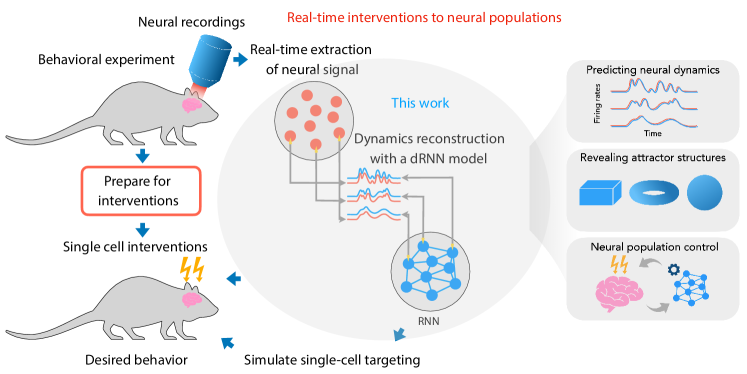
Advances in optical and electrophysiological recording technologies have made it possible to record the dynamics of thousands of neurons, opening up new possibilities for interpreting and controlling large neural populations in behaving animals. A promising way to extract computational principles from these large datasets is to train data-constrained recurrent neural networks (dRNNs). Performing this training in real-time could open doors for research techniques and medical applications to model and control interventions at single-cell resolution and drive desired forms of animal behavior. However, existing training algorithms for dRNNs are inefficient and have limited scalability, making it a challenge to analyze large neural recordings even in offline scenarios. To address these issues, we introduce a training method termed Convex Optimization of Recurrent Neural Networks (CORNN). In studies of simulated recordings, CORNN attained training speeds ~100-fold faster than traditional optimization approaches while maintaining or enhancing modeling accuracy. We further validated CORNN on simulations with thousands of cells that performed simple computations such as those of a 3-bit flip-flop or the execution of a timed response. Finally, we showed that CORNN can robustly reproduce network dynamics and underlying attractor structures despite mismatches between generator and inference models, severe subsampling of observed neurons, or mismatches in neural time-scales. Overall, by training dRNNs with millions of parameters in subminute processing times on a standard computer, CORNN constitutes a first step towards real-time network reproduction constrained on large-scale neural recordings and a powerful computational tool for advancing the understanding of neural computation.
연구 동기 및 목표
- 기존의 dRNN 훈련 알고리즘이 고성능 클러스터에서 수일에 걸쳐 계산이 필요한 비효율성과 낮은 확장성 문제를 해결하기 위해.
- 대규모 신경 기록 데이터에서 실시간으로, 즉각적으로 훈련 가능한 dRNN 훈련을 가능하게 하여 기록 세션 중 이론 기반 간섭을 지원하기 위해.
- 모델 불일치, 샘플링 부족, 시간 스케일 불일치 등에 대해 강건한 훈련 방법을 개발하기 위해.
- 실제 기록 데이터로부터 신경 집단의 동역학을 신속하고 확장 가능하며 정확하게 추론하기 위해.
- 대규모 신경 데이터셋에서 기계적 계산 원리를 추출하는 실용적인 계산 도구를 제공하기 위해.
제안 방법
- CORNN는 dRNN 훈련을 볼록 최적화 문제로 재정의하여 비볼록적인 RNN 훈련을 다루기 쉬운 전역 최적 해로 변환한다.
- 수렴 속도를 가속화하고 안정성을 향상시키기 위해 고정점 초기화 전략을 적용하여 하이퍼파rameter 조정에 대한 의존도를 감소시킨다.
- dRNN의 동역학과 관측된 신경 활동 간의 일치를 강제하는 볼록 목적 함수를 최소화하며, 최소 제곱 오차에 정규화를 적용한다.
- 내부점 방법 또는 액티브 세트 알고리즘을 사용해 효율적으로 최적화를 풀어 CPU 및 GPU에서 빠른 수렴을 가능하게 한다.
- 프레임워크는 최대 3000개의 뉴런까지 넓은 네트워크 훈련을 지원하며, 데이터셋 크기와 네트워크 크기에 따라 선형적, 다항식적으로 확장 가능하다.
- 정규화와 데이터 증강을 통해 노이즈 모델링 및 상관 노이즈와 시간 스케일 불일치에 대한 강건성을 확보한다.
실험 결과
연구 질문
- RQ1비볼록 방법인 BPTT나 FORCE와 비교해 볼록 최적화 프레임워크가 dRNN 훈련 속도를 크게 향상시킬 수 있는가?
- RQ2모델 불일치, 뉴런의 부분 샘플링, 시간 스케일 불일치 상황에서 CORNN이 정확도와 일반화 능력을 얼마나 유지하는가?
- RQ3CORNN는 대규모 신경 집단(예: 수천 개의 뉴런)에 대해 확장 가능하며, 표준 하드웨어에서 분석 시간이 1분 이내로 유지되는가?
- RQ4고정점 초기화가 랜덤 초기화에 비해 수렴 속도와 강건성에 어떤 영향을 미치는가?
- RQ5상관 노이즈나 데이터 접근성 제한과 같은 실제 실험 조건에서도 CORNN은 여전히 효과적인가?
주요 결과
- 모의 실험에서 CORNN는 기존의 BPTT 및 FORCE 방법보다 약 100배 더 빠른 훈련 속도를 기록했으며, 정확도는 유사하거나 향상된 상태였다.
- 다양한 조건에서 뛰어난 강건성을 보였으며, 뉴런의 50% 샘플링 및 시간 스케일 불일치 상황에서도 정확하게 동역학을 재현했다.
- 1000개의 뉴런을 가진 합성 신경망에서 3비트 플립플롭 동역학과 액트로이드 구조를 재구성할 때 높은 정확도(R² > 0.95)를 유지했다.
- 고정점 초기화를 통해 CORNN는 수렴 시간을 최대 50% 감소시켰고, FORCE에서 관찰되던 하이퍼파rameter 조정에 대한 민감도를 완전히 제거했다.
- 실행 시간은 데이터셋 크기와 선형적으로 증가하고 네트워크 크기와 다항식적으로 증가하여, 표준 GPU에서 3000개 뉴런 네트워크의 훈련을 2분 이내로 수행할 수 있었다.
- 상관 노이즈 조건에서도 CORNN는 효과를 유지했으며, 데이터 크기가 증가할수록 성능 향상이 관찰되어 데이터 수집을 통해 데이터 효율성을 더욱 높일 수 있음을 시사했다.
![Figure 2: CORNN: Convex and scalable solver for dRNNs via ADMM [ 51 ] . The CORNN algorithm optimizes the parameters of a recurrent neural network so that activity in hidden units align with activities measured from a ground-truth system, we refer to as a generator. The choice of objective function](https://ar5iv.labs.arxiv.org/html/2311.10200/assets/x2.png)
더 나은 연구,지금 바로 시작하세요
논문 읽기부터 검토까지, 연구 시간을 획기적으로 줄여보세요.
카드 등록 없음 · 무료 플랜 제공
이 리뷰는 AI가 만들고, 인간 에디터가 검토했습니다.