
[논문 리뷰] Cosmology with 6 parameters in the Stage-IV era: efficient marginalisation over nuisance parameters
이 논문은 우주론적 파arameter 추정에서 다수의 부수적 매개변수를 분석적으로 근사하여 극복하는 효율적인 라플라스 근사 방법을 제안한다. 특히 제4단계 광학적 설문조사에 적합하며, 거의 브루트포스 수준의 정확도를 확보하면서도 3–10배 빠른 속도를 달성하여 고차원 부수적 매개변수 공간이 존재하는 상황에서도 여러 설문조사의 확장 가능한 공동 분석을 가능하게 한다.
The analysis of photometric large-scale structure data is often complicated by the need to account for many observational and astrophysical systematics. The elaborate models needed to describe them often introduce many ``nuisance parameters'', which can be a major inhibitor of an efficient parameter inference. In this paper we introduce an approximate method to analytically marginalise over a large number of nuisance parameters based on the Laplace approximation. We discuss the mathematics of the method, its relation to concepts such as volume effects and profile likelihood, and show that it can be further simplified for calibratable systematics by linearising the dependence of the theory on the associated parameters. We quantify the accuracy of this approach by comparing it with traditional sampling methods in the context of existing data from the Dark Energy Survey, as well as futuristic Stage-IV photometric data. The linearised version of the method is able to obtain parameter constraints that are virtually equivalent to those found by exploring the full parameter space for a large number of calibratable nuisance parameters, while reducing the computation time by a factor 3-10. Furthermore, the non-linearised approach is able to analytically marginalise over a large number of parameters, returning constraints that are virtually indistinguishable from the brute-force method in most cases, accurately reproducing both the marginalised uncertainty on cosmological parameters, and the impact of volume effects associated with this marginalisation. We provide simple recipes to diagnose when the approximations made by the method fail and one should thus resort to traditional methods. The gains in sampling efficiency associated with this method enable the joint analysis of multiple surveys, typically hindered by the large number of nuisance parameters needed to describe them.
연구 동기 및 목표
- 광학적 대규모 구조 데이터의 우주론적 분석에서 점점 커지는 고차원 부수적 매개변수 공간의 문제를 해결한다.
- 적색편이 분포 오차 및 내재적 정렬과 같은 시스템성 오차로 인한 부수적 매개변수의 수가 많아져 MCMC 샘플링에 발생하는 계산적 병목 현상을 해결한다.
- 정확도를 훼손하지 않고도 부수적 매개변수를 분석적으로 근사할 수 있는 빠르고 해석 가능한 방법을 개발한다.
- 향후 설문조사(예: LSST, Euclid, Roman)의 공동 분석을 강력하고 확장 가능하게 하기 위해 샘플링 시간을 극적으로 줄인다.
- 실제 데이터 시나리오에서 전통적 샘플링 방법과 비교하여 근사의 정확도와 실패 조건을 정량화한다.
제안 방법
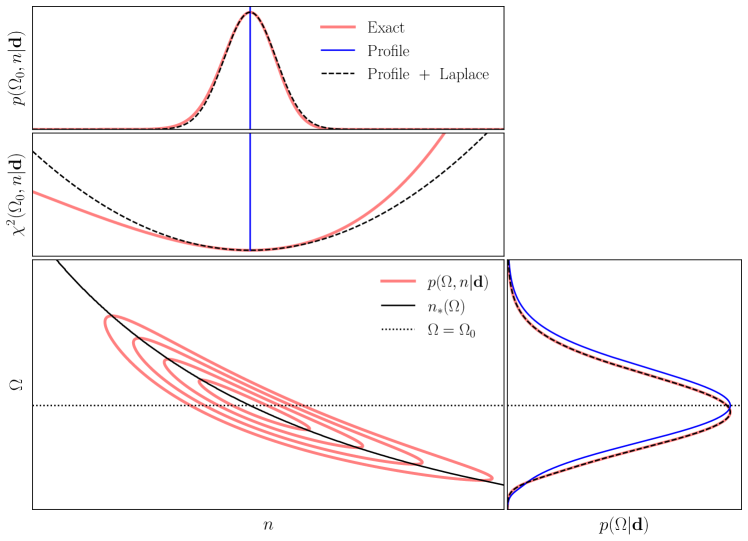
- 우리가 다루는 이론적 예측이 부수적 매개변수에 대해 해석적으로 도함수를 가지는 특성을 활용하여, 라플라스 근사를 적용해 우도 함수에서 부수적 매개변수를 분석적으로 근사한다. 이로써 매개변수 공간의 차원을 감소시킨다.
- 예를 들어 편향, 내재적 정렬 등의 부수적 매개변수에 대해 이론적 예측의 해석적 도함수를 활용하여 라플라스 근사를 효율적으로 계산한다.
- 이론 예측이 부수적 매개변수에 대해 선형적으로 의존하는 校정 가능한 시스템성 오차의 경우, 선형화된 변형된 방법을 도입하여 근사를 단순화한다.
- 라플라스 근사를 통해 근사 과정에서 발생하는 체적 효과를 포착하여, 정확한 불확실성 추정과 편향 방지를 위한 핵심 요소를 확보한다.
- 비정규성 및 우도의 비제곱형 행동을 기반으로 한 단순 기준을 활용해 실패 케이스를 진단하며, 이 경우 기존의 전면 샘플링으로 복귀할 수 있도록 한다.
- MCMC 파이프라인에 이 방법을 통합하여 매개변수 공간의 차원 수 감소와 효율적인 기울기 접근 덕분에 수렴 속도가 2–15배 향상된다.
실험 결과
연구 질문
- RQ1라플라스 근사를 기반으로 한 분석적 근사 방법이, 계산 비용을 크게 줄이면서도 거의 브루트포스 수준의 정확도를 확보할 수 있는가?
- RQ2실제 DES 데이터와 시뮬레이션된 제4단계 데이터에 대해, 라플라스 근사의 성능은 전통적 MCMC 샘플링과 정확도 및 속도 측면에서 어떻게 비교되는가?
- RQ3라플라스 근사가 어떤 범위에서 실패하며, 이러한 경우를 신뢰성 있게 식별할 수 있는 진단 도구는 무엇인가?
- RQ4이론 예측이 부수적 매개변수에 대해 선형적으로 의존할 경우, 선형화된 방법의 정확도는 어느 정도 유지되며, 부수적 매개변수의 수가 증가함에 따라 어떻게 스케일링되는가?
- RQ5이 방법을 통해 고차원 부수적 매개변수 공간의 계산적 부담을 완화시켜 여러 광학 설문조사의 공동 분석을 가능하게 할 수 있는가?
주요 결과
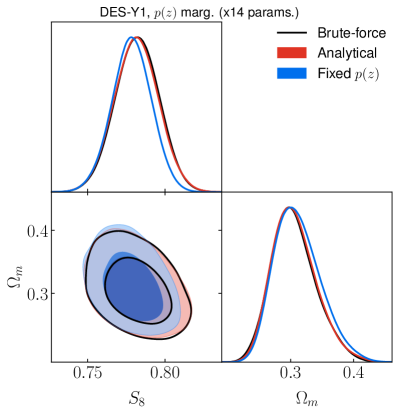
- 선형화된 라플라스 근사 방법은 校정 가능한 시스템성 오차의 경우, 전체 MCMC 샘플링과 거의 구분할 수 없을 정도로 정확한 매개변수 제약 조건을 제공하며, 계산 시간은 3–10배 감소한다.
- 비선형화된 라플라스 방법은 우주론적 매개변수의 주변 불확실성과 근사 과정에서 발생하는 체적 효과를 정확히 재현하여 대부분의 경우 브루트포스 결과와 일치한다.
- 매개변수 공간의 차원 수 감소와 효율적인 기울기 계산 덕분에 MCMC 수렴 시간이 2–15배 단축된다.
- 프로파일 우도 방법은 편향 없는 제약 조건을 제공한 반면, 테스트된 설정에서 주변 분포는 편향을 보였다. 이는 체적 효과의 중요성을 강조한다.
- 비정규 데이터 또는 비제곱형 우도가 존재하는 경우, 근사가 실패할 수 있음을 진단할 수 있는 규칙를 제공하며, 이러한 경우 기존의 전면 샘플링이 여전히 필요하다.
- 고차원 부수적 매개변수 공간의 계산적 병목 현상을 극복함으로써, 이 방법은 여러 광학 설문조사의 확장 가능한 공동 분석을 가능하게 한다.
더 나은 연구,지금 바로 시작하세요
논문 읽기부터 검토까지, 연구 시간을 획기적으로 줄여보세요.
카드 등록 없음 · 무료 플랜 제공
이 리뷰는 AI가 만들고, 인간 에디터가 검토했습니다.