
[논문 리뷰] Critical behaviors of the $O(4)$ and $Z(2)$ symmetries in the QCD phase diagram
이 연구는 이중 쿼크-메손 효과 이론 내에서 기능적 고체상자(기능적 고체상자, fRG)를 사용하여 QCD 상도에서 O(4) 및 Z(2) 보편성 클래스의 임계 행동을 조사한다. 체비셰프 다항식 전개를 활용해 fRG 흐름 방정식을 풀어, 초순수 상전이의 임계 지수를 계산하였으며, conformal bootstrap, 몬테카를로 및 고전적 방법 결과와 정량적 일치를 보였다. 또한 상도에서 매우 좁은 임계 영역이 존재하는 것으로 밝혀졌다.
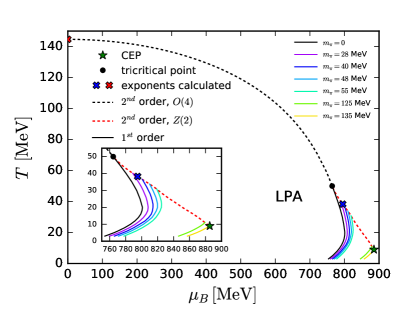
In this work we have studied the QCD phase structure and critical dynamics related to the 3-$d$ $O(4)$ and $Z(2)$ symmetry universality classes in the two-flavor quark-meson low energy effective theory within the functional renormalization group approach. We have employed the expansion of Chebyshev polynomials to solve the flow equation for the order-parameter potential. The chiral phase transition line of $O(4)$ symmetry in the chiral limit, and the $Z(2)$ line of critical end points related to the explicit chiral symmetry breaking are depicted in the phase diagram. Various critical exponents related to the order parameter, chiral susceptibilities and correlation lengths have been calculated for the 3-$d$ $O(4)$ and $Z(2)$ universality classes in the phase diagram, respectively. We find that the critical exponents obtained in the computation, where a field-dependent mesonic nontrivial dispersion relation is taken into account, are in quantitative agreement with results from other approaches, e.g., the conformal bootstrap, Monte Carlo simulations and $d=3$ perturbation expansion, etc. Moreover, the size of the critical regime in the QCD phase diagram is found to be very small.
연구 동기 및 목표
- 유한한 온도와 양성자 화학적 포텐셜 조건 하에서 QCD 상도의 O(4) 및 Z(2) 보편성 클래스의 임계 역학을 조사하기 위해.
- 초순수 한계에서의 쿼크 대칭성 붕괴가 없는 O(4)의 경우와 임계 끝점에서의 명시적 쿼크 대칭성 붕괴가 있는 Z(2)의 경우, 쿼크 상전이의 임계 지수를 계산하기 위해.
- 효과적 포텐셜의 fRG 흐름 방정식을 수치적으로 해결하기 위해 체비셰프 다항식 전개를 사용하여, 필드 의존성 메손 분산 관계를 정확하게 처리할 수 있도록 하기 위해.
- 특히 임계 끝점(Critical End Point, CEP)을 고려할 때 QCD 상도에서의 임계 영역 크기를 평가하기 위해.
제안 방법
- 기능적 고체상자(fRG) 접근법을 사용하여 이중 쿼크-메손 저에너지 효과 이론을 적용하여 QCD의 임계 현상을 연구한다.
- 효과적 포텐셜을 체비셰프 다항식 전개하여 적분미분형 fRG 흐름 방정식을 수치적으로 해결함으로써, 순서 매개변수 및 그 도함수의 고정밀도 계산이 가능해진다.
- fRG 흐름 방정식 내에서 필드 의존성 메손 비정상 분산 관계를 통합하여, 임계 지수 계산의 정확도를 향상시킨다.
- 보존 및 페르미온 보편자에 대한 임계 함수를 마츠부라 형식을 사용하여 계산하며, 유한한 온도 및 화학적 포텐셜에 대한 적절한 처리를 수행한다.
- 임계점 근처의 순서 매개변수, 쿼크 수렴도 및 상관 길이의 스케일링 행동에서 임계 지수를 추출한다.
- 정확도를 검증하기 위해 기존의 conformal bootstrap, 몬테카를로 시뮬레이션 및 d=3 고전 이론 결과와 비교하여 메서드를 검증한다.

실험 결과
연구 질문
- RQ1QCD 초순수 한계에서 3차원 O(4) 보편성 클래스의 임계 지수는 무엇이며, 다른 비양자역학적 방법과 비교해 어떻게 다를까?
- RQ2임계 끝점에서 Z(2) 보편성 클래스의 임계 지수는 conformal bootstrap 및 격자 시뮬레이션 결과와 어떻게 비교되는가?
- RQ3QCD 상도에서 임계 영역의 크기는 얼마이며, 특히 임계 끝점 주변에서 어떻게 평가되는가?
- RQ4필드 의존성 메손 분산 관계를 fRG 프레임워크에 포함시키면 임계 행동에 어떤 영향을 미치는가?
- RQ5체비셰프 다항식 전개 방법은 O(4) 및 Z(2) 보편성 클래스의 임계 역학을 정확히 포착할 수 있는가?
주요 결과
- 체비셰프 전개를 사용한 fRG를 통해 계산된 3차원 O(4) 및 Z(2) 보편성 클래스의 임계 지수는 conformal bootstrap, 몬테카를로 시뮬레이션 및 d=3 고전 이론 결과와 정량적 일치를 보였다.
- QCD 상도에서의 임계 영역은 매우 좁은 것으로 밝혀졌으며, 이는 물리적 매개변수 공간 내에서 임계 현상이 매우 제한됨을 시사한다.
- 초순수 한계에서의 쿼크 상전이 선은 O(4) 대칭 보편성과 일치하며, 축성 비대칭 고려 및 격자 QCD 결과와도 일치한다.
- Z(2) 대칭과 관련된 임계 끝점(Critical End Point, CEP)은 예측된 바와 같이 450 MeV ≤ μ_B ≤ 650 MeV 범위에 위치한다.
- 비틀림 없는 메손 분산 효과가 성공적으로 포착되었으며, 이는 정확한 임계 지수 계산에 필수적이다.
- 체비셰프 다항식의 사용은 효과적 포텐셜의 fRG 흐름 방정식을 고정밀도로 해석할 수 있도록 하여, QCD 임계성의 비양자역학적 연구에서의 유용성을 입증한다.
더 나은 연구,지금 바로 시작하세요
논문 읽기부터 검토까지, 연구 시간을 획기적으로 줄여보세요.
카드 등록 없음 · 무료 플랜 제공
이 리뷰는 AI가 만들고, 인간 에디터가 검토했습니다.