
[논문 리뷰] Criticality and entanglement in non-unitary quantum circuits and tensor networks of non-interacting fermions
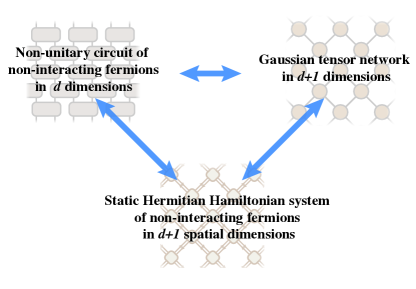
이 논문은 d 차원에서 비유니터리 양자 회로와 d+1 차원에서의 정적 불순물이 존재하는 유니터리 비상호작용 페르미온 시스템 사이에 완전한 대응 관계를 수립한다. 비유니터리 회로에서 관찰되는 임계 양자 얽힘 상전이는 Altland-Zirnbauer 대칭 계열 DIII의 안정된 금속 임계성에서 기인하며, 이는 불순물이 있는 페르미온 시스템을 통한 유일한 프레임워크를 제공하여 얽힘 전이를 분류하고 이해한다.
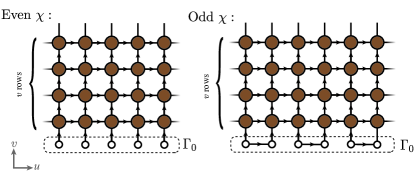
Models for non-unitary quantum dynamics, such as quantum circuits that include projective measurements, have been shown to exhibit rich quantum critical behavior. There are many complementary perspectives on this behavior. For example, there is a known correspondence between d-dimensional local non-unitary quantum circuits and tensor networks on a D=(d+1)-dimensional lattice. Here, we show that in the case of systems of non-interacting fermions, there is furthermore a full correspondence between non-unitary circuits in d spatial dimensions and unitary non-interacting fermion problems with static Hermitian Hamiltonians in D=(d+1) spatial dimensions. This provides a powerful new perspective for understanding entanglement phases and critical behavior exhibited by non-interacting circuits. Classifying the symmetries of the corresponding non-interacting Hamiltonian, we show that a large class of random circuits, including the most generic circuits with randomness in space and time, are in correspondence with Hamiltonians with static spatial disorder in the ten Altland-Zirnbauer symmetry classes. We find the criticality that is known to occur in all of these classes to be the origin of the critical entanglement properties of the corresponding random non-unitary circuit. To exemplify this, we numerically study the quantum states at the boundary of Haar-random Gaussian fermionic tensor networks of dimension D=2 and D=3. We show that the most general such tensor network ensemble corresponds to a unitary problem of non-interacting fermions with static disorder in Altland-Zirnbauer symmetry class DIII, which for both D=2 and D=3 is known to exhibit a stable critical metallic phase. Tensor networks and corresponding random non-unitary circuits in the other nine Altland-Zirnbauer symmetry classes can be obtained from the DIII case by implementing Clifford algebra extensions for classifying spaces.
연구 동기 및 목표
- d 차원에서의 비유니터리 비상호작용 페르미온 회로와 d+1 차원에서의 유니터리 불순물이 있는 페르미온 해밀토니안 사이에 완전한 대응 관계를 수립한다.
- 10개의 Altland-Zirnbauer 대칭 계열을 사용하여 무작위 비유니터리 회로에서의 얽힘 상전이와 임계 행동을 분류한다.
- 무작위 가우시안 텐서 네트워크에서 관측된 임계 얽힘은 대칭 계열 DIII의 안정된 금속 상에서 기인함을 보여준다.
- 기존의 임계 행동이 알려진 불순물이 있는 페르미온 시스템에 맵핑함으로써, 얽힘 전이를 통합적으로 이해할 수 있는 프레임워크를 제공한다.
제안 방법
- 각 가우시안 텐서를 공분산 행렬에서 유도된 전이 행렬을 사용하여 단일 산란 중심이 있는 유니터리 산란 문제로 매핑한다.
- 텐서 네트워크의 동역학을 포함하는 전이 행렬 형식을 구축하고, 이를 정적 불순물이 있는 비상호작용 페르미온 해밀토니안으로 매핑한다.
- 전이 행렬의 대칭성을 식별하여 해당 시스템을 10개의 Altland-Zirnbauer 대칭 계열 중 하나로 분류하며, 특히 DIII 계열에 중점을 둔다.
- 양성 생성자를 포함한 클리포드 대수의 확장을 사용하여, 10개의 대칭 계열 모두에 대응하는 텐서 네트워크 집합을 체계적으로 생성한다.
- D=2와 D=3에서 하어-랜덤 가우시안 텐서 네트워크에 대한 수치 시뮬레이션을 수행하여 얽힘 엔트로피, 상관 함수, 상호정보량을 계산한다.
- 다시 정규화 군과 장 이론 기법을 적용하여 DIII 금속 상의 상관 함수에서의 로그 보정 항을 분석적으로 이해한다.
실험 결과
연구 질문
- RQ1d 차원에서의 비유니터리 비상호작용 페르미온 회로는 d+1 차원에서의 유니터리 불순물이 있는 페르미온 시스템으로 어떻게 매핑될 수 있는가?
- RQ2무작위 비유니터리 회로에서 관측되는 임계 얽힘의 기원은 무엇이며, 불순물이 있는 페르미온 시스템의 대칭 계열과 어떻게 관련이 있는가?
- RQ3가장 일반적인 가우시안 텐서 네트워크 집합이 왜 대칭 계열 DIII에 대응하는가? 그리고 이는 얽힘 스케일링에 어떤 영향을 미치는가?
- RQ4전이 행렬의 대칭성은 얽힘 임계성의 보편성 계열을 어떻게 결정하는가?
- RQ5클리포드 대수의 확장을 통해 텐서 네트워크 구성법을 사용하여 Altland-Zirnbauer 대칭 계열의 10가지 분류를 모두 실현할 수 있는가?
주요 결과
- D=2와 D=3에서 하어-랜덤 가우시안 텐서 네트워크의 임계 얽힘 상은 Altland-Zirnbauer 대칭 계열 DIII의 안정된 금속 상과 일치한다.
- 임계 상에서의 얽힘 엔트로피는 DIII 금속 상과 일치하는 로그 보정 항을 나타내며, 이는 비자명한 임계점을 시사한다.
- 수치 결과는 임계 상에서의 상호정보량과 상관 함수가 로그 보정 항을 따라 스케일링하며, DIII 계열의 장 이론 예측과 일치함을 보여준다.
- 전이 행렬 형식은 입자-홀 대칭성을 유지하는 유니터리 산란 문제로 각 가우시안 텐서를 매핑하며, DIII 분류를 확인한다.
- 양성 생성자를 포함한 클리포드 대수의 확장을 통해 저자들은 10개의 Altland-Zirnbauer 대칭 계열 모두에 대응하는 텐서 네트워크 집합을 구성하였으며, DIII 사례를 일반화한다.
- 이 연구는 비유니터리 회로에서의 임계성이 랜덤성의 산물이 아니며, DIII 계열의 위상적이고 대칭 보호된 금속 상과 깊이 연관된 강건한 특성임을 입증한다.
더 나은 연구,지금 바로 시작하세요
논문 읽기부터 검토까지, 연구 시간을 획기적으로 줄여보세요.
카드 등록 없음 · 무료 플랜 제공
이 리뷰는 AI가 만들고, 인간 에디터가 검토했습니다.