
[논문 리뷰] Demonstration of Robust and Efficient Quantum Property Learning with Shallow Shadows
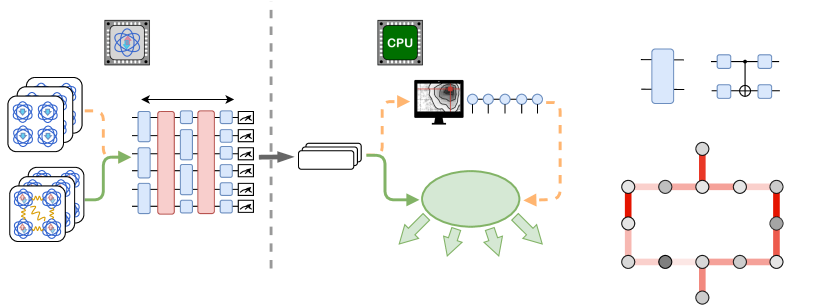
이 논문은 잡음에 강인한 얕은 색션 프로토콜을 소개한다. 이는 얕은 무작위 양자 회로에서의 실험적 잡음을 모델링하고 보정하기 위해 베이지안 추론을 사용하는 잡음 완화 기반 양자 성질 학습 프레임워크이다. 이 프로토콜은 표준 단일 큐비트 측정보다 더 낮은 샘플 복잡도로, 노이즈가 있는 초전도 양자 하드웨어에서 양자 상태 성질—예를 들어 허상도, 얽힘 엔트로피, 기대값—을 정확하게 추정할 수 있도록 한다.
Extracting information efficiently from quantum systems is a major component of quantum information processing tasks. Randomized measurements, or classical shadows, enable predicting many properties of arbitrary quantum states using few measurements. While random single-qubit measurements are experimentally friendly and suitable for learning low-weight Pauli observables, they perform poorly for nonlocal observables. Prepending a shallow random quantum circuit before measurements maintains this experimental friendliness, but also has favorable sample complexities for observables beyond low-weight Paulis, including high-weight Paulis and global low-rank properties such as fidelity. However, in realistic scenarios, quantum noise accumulated with each additional layer of the shallow circuit biases the results. To address these challenges, we propose the \emph{robust shallow shadows protocol}. Our protocol uses Bayesian inference to learn the experimentally relevant noise model and mitigate it in postprocessing. This mitigation introduces a bias-variance trade-off: correcting for noise-induced bias comes at the cost of a larger estimator variance. Despite this increased variance, as we demonstrate on a superconducting quantum processor, our protocol correctly recovers state properties such as expectation values, fidelity, and entanglement entropy, while maintaining a lower sample complexity compared to the random single qubit measurement scheme. We also theoretically analyze the effects of noise on sample complexity and show how the optimal choice of the shallow shadow depth varies with noise strength. This combined theoretical and experimental analysis positions the robust shallow shadow protocol as a scalable, robust, and sample-efficient protocol for characterizing quantum states on current quantum computing platforms.
연구 동기 및 목표
- 실제 잡음 조건 하에서 얕은 색션의 실험적 검증 부족을 보완한다.
- 양자 성질 추정 과정에서 얕은 양자 회로에 의해 유도되는 잡음에 의한 편향을 극복한다.
- 비국소적 및 전역 관측량(예: 허상도, 얽힘 엔트로피)의 강건한 추정을 유지하면서 낮은 샘플 복잡도를 확보한다.
- 캘리브레이션 데이터에서 잡음 모델을 학습하여 측정 편향을 보정하는 후처리 프레임워크를 개발한다.
- 실제 127큐비트 초전도 프로세서(ibo_kyiv)에서 프로토콜의 확장성과 효율성을 입증한다.
제안 방법
- 비국소적 및 전역 관측량의 효율적 학습을 위해 단일 큐비트 측정에 얕은 무작위 양자 회로를 사전 삽입한다.
- 양자 프로세서에서 수집한 실험적 캘리브레이션 데이터로부터 기기 특화 잡음 모델을 베이지안 추론을 통해 학습한다.
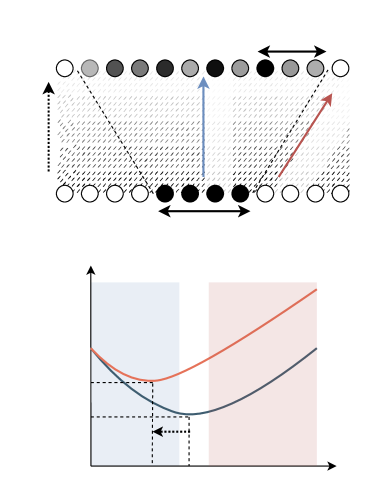
- 편향과 분산의 균형을 고려해 추정기 기대값의 잡음 유도 편향을 보정하기 위해 후처리 완화 기법을 적용한다.
- 다중 큐비트 회로에서의 현실적인 잡음 영향을 포괄하기 위해 공간적으로 상관된 잡음 모델을 구축한다.
- 클래식 색션 프레임워크를 활용해 단일 데이터셋으로부터 한 번의 측정으로 여러 성질을 추정할 수 있도록 한다.
- 이론적 분석을 통해 잡음이 최적의 회로 깊이와 샘플 복잡도에 미치는 영향을 정량화하여 프로토콜 설계를 안내한다.
실험 결과
연구 질문
- RQ1얕은 양자 회로의 잡음이 클래식 색션을 사용한 양자 성질 추정 정확도에 어떤 영향을 미치는가?
- RQ2실제 잡음 조건 하에서 최적의 얕은 무작위 회로 깊이는 무엇이며, 잡음 강도에 따라 어떻게 스케일링되는가?
- RQ3베이지안 추론이 후처리 과정에서 기기 특화 잡음을 효과적으로 학습하고 보정하여 추정기 정확도를 복원하는 데 유용한가?
- RQ4강건한 얕은 색션 프로토콜은 단일 큐비트 무작위 측정에 비해 샘플 복잡도를 얼마나 줄이는가?
- RQ5이 프로토콜은 노이즈가 있는 근접 양자 하드웨어에서 허상도 및 얽힘 엔트로피와 같은 전역 성질을 신뢰성 있게 복원할 수 있는가?
주요 결과
- 강건한 얕은 색션 프로토콜은 심각한 잡음이 존재하는 127큐비트 초전도 프로세서(ibo_kyiv)에서도 양자 상태 성질—기대값, 허상도, 얽힘 엔트로피—을 성공적으로 복원한다.
- 실제 잡음 조건 하에서도 표준 단일 큐비트 무작위 측정 기법보다 낮은 샘플 복잡도를 유지한다.
- 이론적 분석에 따르면 최적의 얕은 회로 깊이는 잡음 강도가 증가함에 따라 감소하며, 이 상호 관계는 정량적으로 특성화되어 있다.
- 베이지안 잡음 모델링은 잡음 유도 편향을 효과적으로 보정하지만, 이는 추정기 분산 증가를 수반하며, 이는 경험적으로 관리 가능한 수준이다.
- 몬테카를로 시뮬레이션과 AKLT 상태 및 벨 상태에 대한 실험 데이터는 다양한 양자 상태와 회로 깊이에서 일관된 성능을 확인한다.
- 프로토콜은 단일 큐비트 무작위 측정으로는 잘 추정되지 않는 저질서도 전역 관측량(예: 허상도, 얽힘 엔트로피)의 정확한 추정을 달성한다.
더 나은 연구,지금 바로 시작하세요
논문 읽기부터 검토까지, 연구 시간을 획기적으로 줄여보세요.
카드 등록 없음 · 무료 플랜 제공
이 리뷰는 AI가 만들고, 인간 에디터가 검토했습니다.