
[논문 리뷰] Diffusion-RWKV: Scaling RWKV-Like Architectures for Diffusion Models
Diffusion-RWKV는 RWKV 백본을 확산 기반 이미지 합성을 위해 적응시키며, Transformer 기반 확산 모델에 비해 선형 시간 복잡도와 더 낮은 FLOPs로 경쟁력 있는 이미지 품질을 달성합니다.
Transformers have catalyzed advancements in computer vision and natural language processing (NLP) fields. However, substantial computational complexity poses limitations for their application in long-context tasks, such as high-resolution image generation. This paper introduces a series of architectures adapted from the RWKV model used in the NLP, with requisite modifications tailored for diffusion model applied to image generation tasks, referred to as Diffusion-RWKV. Similar to the diffusion with Transformers, our model is designed to efficiently handle patchnified inputs in a sequence with extra conditions, while also scaling up effectively, accommodating both large-scale parameters and extensive datasets. Its distinctive advantage manifests in its reduced spatial aggregation complexity, rendering it exceptionally adept at processing high-resolution images, thereby eliminating the necessity for windowing or group cached operations. Experimental results on both condition and unconditional image generation tasks demonstrate that Diffison-RWKV achieves performance on par with or surpasses existing CNN or Transformer-based diffusion models in FID and IS metrics while significantly reducing total computation FLOP usage.
연구 동기 및 목표
- RWKV 아키텍처를 확산 기반 이미지 생성 작업에 맞게 적응하는 것을 탐구한다.
- 안정성과 확장성을 보장하기 위한 conditioning, skip 연결, 그리고 모델 확장성에 대해 조사한다.
- 여러 데이터셋에서 픽셀 및 잠재 공간 표현에 대한 경험적 기준선을 제공한다.
- 품질과 효율성 측면에서 CNN/Transformer 확산 베이스라인과의 성능을 비교한다.
제안 방법
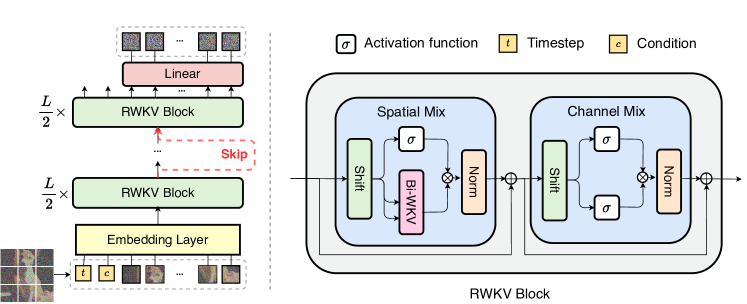
- Bi-RWKV를 백본으로 사용하여 패치화된 이미지 토큰을 양방향으로 선형 복잡도 방식으로 처리한다.
- 표준 self-attention을 양방향 RWKV 기반 메커니즘으로 교체하고, 사방향 공간 시프트와 전역 선형 주의(global linear attention)를 포함한다.
- 타임스텝 정보 및 클래스 정보를 위해 in-context 토큰, adaLN, 또는 adaLN-Zero를 통한 conditioning을 도입한다.
- 패치화하고 임베드한 이미지 토큰에 위치 임베딩을 더해 토큰 시퀀스를 구성한다.
- 얕은 브랜치와 깊은 브랜치 상태를 선형 프로젝션 전에 연결(concatenate)하는 skip-connection 프레임워크를 적용한다.
- 최종 Bi-RWKV 출력을 선형 디코더로 디코딩하여 DDPM 기반 샘플링을 위한 노이즈와 대각 분산을 예측한다.
실험 결과
연구 질문
- RQ1RWKV-like 백본으로 구축된 확산 모델이 Transformer 기반 확산 모델과 비교해 고해상도 이미지 생성 작업에서 어떤 성능을 보이나요?
- RQ2어떤 아키텍처 선택(패치 크기, skip 연결, conditioning)이 품질, 속도, 확장성의 균형을 가장 효과적으로 이루나요?
- RQ3다양한 해상도에서 낮은 FLOPs와 메모리 사용으로 경쟁력 있는 FID/IS를 Diffusion-RWKV가 달성할 수 있나요?
- RQ4CIFAR-10, CelebA, ImageNet 같은 데이터셋에서 깊이/너비의 모델 확장이 성능과 효율성에 어떤 영향을 미치나요?
주요 결과
- Diffusion-RWKV는 유사한 학습 설정에서 CNN/Transformer 확산 모델과 동등하거나 더 나은 FID 결과를 달성합니다.
- 더 작은 패치 크기와 긴 skip 연결 연결이 생성 품질과 학습 효율을 개선합니다.
- AdaLN-Zero conditioning은 in-context conditioning에 비해 더 우수한 FID 성능과 효율성을 제공합니다.
- 더 큰 Bi-RWKV 모델은 증가하는 FLOPs와 함께 더 나은 FID를 제공하여 DiT 베이스라인과 유사한 확장 가능한 개선을 보여줍니다.
- ImageNet 256x256에서 DRWKV-H/2는 일부 최첨단 모델에 비해 총 FLOPs가 낮으면서도 경쟁력 있는 FID를 달성합니다.
- 512x512에서 DRWKV-H/2는 최상위 방법에 근접하면서도 계산 부담을 줄여 여전히 경쟁력을 유지합니다.

더 나은 연구,지금 바로 시작하세요
논문 읽기부터 검토까지, 연구 시간을 획기적으로 줄여보세요.
카드 등록 없음 · 무료 플랜 제공
이 리뷰는 AI가 만들고, 인간 에디터가 검토했습니다.