
[논문 리뷰] Direct observation of Floquet-Bloch states in monolayer graphene
본 논문은 monolayer graphene에서 Floquet-Bloch 상태를 에너지-운동량 해상도로 직접 관찰하기 위해 mid-infrared 펌프를 사용한 시간- 및 각도 해상도 광전자방출 분광법(trARPES)을 수행하고, 편광 의존성이 Floquet–Volkov 결합을 드러내는 레플리카 밴드를 보인다고 보고한다.
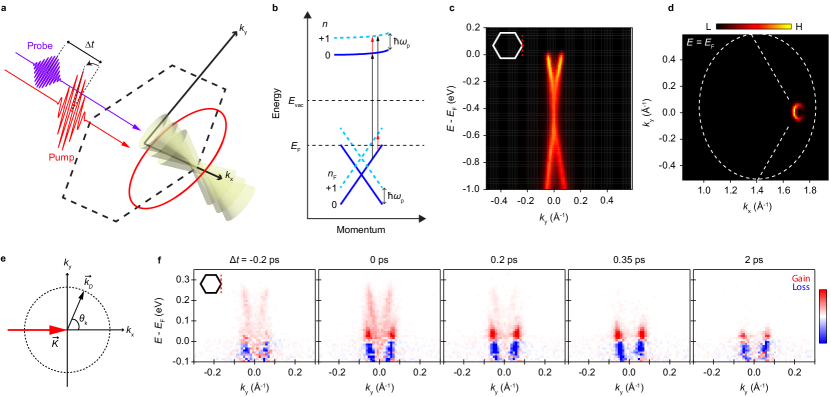
Floquet engineering is a novel method of manipulating quantum phases of matter via periodic driving [1, 2]. It has successfully been utilized in different platforms ranging from photonic systems [3] to optical lattice of ultracold atoms [4, 5]. In solids, light can be used as the periodic drive via coherent light-matter interaction. This leads to hybridization of Bloch electrons with photons resulting in replica bands known as Floquet-Bloch states. After the direct observation of Floquet-Bloch states in a topological insulator [6], their manifestations have been seen in a number of other experiments [7-14]. By engineering the electronic band structure using Floquet-Bloch states, various exotic phase transitions have been predicted [15-22] to occur. To realize these phases, it is necessary to better understand the nature of Floquet-Bloch states in different materials. However, direct energy and momentum resolved observation of these states is still limited to only few material systems [6, 10, 14, 23, 24]. Here, we report direct observation of Floquet-Bloch states in monolayer epitaxial graphene which was the first proposed material platform [15] for Floquet engineering. By using time- and angle-resolved photoemission spectroscopy (trARPES) with mid-infrared (mid-IR) pump excitation, we detected replicas of the Dirac cone. Pump polarization dependence of these replica bands unequivocally shows that they originate from the scattering between Floquet-Bloch states and photon-dressed free-electron-like photoemission final states, called Volkov states. Beyond graphene, our method can potentially be used to directly observe Floquet-Bloch states in other systems paving the way for Floquet engineering in a wide range of quantum materials.
연구 동기 및 목표
- 고체에서 양자상 조작의 한 방법으로 Floquet 엔지니어링을 동기로 제시하는 연구를 수행한다.
- monolayer graphene에서 Floquet-Bloch 상태를 에너지-운동량 해상도로 직접 관찰하는 것을 입증한다.
- 펌프 편광 의존성을 통해 Floquet-Bloch 기여를 Volkov 최종 상태 효과와 구분한다.
- 편광 회전에 따른 레플리카 밴드 진화를 해석하기 위한 간단한 분석 모델을 개발하고 적용한다.
제안 방법
- mid-infrared 펌프(246 meV)와 26.4 eV 프로브를 갖춘 시간- 및 각도 해상도 광전자방출 분광법(trARPES)을 사용하여 그래핀에서 레플리카 Dirac 콘을 관찰한다.
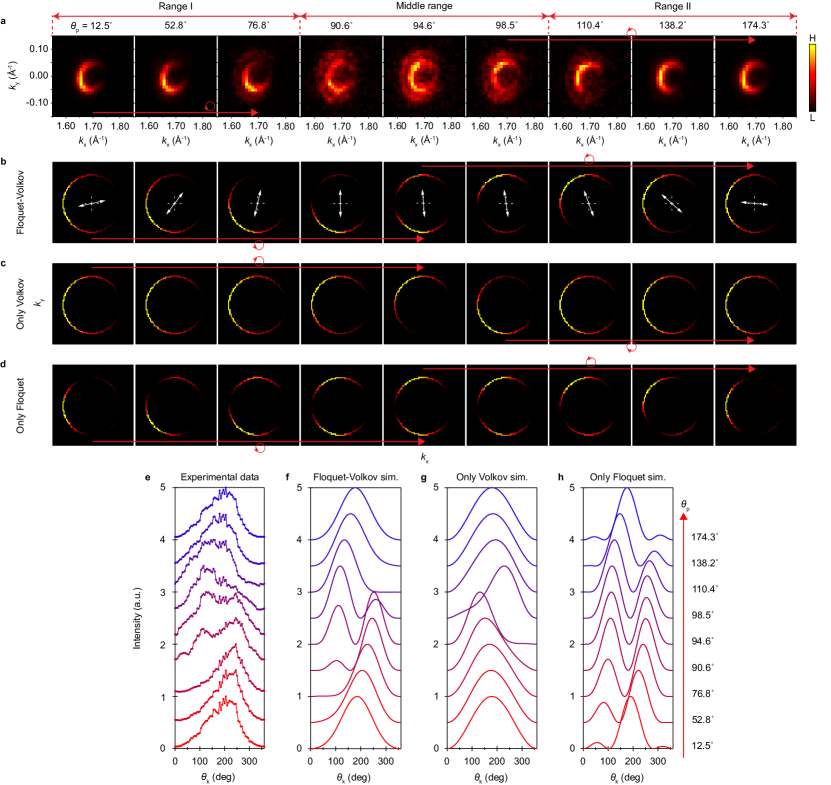
- 펌프 편광이 회전될 때 ARPES 스펙트럼을 기록하여 k-공간에서 레플리카 밴드의 진화를 추적한다.
- 실험적 편광 의존 레플리카 밴드 진화를 Floquet–Volkov 결합, 오직 Volkov 상태, 그리고 오직 Floquet 상태의 세 가지 시나리오를 기반으로 한 시뮬레이션과 비교한다.
- P1이 |M|^2 |γ|^2에 비례하도록 하는 산란 매트릭스 형식을 사용하고, γ가 Floquet- 및 Volkov 상호작용 매개변수(α, β)를 암호화한다.
- γ를 모델링하고 결과 레플리카 밴드 동역학을 설명하기 위해 펌프 입사각과 평면 내 벡터 퍼텐셜을 도입한다(γ 및 관련 항의 방정식).
- 이전 연구에서 영감을 얻은 해석적 모델을 사용하여 Floquet-Bloch 기여를 Volkov 효과와 구분한다.
실험 결과
연구 질문
- RQ1mid-IR 펌프를 이용한 trARPES로 monolayer graphene에서 Floquet-Bloch 상태를 직접 관찰할 수 있는가?
- RQ2관찰된 레플리카 밴드가 Floquet-Bloch 상태, Volkov 상태, 또는 이들의 결합에서 비롯되는지, 펌프 편광 의존성으로 입증되는가?
- RQ3펌프의 편광이 레플리카 밴드의 진화에 어떤 영향을 미치며, 이것이 Floquet–Volkov 상호작용에 대해 시사하는 바는 무엇인가?
주요 결과
- mid-IR 펌프 자극 이후 그래핀에서 디랙 콘의 레플리카가 나타나며, 광자에 의해 구성된 상태를 시사한다.
- 편광 회전에 따른 레플리카 밴드의 진화는 Volkov 상태만으로 설명될 수 없고 Floquet–Volkov 산란과 일치한다.
- Floquet-Bloch 및 Volkov 결합 모델은 편광 의존 화살 모양 회전과 두 개의 아크의 공존을 재현하며 실험적 경향과 일치한다.
- 순수한 Floquet 또는 순수한 Volkov 시나리오는 편광 각도에 따른 레플리카 밴드의 전체 진화를 포착하지 못한다.
- 이 결과는 그래핀에서 Floquet-Bloch 상태에 대한 직접적인 증거를 제공하며, Floquet 엔지니어링을 위한 다른 재료에도 확장 가능한 틀을 제시한다.
더 나은 연구,지금 바로 시작하세요
연구 설계부터 논문 작성까지, 연구 시간을 획기적으로 줄여보세요.
카드 등록 없음 · 무료 플랜 제공
이 리뷰는 AI가 만들고, 인간 에디터가 검토했습니다.