
[논문 리뷰] Discovery of the local counterpart of disc galaxies at z > 4: The oldest thin disc of the Milky Way using Gaia-RVS
이 연구는 고정밀 Gaia-RVS 데이터와 StarHorse 을 활용하여 우리 은하의 가장 오래된 얇은 디스크를 발견하였다. 이 디스크는 빅뱅 이후 10억 년 이내에 형성되었으며, 냉각된 얇은 디스크 궤도를 도는 금속 빈도가 낮은 별들은 주로 130억 년 이상 되었으며, 수직 속도 분산(σ_Vz)은 약 20–25 km s⁻¹로, JWST와 ALMA가 관측한 고적도 디스크 은하와 일치한다. 이는 초기 디스크 형성과 지속적인 내측에서 외측으로의 성장을 시사한다.
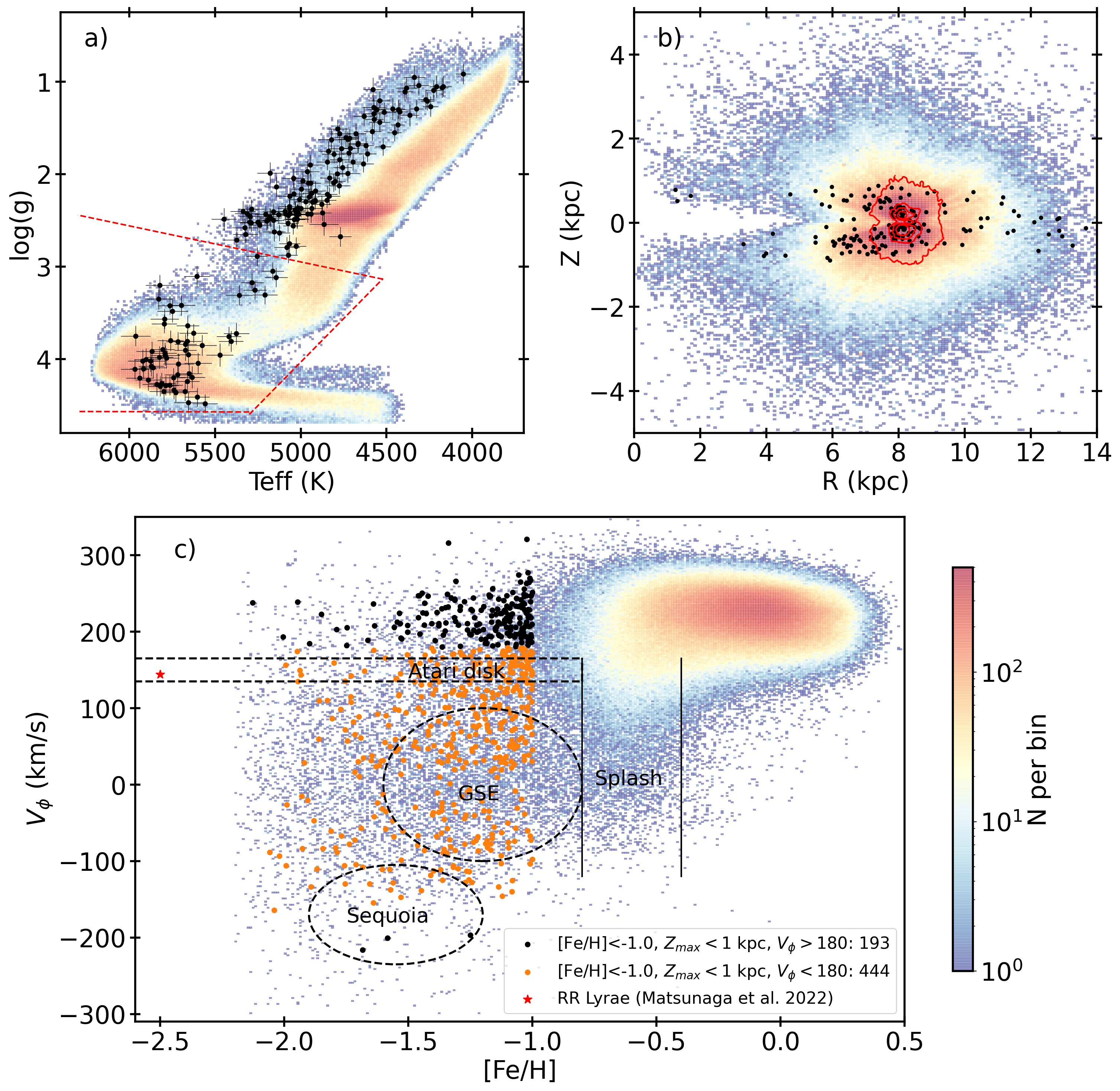
JWST has recently detected numerous disc galaxies at high-redshifts and there have been observations of cold disc galaxies at z > 4 with ALMA. In the Milky Way, recent studies find metal-poor stars in cold disc orbits, suggesting an ancient disc. We investigated a sample of 565,606 stars from the hybrid-CNN analysis of the Gaia-DR3 RVS stars. The sample contains 8,500 stars with [Fe/H]<-1. For a subset of ~200,000 MSTO and subgiant stars we computed distances and ages using the StarHorse code with a mean precision of 1% and 12%, respectively. First, we confirm the existence of metal-poor stars in thin disc orbits - over 50% are older than 13 Gyr. Second, we report the discovery of the oldest thin disc of the Milky Way(MW), which extends across a wide range of metallicities, from metal-poor to super-solar stars. The metal-poor stars in disc orbits manifest as a readily visible tail of the metallicity distribution. The high-[α/Fe] thick disc exhibits a vertical velocity dispersion of 35 km/s, while the thin disc shows 10 to 15 km/s lower at similar ages. Our old thin disc $σ_{V_z}$ appears similar to those estimated for the high-z disc galaxies. Third, we extend the [Y/Mg] chemical clock to the oldest ages and estimate a slope of -0.038 dex/Gyr. Finally, we confirm our discovery by showing that the splash includes high- and low-[α/Fe] populations that are both old and extends to super-solar [Fe/H]. We find about 6 to 10% of the old thin disc was heated to thick disc orbits with the youngest splashed stars being 9 to 10 Gyrs. We conclude the MW thin disc forms <1 billion years from Big Bang, building up inside-out, preceding earlier estimates by about 4-5 billion years. Considering a massive merger event such as the GSE, a Splash is expected - we find a portion of the old thin disc is heated to thick disc velocities and the Splash extends to super-solar [Fe/H] regimes.
연구 동기 및 목표
- 우리 은하의 얇은 디스크 형성 시기를 규명하고, 이전에 약 8–90억 년으로 추정된 시기를 도전한다.
- 냉각된 디스크 궤도를 도는 금속 빈도가 낮은 별들이 고대 얇은 디스크의 일부인지, 또는 헬로/하위구조의 일부인지 확인한다.
- 가우아-엔셀라두스와 같은 주요 형성합류가 얇은 디스크 운동학으로부터 두꺼운 디스크 운동학으로 별을 가열하는 데 미치는 영향을 조사한다.
- 가장 오래된 연령 영역에서 [Y/Mg] 화학 시계를 사용하여 별 연령 추정치를 검증한다.
- 초과금속성 금속 농도까지 포함한 고대 얇은 디스크의 전체 금속 농도 범위를 매핑한다.
제안 방법
- Gaia DR3 RVS에서 확보한 202,384개의 주계열 전환점 및 주거성 브랜치 별들을 활용하였으며, 6차원 운동량 공간과 고품질 별의 물리적 특성을 확보하였다.
- 광학 및 분광학 데이터를 사용하여 거리와 연령을 각각 1% 및 12%의 정밀도로 추정하기 위해 StarHorse 코드를 적용하였다.
- GALAH 조사에서 확보한 화학 농도를 Gaia-RVS 데이터와 융합하여 운동학적 및 화학역학적 분석을 위한 [α/Fe] 및 [Fe/H]를 계산하였다.
- 나이 추정치의 정합성을 검증하기 위해 [Y/Mg] 농도 비율을 화학 시계로 사용하였으며, 기울기 −0.038 dex Gyr⁻¹를 발견하였다.
- 수직 속도 분산(σ_Vz)을 분석하여 얇은 디스크(낮은 σ_Vz)와 두꺼운 디스크(높은 σ_Vz) 인구를 구분하였다.
- 형성합류 사건으로 인해 얇은 디스크 궤도에서 두꺼운 디스크 궤도로 이동한 별들을 추적하기 위해 스플래시 인구를 연령과 금속 농도에 따라 분석하였다.
실험 결과
연구 질문
- RQ1우리 은하의 얇은 디스크는 언제 형성되었으며, GSE 형성합류 이전에 형성되었는가?
- RQ2냉각된 디스크 궤도를 도는 금속 빈도가 낮은 별들은 고대 얇은 디스크의 일부인지, 헬로/하위구조의 일부인지?
- RQ3고대 얇은 디스크의 수직 속도 분산은 얼마이며, 고적도 디스크 은하와 비교해보면 어떠한가?
- RQ4GSE 형성합류로 인해 고대 얇은 디스크가 두꺼운 디스크 운동학으로 얼마나 가열되었는가?
- RQ5스플래시 인구는 초과금속성까지 확장되는가? 이는 초기 디스크 형성에 어떤 의미를 갖는가?
주요 결과
- 우리 은하의 얇은 디스크는 빅뱅 이후 10억 년 이내에 형성되었으며, 이는 이전 추정치보다 40–50억 년 빠른 것이다.
- 얇은 디스크 궤도를 도는 금속 빈도가 낮은 별의 50% 이상이 130억 년 이상 되었으며, 이는 고대 기원을 확인한다 (Z_max < 1 kpc, V_φ > 180 km s⁻¹).
- 고대 얇은 디스크의 수직 속도 분산(σ_Vz)은 20–25 km s⁻¹이며, 고-[α/Fe] 두꺼운 디스크(σ_Vz ≈ 35 km s⁻¹)보다 10–15 km s⁻¹ 낮다.
- [Y/Mg] 화학 시계는 가장 오래된 연령 영역까지 연장되었으며, 기울기 −0.038 dex Gyr⁻¹를 기록하여 StarHorse 연령 추정치의 정합성을 검증하였다.
- 고대 얇은 디스크의 약 6–10%가 두꺼운 디스크 운동학으로 가열되었으며, 이 속도에서 나이가 어린 저-[α/Fe] 별은 존재하지 않아, 가열 과정이 90–100억 년 이전에 발생했음을 시사한다.
- 스플래시 인구는 고령(≥90억 년)의 고- 및 저-[α/Fe] 별을 포함하며, 초과금속성 [Fe/H] ≈ 0.25까지 연장되며, 이는 냉각된 디스크에서 초기에 지속적인 별 형성을 시사한다.
![Figure 2 : Toomre diagrams ( $\sqrt{V^{2}_{R}+V^{2}_{\phi}}$ vs. $V_{\phi}$ ) for the age sample stars in bins of age and [ Fe / H ] . The plots are color-coded by logarithm of stellar density. Older to younger ages from top to bottom and metal-poor to metal-rich [ Fe / H ] from left to right. The a](https://ar5iv.labs.arxiv.org/html/2402.00561/assets/plots/mp_sample_age_toomre_age_mh_bins_1.png)
더 나은 연구,지금 바로 시작하세요
논문 읽기부터 검토까지, 연구 시간을 획기적으로 줄여보세요.
카드 등록 없음 · 무료 플랜 제공
이 리뷰는 AI가 만들고, 인간 에디터가 검토했습니다.