
[논문 리뷰] Dry-to-Wet Soil Gradients Enhance Convection and Rainfall over Subtropical South America
이 연구는 수십 km에 이르는 건조에서 습한 토양 수분(SM) 기울기가 열대 이남 아메리카의 대류와 강수를 증가시킨다는 것을 밝혀냈다. 이는 건조한 토양 위에서 깊은 대류를 유도하는 메조스케일 순환을 유발하기 때문이다. 토양 수분-강수량(SM-PPT) 피드백의 부호는 배경 바람에 매우 민감하게 의존한다: 약한 바람은 음성 피드백(강수량이 건조한 지역에 국한됨)을 유도하고, 강한 바람은 전파와 양성 피드백(강수량이 바람 아래쪽으로 이동함)을 가능하게 하며, 이는 대류 척도 모델링의 핵심 과제를 드러낸다.
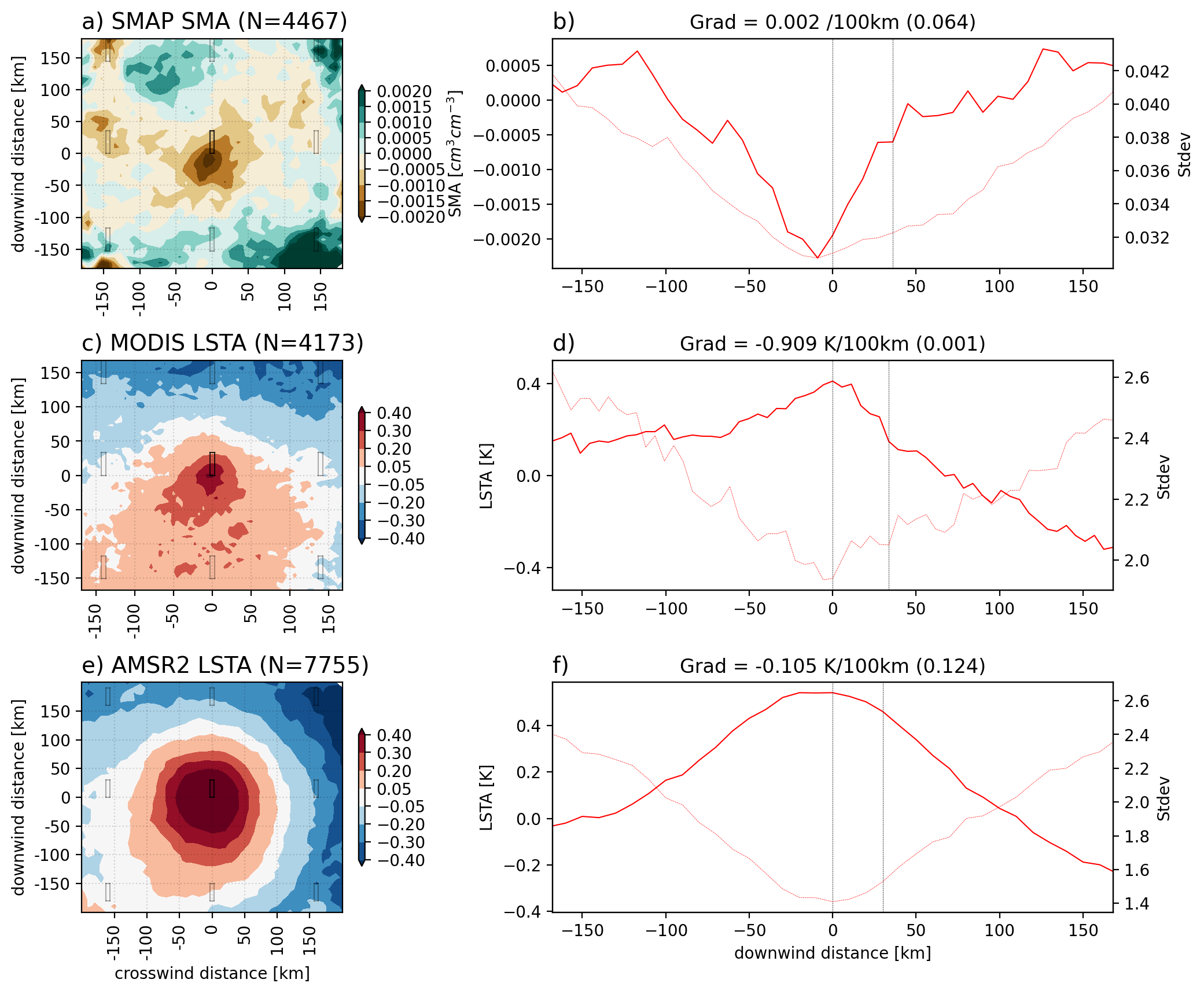
Soil moisture-precipitation (SM-PPT) feedbacks at the mesoscale represent a major challenge for numerical weather prediction, especially for subtropical regions that exhibit large variability in surface SM. How does surface heterogeneity, specifically mesoscale gradients in SM and land surface temperature (LST), affect convective initiation (CI) over South America? Using satellite data, we track nascent, daytime convective clouds and quantify the underlying antecedent (morning) surface heterogeneity. We find that convection initiates preferentially on the dry side of strong SM/LST boundaries with spatial scales of tens of kilometers. The strongest alongwind gradients in LST anomalies at 30 km length scale underlying the CI location occur during weak background low-level wind (<2.5m/s), high convective available potential energy (>1500J/kg) and low convective inhibition (<250J/kg) over sparse vegetation. At 100 km scale, strong gradients occur at the CI location during convectively unfavorable conditions and strong background flow. The location of PPT is strongly sensitive to the strength of the background flow. The wind profile during weak background flow inhibits propagation of convection away from the dry regions leading to negative SM-PPT feedback whereas strong background flow is related to longer lifecycle and rainfall hundreds of kilometers away from the CI location. Thus, the sign of the SM-PPT feedback is dependent on the background flow. This work presents the first observational evidence that CI over subtropical South America is associated with dry soil patches on the order of tens of kilometers. Convection-permitting numerical weather prediction models need to be examined for accurately capturing the effect of SM heterogeneity in initiating convection over such semi-arid regions.
연구 동기 및 목표
- 열대 이남 아메리카에서 메조스케일 토양 수분(SM)과 지표면 온도(LST) 이질성이 대류 유도(CI)에 미치는 영향을 이해하기 위해.
- 배경 바람, CAPE, CIN이 대류 척도에서 SM-PPT 피드백을 조절하는 데 기여하는 정도를 정량화하기 위해.
- SM/LST 기울기의 공간 척도(30 km 대비 100 km)가 대류와 강수에 미치는 영향을 평가하기 위해.
- 식생 덮개와 지형이 이질적인 표면에서 메조스케일 순환과 CI에 미치는 영향을 평가하기 위해.
- 배경 유동에 따른 SM-PPT 피드백 부호 의존성에 대한 관측적 증거를 제공하여, 대류 허용 모델의 개선에 기여하기 위해.
제안 방법
- 위성 자료를 사용하여 낮 동안 형성된 초기 대류 구름을 추적하여 열대 이남 아메리카 전역에서 대류 유도(CI) 위치를 특정하였다.
- SM 및 LST 이상치에 대해 30 km 및 100 km 공간 척도를 사용하여 이전 아침의 표면 이질성을 분석하였다.
- 다중 위성 데이터셋을 활용: 강수량은 GPM-IMERG, 마이크로파 토양 수분은 SMAP, LST는 MODIS 및 AMSR2, 바람, CAPE 및 CIN은 ERA5를 사용하였다.
- 배경 바람 조건에 따라 다양하게 변화하는 상풍 방향 LST 이상치(LSTA) 기울기를 계산하고, CI 발생과의 상관관계를 평가하였다.
- 배경 바람 강도를 약한(≤2.5 m/s) 및 강한(>2.5 m/s)으로 분류하여 피드백 부호를 평가하였다.
- CI 이후 24시간 동안의 강수량 이상치를 매핑하여 전파성과 피드백 강도를 평가하였다.

실험 결과
연구 질문
- RQ1열대 이남 아메리카에서 건조한 지역 주변의 더 습한 지역에 인접한 건조한 토양 패치에서 대류가 선호적으로 유도되는가?
- RQ230 km 및 100 km 척도의 SM/LST 기울기는 메조스케일 순환과 CI 가능성에 어떤 영향을 미치는가?
- RQ3배경 바람 속도가 SM-PPT 피드백의 부호를 결정하는 데 어떤 역할을 하는가?
- RQ4식생 덮개와 지형은 토양 수분 이질성이 대류를 유도하는 데 효과를 어떻게 조절하는가?
- RQ5건조한 지역에서 습한 지역으로의 대류 전파가 강수의 공간 패턴과 피드백 부호에 얼마나 큰 영향을 미치는가?
주요 결과
- 대류는 약한 배경 바람(<2.5 m/s) 조건에서 특히 30 km 척도에서 강한 SM/LST 기울기의 건조 측면에서 선호적으로 유도된다.
- 가장 강한 상풍 방향 LST 기울기(30 km 척도)는 CAPE가 높음(>1500 J/kg)이고 CIN이 낮음(<250 J/kg)인 조건에서 발생하며, 이는 흩어진 식생 지역에서 CI를 유리하게 만든다.
- 100 km 척도에서는 강한 배경 바람(>2.5 m/s) 조건에서도 메조스케일 순환을 유도함으로써 혼합 효과를 상쇄하고 대류를 유도할 수 있다.
- 복잡한 지형에서는 100 km 척도의 SM 불균일성이 오르막 기류를 유도하여 동부 안데스와 브라질 고원에서 대류를 강화시키며, 이는 하강 기류와 반대된다.
- 약한 배경 바람 조건에서는 대류가 건조한 패치에 고정되어 음성 SM-PPT 피드백(건조한 토양에서 강수량 발생)을 초래한다.
- 강한 배경 바람 조건에서는 대류 시스템이 수백 km에 걸쳐 바람 아래쪽으로 전파되어 양성 SM-PPT 피드백과 CI 위치에서 멀리 떨어진 지역의 강수량을 초래한다.
더 나은 연구,지금 바로 시작하세요
논문 읽기부터 검토까지, 연구 시간을 획기적으로 줄여보세요.
카드 등록 없음 · 무료 플랜 제공
이 리뷰는 AI가 만들고, 인간 에디터가 검토했습니다.