
[논문 리뷰] Dynamical Tests of a Deep-Learning Weather Prediction Model
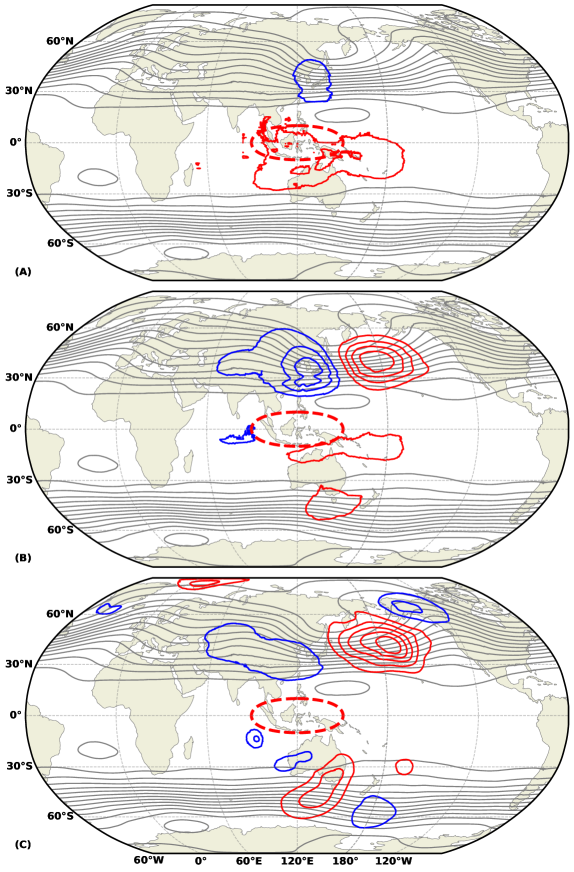
이 연구는 Pangu-weather 딥러닝 모델을 네 가지 표준 역학 실험—열대 가열, 중위도 시기어 발생, 지구적 조정, 허리케인 발달—을 통해 평가하여, 물리적으로 현실적인 신호 전파와 구조적 진화를 생성함을 입증한다. 모델은 매츠노–길 응답, 중위도 파동 복사, 수증기 의존적 허리케인 강화와 같은 핵심 대기역학을 보이며, 순수한 패턴 매칭을 넘어서 실제 물리 법칙을 내재하고 있음을 시사한다.
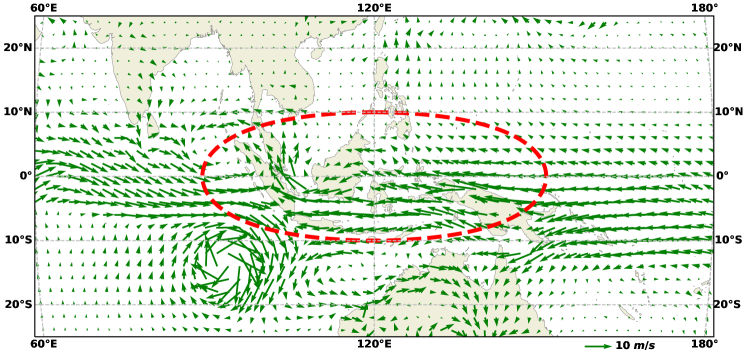
Global deep-learning weather prediction models have recently been shown to produce forecasts that rival those from physics-based models run at operational centers. It is unclear whether these models have encoded atmospheric dynamics, or simply pattern matching that produces the smallest forecast error. Answering this question is crucial to establishing the utility of these models as tools for basic science. Here we subject one such model, Pangu-weather, to a set of four classical dynamical experiments that do not resemble the model training data. Localized perturbations to the model output and the initial conditions are added to steady time-averaged conditions, to assess the propagation speed and structural evolution of signals away from the local source. Perturbing the model physics by adding a steady tropical heat source results in a classical Matsuno--Gill response near the heating, and planetary waves that radiate into the extratropics. A localized disturbance on the winter-averaged North Pacific jet stream produces realistic extratropical cyclones and fronts, including the spontaneous emergence of polar lows. Perturbing the 500hPa height field alone yields adjustment from a state of rest to one of wind--pressure balance over ~6 hours. Localized subtropical low pressure systems produce Atlantic hurricanes, provided the initial amplitude exceeds about 5 hPa, and setting the initial humidity to zero eliminates hurricane development. We conclude that the model encodes realistic physics in all experiments, and suggest it can be used as a tool for rapidly testing ideas before using expensive physics-based models.
연구 동기 및 목표
- 딥러닝 기반 날씨 모델인 Pangu-weather가 실제 대기역학을 내재하고 있는지 여부를 평가하기 위해
- 모델이 훈련 데이터 분포 외부의 국소적 교란에 대해 알려진 물리적 반응을 재현할 수 있는지 테스트하기 위해
- 모델이 대기역학 분야에서 과학적 가설 검증을 위한 빠른 도구로서 유용한지 평가하기 위해
- 모델의 행동이 이상화된 실험에서 이론적 및 관측적 기대와 정성적으로 일치하는지 확인하기 위해
- 딥러닝 모델이 비용이 많이 드는 물리 기반 모델 실행 이전에 기초 연구를 가속화할 잠재력을 탐색하기 위해
제안 방법
- 훈련 데이터와의 직접적 중복을 피하기 위해 기후학적이고 시간 평균화된 초기 조건을 사용하여 네 가지 이상화된 역학 실험을 수행한다.
- 초기 조건 또는 모델 출력에 국소적 교란을 적용하며, 이는 정적인 열대 가열, 기류의 교란, 500 hPa 고도 이상, 표면 저기압 시스템을 포함한다.
- Pangu-weather 모델의 1시간, 3시간, 6시간, 24시간 예측 헤드를 사용하여 시간에 따른 진화를 시뮬레이션하며, ERA5 재분석 데이터로 훈련된 비전 트랜스포머 아키텍처를 활용한다.
- 이론적 기대와 비교하여 신호 전파 속도, 구조적 진화, 반응 패턴(예: 파동 복사, 시기어 발생, 균형 상태로의 조정)을 분석한다.
- 초기 수증기 농도를 0으로 설정하는 등의 민감도 테스트를 수행하여 수증기 조건에 따라 달라지는 의존성(예: 수증기 대류)을 평가한다.
- 물리 기반 모델과의 직접적인 정량적 기준 대비 없이, 기존 대기이론과 관측 결과와의 정성적 비교를 수행한다.
실험 결과
연구 질문
- RQ1정적인 열대 가열에 노출되었을 때 Pangu-weather 모델이 물리적으로 현실적인 매츠노–길 응답을 생성하는가?
- RQ2겨울 평균 기류의 국소적 교란에서 모델이 중위도 시기어와 극지방 저기압을 생성할 수 있는가?
- RQ3균형이 깨진 500 hPa 고도 이상으로 초기화되었을 때 모델이 지구적 조정을 보이는가?
- RQ4초기 순환의 강도와 수증기 농도에 기반한 관측된 열대 시기어 발달 임계치를 모델이 재현하는가?
- RQ5모델의 국소적 교란에 대한 반응이 알려진 대기역학 및 관측 행동과 정성적으로 일치하는가?
주요 결과
- 정적인 열대 가열은 열대권에서 매츠노–길 응답과 태양계 파동을 유도하며, 이는 선형 파동 이론과 일치한다.
- 겨울 평균 북태평양 기류에 국소적 교란을 가했을 때 중위도 시기어와 극지방 저기압이 자발적으로 발생하며, 이는 현실적인 열대 기류 불안정성을 시사한다.
- 초기 500 hPa 고도 이상은 약 6시간 내에 지구적 평형 상태로 조정되며, 발산류가 순환류로 전환된다.
- 대서양 허리케인은 초기 표면 저기압 강도가 약 ~5 hPa를 초과할 때만 형성되며, 초기 수증기 농도를 0으로 설정하면 발달이 멈춘다.
- 모델의 국소적 교란에 대한 반응은 여러 시간 스케일에서 알려진 대기역학과 정성적으로 일치하는 신호 전파와 구조적 진화를 보인다.
- 모델의 행동은 국소 입력으로부터 복잡한 비선형 대기반응을 재현할 수 있음을 바탕으로, 패턴 매칭을 넘어서 물리적 제약을 내재하고 있음을 시사한다.
더 나은 연구,지금 바로 시작하세요
논문 읽기부터 검토까지, 연구 시간을 획기적으로 줄여보세요.
카드 등록 없음 · 무료 플랜 제공
이 리뷰는 AI가 만들고, 인간 에디터가 검토했습니다.