
[논문 리뷰] Engineering Software Systems for Quantum Computing as a Service: A Mapping Study
본 연구는 QCaaS 연구에 대한 체계적 매핑 연구를 수행하여 모델링 표기법, 패턴, 언어, 배포 플랫폼 및 신흥 추세를 식별한다.
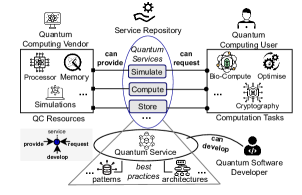
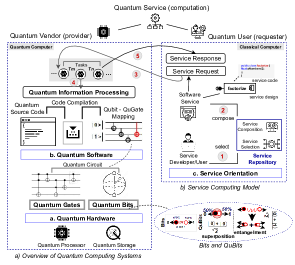
Quantum systems have started to emerge as a disruptive technology and enabling platforms - exploiting the principles of quantum mechanics - to achieve quantum supremacy in computing. Academic research, industrial projects (e.g., Amazon Braket), and consortiums like 'Quantum Flagship' are striving to develop practically capable and commercially viable quantum computing (QC) systems and technologies. Quantum Computing as a Service (QCaaS) is viewed as a solution attuned to the philosophy of service-orientation that can offer QC resources and platforms, as utility computing, to individuals and organisations who do not own quantum computers. To understand the quantum service development life cycle and pinpoint emerging trends, we used evidence-based software engineering approach to conduct a systematic mapping study (SMS) of research that enables or enhances QCaaS. The SMS process retrieved a total of 55 studies, and based on their qualitative assessment we selected 9 of them to investigate (i) the functional aspects, design models, patterns, programming languages, deployment platforms, and (ii) trends of emerging research on QCaaS. The results indicate three modelling notations and a catalogue of five design patterns to architect QCaaS, whereas Python (native code or frameworks) and Amazon Braket are the predominant solutions to implement and deploy QCaaS solutions. From the quantum software engineering (QSE) perspective, this SMS provides empirically grounded findings that could help derive processes, patterns, and reference architectures to engineer software services for QC.
연구 동기 및 목표
- Quantum Computing as a Service (QCaaS)를 가능하게 하거나 개선하는 기존 솔루션을 조사한다.
- QCaaS의 기능적 측면, 설계 모델, 패턴, 프로그래밍 언어, 배포 플랫폼 및 운용화를 특성화한다.
- 향후 QCaaS 연구와 실무를 이끌 미래의 추세와 격차를 식별한다.
- 양자 소프트웨어 공학 관점에서 QC를 위한 소프트웨어 서비스 엔지니어링에 실증적으로 근거한 지침을 제공한다.
제안 방법
- 증거 기반 소프트웨어 엔지니어링 방법을 사용하여 체계적 매핑 연구(SMS)를 수행했다.
- 주요 전자 데이터 소스(IEEE Xplore, ACM DL, SpringerLink, ScienceDirect, Wiley Online Library) 및 Google Scholar에서 검색하되 소스별로 맞춤 검색 문자열을 사용했다.
- 시드 연구에서의 순방향 스노볼링을 적용하여 후보 집합을 확장했다.
- 사전에 정의된 기준(S1-S4, Q1-Q5)을 사용하여 연구를 선별하고 품질을 평가해 최종 분석에 9건의 연구를 선택했다.
- 적응된 IBM SOA 라이프사이클(구상, 모델링, 조립, 배포)에 맞춘 구조화된 데이터 추출.
- 기능적 측면, 모델링 표기법, 패턴, 언어, 배포 플랫폼 측면에서 결과를 보고했다.
실험 결과
연구 질문
- RQ1RQ1: 문헌에서 QCaaS 개발을 지원하기 위해 보고된 솔루션은 무엇인가?
- RQ2RQ2: QCaaS에 관한 연구의 신흥 추세는 무엇인가?
주요 결과
- QCaaS에 대해 식별되는 세 가지 모델링 표기법(UML, 그래프 기반 모델, 프로세스 모델).
- QCaaS를 위한 다섯 가지 설계 패턴의 카탈로그가 보고된다(API Gateway, Layered Architecture, Classic-Quantum Split, Service Wrapping, Repository).
- Python(네이티브 또는 프레임워크를 통한)과 Amazon Braket이 QCaaS 솔루션의 주된 구현/배포 선택지이다.
- QCaaS에 대해 네 가지 응용 도메인이 식별되었다: 최적화, 프로세스 자동화, 수학, 양자 시뮬레이션으로 도구/언어 선택에 영향을 미친다.
- 배포를 위한 세 가지 양자 벤더/플랫폼이 강조된다: Amazon Braket, IBM Quantum, 및 Rigetti.
- 신흥 트렌드에는 비기능적 측면에 대한 강조, 모델 주도 공학과 로우코드 접근법, 양자 도메인 공학(QSRs), 인간 역할, 그리고 QCaaS의 프로세스 중심 개발이 포함된다.
더 나은 연구,지금 바로 시작하세요
연구 설계부터 논문 작성까지, 연구 시간을 획기적으로 줄여보세요.
카드 등록 없음 · 무료 플랜 제공
이 리뷰는 AI가 만들고, 인간 에디터가 검토했습니다.