
[논문 리뷰] Enhanced sensitivity via non-Hermitian topology
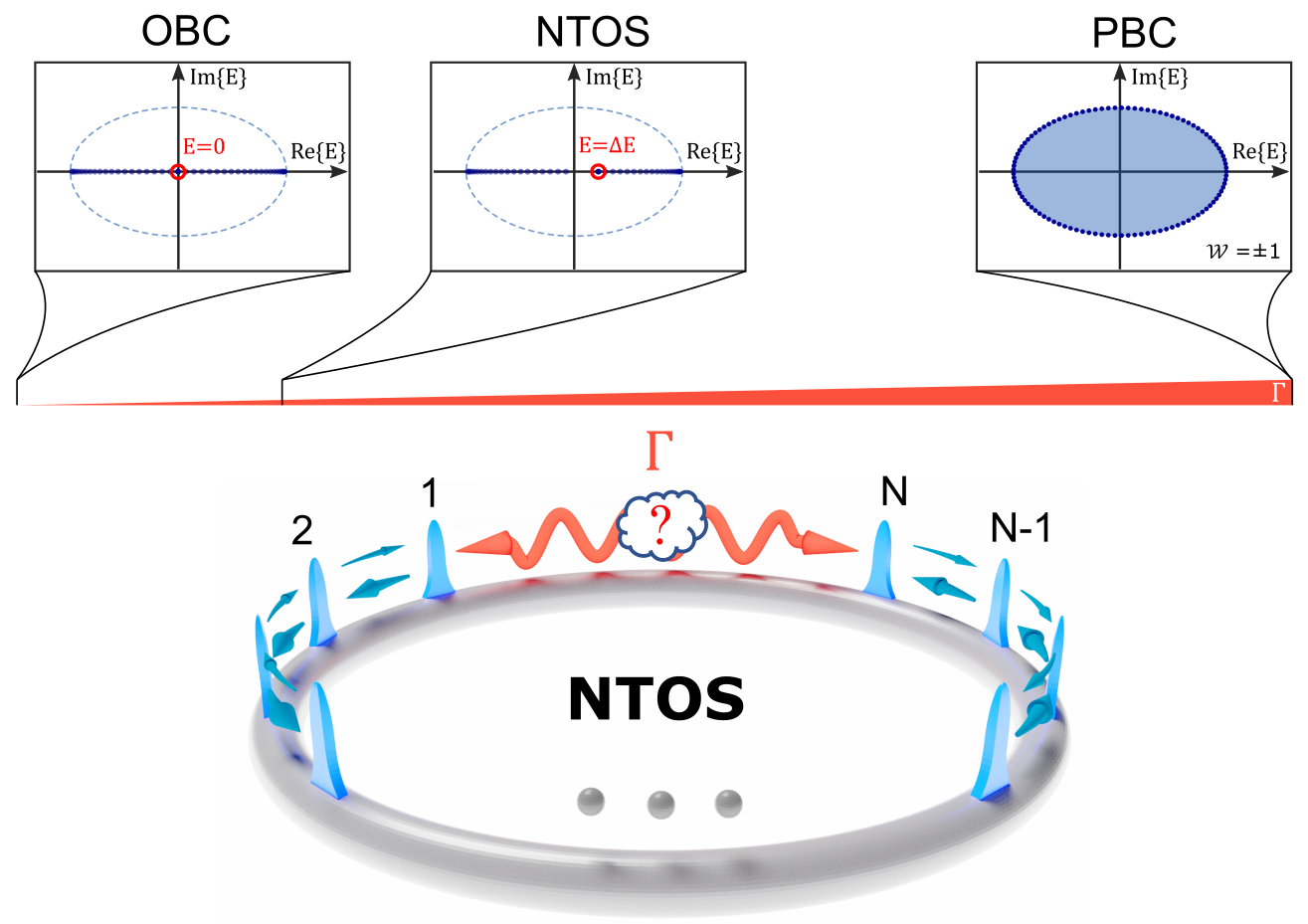
이 논문은 히타노-넬슨 모델에 기반한 광학적 시간다중화 공명기반 네트워크를 사용하여 비헤르미트형 토폴로지 센서(NTOS)의 실험적 구현을 보여준다. 비헤르미트성과 토폴로지의 상호작용을 활용함으로써, 시스템은 래티스 크기가 증가함에 따라 지수적으로 향상된 감도를 달성하며, N=23 래티스 사이트까지 실험적으로 확인되어 전통적인 센싱 한계를 초월한다.
Sensors are indispensable tools of modern life that are ubiquitously used in diverse settings ranging from smartphones and autonomous vehicles to the healthcare industry and space technology. By interfacing multiple sensors that collectively interact with the signal to be measured, one can go beyond the signal-to-noise ratios (SNR) than those attainable by the individual constituting elements. Such distributed sensing techniques have also been implemented in the quantum regime, where a linear increase in the SNR has been achieved via using entangled states. Along similar lines, coupled non- Hermitian systems have provided yet additional degrees of freedom to obtain better sensors via higher-order exceptional points. Quite recently, a new class of non-Hermitian systems, known as non-Hermitian topological sensors (NTOS) has been theoretically proposed. Remarkably, the synergistic interplay between non-Hermiticity and topology is expected to bestow such sensors with an enhanced sensitivity that grows exponentially with the size of the sensor network. Here, we experimentally demonstrate NTOS using a network of photonic time-multiplexed resonators in the synthetic dimension represented by optical pulses. By judiciously programming the delay lines in such a network, we realize the archetypical Hatano-Nelson model for our non-Hermitian topological sensing scheme. Our experimentally measured sensitivities for different lattice sizes confirm the characteristic exponential enhancement of NTOS. We show that this peculiar response arises due to the combined synergy between non-Hermiticity and topology, something that is absent in Hermitian topological lattices. Our demonstration of NTOS paves the way for realizing sensors with unprecedented sensitivities.
연구 동기 및 목표
- 비헤르미트형 토폴로지 센서(NTOS)가 래티스 크기에 따라 지수적으로 증가하는 감도를 실현할 수 있음을 실험적으로 보여주기.
- 이론적 예측인 NTOS에서의 감도 향상 메커니즘이 허미트 시스템에서는 관찰되지 않는 비헤르미트성과 토폴로지의 상호작용에 기인한다는 것을 검증하기.
- 조절 가능한 경계 결합을 가진 시간다중화 광학 플랫폼을 통해 비헤르미트형 토폴로지 래티스를 실현하고 특성화하기.
- NTOS의 감도 스케일링을 기존의 분산 센싱 및 허미트형 토폴로지 시스템과 비교하여 우월한 성능을 보여주기.
- 양자 센싱, 라이다, 중력파 탐지 등에 적용 가능한 고감도 센서의 개념 증명 제공하기.
제안 방법
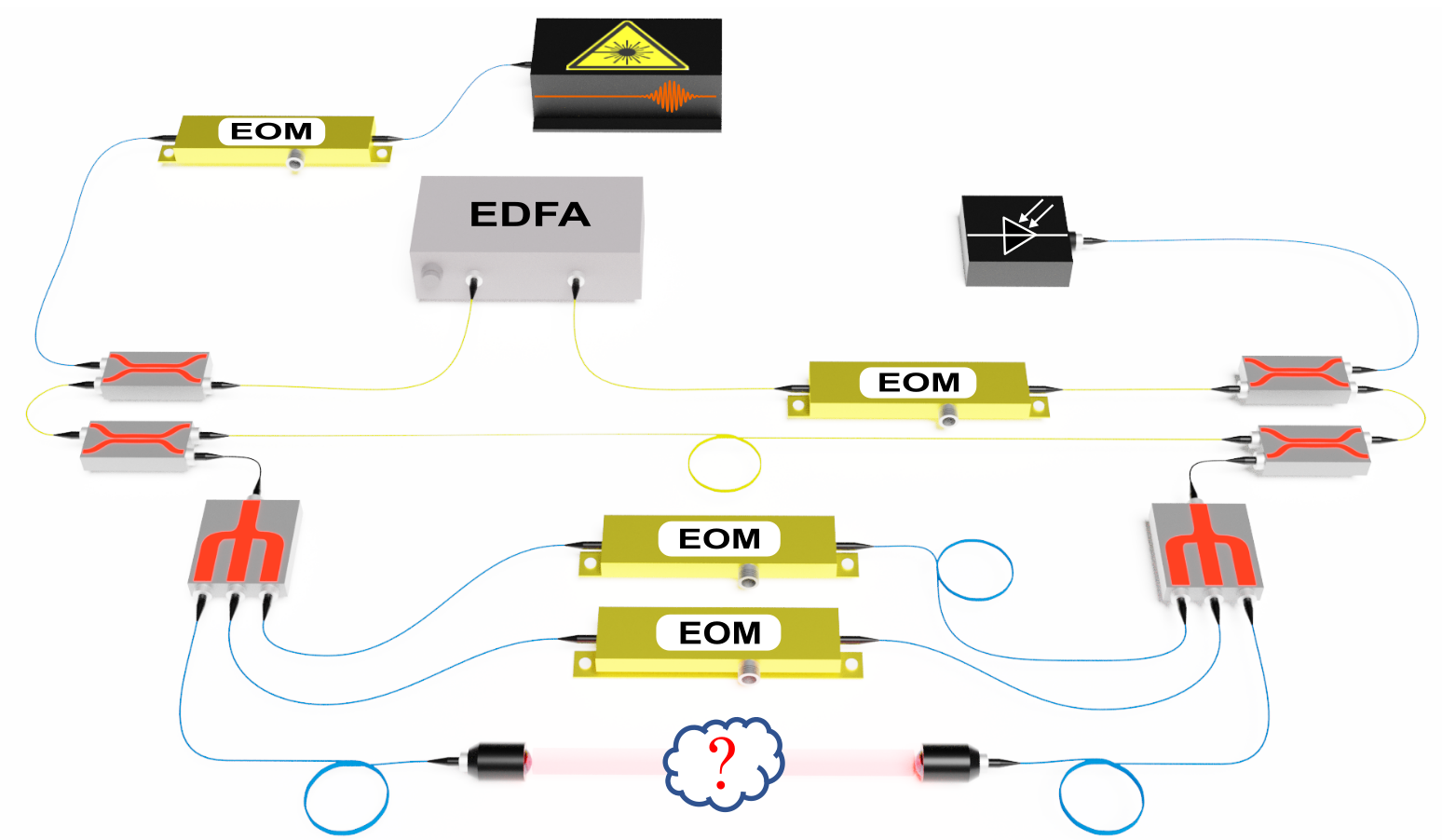
- 시간다중화 공명기반 네트워크를 사용하여, 시간 지연로 정의된 합성 차원에서 광 펄스를 이용한 실험.
- 전기광학 모듈레이터를 사용하여 이웃하는 펄스 간의 비대칭적이고 비상호적 결합을 구현함으로써 히타노-넬슨 해밀토니안을 실현.
- 장거리 지연선과 조절 가능한 전기광학 모듈레이터를 통해 첫 번째와 마지막 펄스 간의 경계 결합을 제어하여 외란을 시뮬레이션.
- 히타노-넬슨 래티스의 제로모드를 주입하고 10회의 순환 동안 축적시킨 후, 근처 이웃 간의 결합을 활성화.
- 50회의 반복 동안 캐비티 레이지 다운 트레이스를 기록하여 감쇠율 이격을 추출하며, 내재된 감쇠를 校정하기 위해 기준 펄스를 사용.
- 감도는 경계 결합 외란에 의한 제로모드의 고유값(감쇠율) 이격을 래티스 크기로 스케일링하여 정량화.
실험 결과
연구 질문
- RQ1실제 실험 시스템에서 비헤르미트형 토폴로지 센서(NTOS)가 래티스 크기에 따라 지수적으로 증가하는 감도를 달성할 수 있는가?
- RQ2NTOS에서의 감도 향상 메커니즘이 비헤르미트성과 토폴로지의 상호작용에 의해만 발생하며, 다른 메커니즘에 의해 발생하지 않는가?
- RQ3NTOS의 감도 스케일링은 기존의 분산 센싱 및 허미트형 토폴로지 시스템과 비교해 어떻게 다를까?
- RQ4히타노-넬슨 모델에서의 지수적 감도 스케일링 이론 예측이 광학 플랫폼에서 실험적으로 검증될 수 있는가?
- RQ5향상된 감도가 시스템 파rameter의 정밀조절 없이도 강인하고 관측 가능한가?
주요 결과
- 비헤르미트형 토폴로지 센서의 실험적 감도는 래티스 사이트 수에 따라 지수적으로 증가함을 확인하여 이론 예측을 실험적으로 검증.
- N=23까지의 래티스 크기에서, 기존의 √N 스케일링을 따르는 분산 센싱 대비 감도가 2개 이상의 주기수 증가.
- 시스템 파rameter의 정밀조절 없이도 감도 향상가 관찰되어, 다른 비헤르미트 센싱 기법과의 차별성을 보임.
- 감도 향상 메커니즘이 비헤르미트성과 토폴로지의 상호작용에 의해 주도됨을 입증하며, SSH 모델과 같은 허미트형 토폴로지 시스템에서는 유사한 스케일링 관찰되지 않음.
- 경계 결합 외란에 의한 제로모드의 고유값 이격은 래티스 크기와 함께 지수적으로 증가하며, 측정된 감도 향상 요소는 이론 예측과 일치.
- 기준 펄스를 통해 관측된 감쇠율 이격이 내재된 캐비티 손실이 아닌 비헤르미트형 토폴로지 효과에 기인함을 확인.
더 나은 연구,지금 바로 시작하세요
논문 읽기부터 검토까지, 연구 시간을 획기적으로 줄여보세요.
카드 등록 없음 · 무료 플랜 제공
이 리뷰는 AI가 만들고, 인간 에디터가 검토했습니다.