
[논문 리뷰] Expansion-Squeeze-Excitation Fusion Network for Elderly Activity Recognition
이 논문은 RGB 및 스켈레톤 특징을 융합하기 위해 모odal 및 채널 기반 주의 메커니즘을 학습하는 확장-압축-주의 융합 네트워크(ESE-FN)를 제안한다. 이 방법은 새로운 다중 모odal 손실과 이중 주의 융합 전략을 통해 대규모 ETRI-Activity3D 데이터셋에서 SOTA 정확도 96.7%를 달성하며, 기존 방법들을 능가한다.
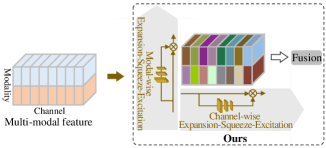
This work focuses on the task of elderly activity recognition, which is a challenging task due to the existence of individual actions and human-object interactions in elderly activities. Thus, we attempt to effectively aggregate the discriminative information of actions and interactions from both RGB videos and skeleton sequences by attentively fusing multi-modal features. Recently, some nonlinear multi-modal fusion approaches are proposed by utilizing nonlinear attention mechanism that is extended from Squeeze-and-Excitation Networks (SENet). Inspired by this, we propose a novel Expansion-Squeeze-Excitation Fusion Network (ESE-FN) to effectively address the problem of elderly activity recognition, which learns modal and channel-wise Expansion-Squeeze-Excitation (ESE) attentions for attentively fusing the multi-modal features in the modal and channel-wise ways. Furthermore, we design a new Multi-modal Loss (ML) to keep the consistency between the single-modal features and the fused multi-modal features by adding the penalty of difference between the minimum prediction losses on single modalities and the prediction loss on the fused modality. Finally, we conduct experiments on a largest-scale elderly activity dataset, i.e., ETRI-Activity3D (including 110,000+ videos, and 50+ categories), to demonstrate that the proposed ESE-FN achieves the best accuracy compared with the state-of-the-art methods. In addition, more extensive experimental results show that the proposed ESE-FN is also comparable to the other methods in terms of normal action recognition task.
연구 동기 및 목표
- 인간-물체 상호작용과 저진폭 운동을 포함한 미세하고 유사한 노인의 활동을 인식하는 데 도전하는 것.
- 다양한 모달 간의 구분 가능한 시공간 패턴을 포착하여 RGB 영상과 스켈레톤 시퀀스 간의 특징 융합을 향상시키는 것.
- 다양한 모달 간 및 채널 간의 종속성을 모델링하는 학습 가능한 주의 메커니즘을 설계하여 특징 표현을 향상시키는 것.
- 단일 모달 및 융합된 다중 모달 예측 간 일관성을 확보하기 위해 새로운 다중 모달 손실 함수를 설계하는 것.
- 표준 정상 행동 인식 벤치마크(NTU RGB+D)에서 성능을 평가하여 일반화 능력을 검증하는 것.
제안 방법
- 모달 기반 ESE 주의(M-ESEA)를 통해 RGB와 스켈레톤 모달 간 특징 융합을 위한 이중 주의 메커니즘을 제안한다.
- 융합된 특징 내 채널 간 종속성을 모델링하여 구분 능력을 향상시키기 위해 채널 기반 ESE 주의(C-ESEA)를 도입한다.
- 두 단계 융합 파이프라인을 활용: 먼저 M-Net을 통한 모달 기반 융합, 그 다음 C-Net을 통한 채널 기반 융합.
- 단일 모달 예측 손실의 최소값과 융합 모달의 예측 손실 간 차이를 페널티 처리하는 다중 모달 손실(ML)을 설계하여 일관성을 강제한다.
- 융합 이전에 독립적으로 RGB와 스켈레톤 특징을 추출하기 위해 이중 브랜치 백본 네트워크를 사용한다.
- 확장 및 압축 연산을 적용하여 국소적 및 전역적 특징 상호작용을 모델링하며, SENet 계열을 확장하여 업샘플링 및 다운샘플링 동작을 구현한다.
실험 결과
연구 질문
- RQ1모달 및 채널 차원에서 동시에 작동하는 이중 주의 융합 메커니즘이 노인의 활동 인식 성능을 향상시키는가?
- RQ2제안된 다중 모달 손실은 단일 모달 및 융합 예측 간 일관성을 유지하는 데 얼마나 효과적인가?
- RQ3ESE-FN은 노인 전용 활동을 초월하여 일반 행동 인식 작업에 일반화되는가?
- RQ4확장 및 압축 연산은 기존 주의 메커니즘에 비해 특징 표현을 얼마나 향상시키는가?
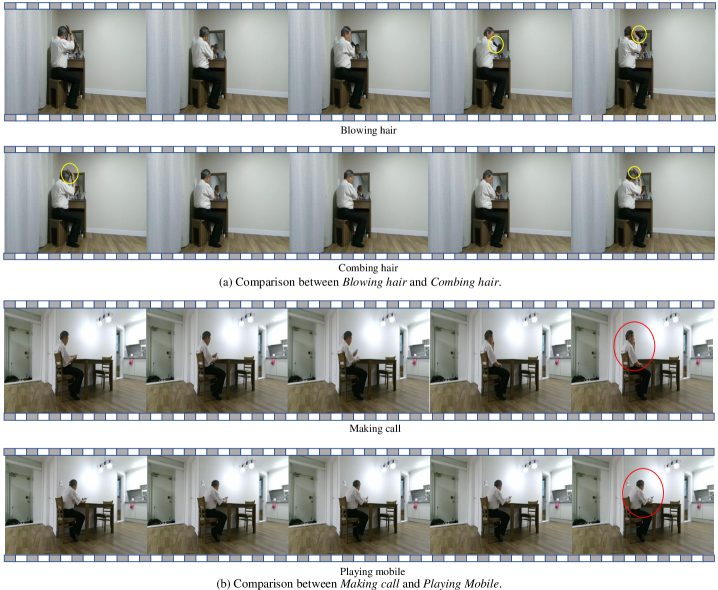
- RQ5‘헤어를 부는 것’과 ‘머리를 빗는 것’처럼 매우 유사한 시각적 활동에 대해 모델은 어떤 성능을 보이는가?
주요 결과
- ESE-FN은 ETRI-Activity3D 데이터셋에서 SOTA 정확도 96.7%를 달성하여 기존 방법들을 능가한다.
- NTU RGB+D 데이터셋에서 Cross-Subject 및 Cross-View 프로토콜 모두에서 SOTA 방법 대비 각각 0.7% 및 0.2% 향상된 성능을 기록한다.
- NTU RGB+D에서의 오차 행렬은 강력한 클래스별 인식 성능을 보이며, 주대각선이 항상 밝지 않아 모든 60개의 행동 클래스에서 높은 인식 정확도를 나타낸다.
- 제거 실험을 통해 M-ESEA 및 C-ESEA 구성 요소가 성능 향상에 기여한다는 것이 확인되어 이중 주의 융합의 효과성을 검증한다.
- 제안된 다중 모달 손실은 단일 모달 및 융합 예측 간 일관성을 강제함으로써 훈련을 안정화시키고 일반화 능력을 향상시킨다.
- ‘전화를 거는 것’과 ‘모바일을 만지는 것’처럼 미세한 손 움직임이나 물체 상호작용의 차이만 있는 미세한 유사 활동에 대해 모델은 뛰어난 내성성을 보였다.
더 나은 연구,지금 바로 시작하세요
논문 읽기부터 검토까지, 연구 시간을 획기적으로 줄여보세요.
카드 등록 없음 · 무료 플랜 제공
이 리뷰는 AI가 만들고, 인간 에디터가 검토했습니다.