
[논문 리뷰] Exploring Separable Attention for Multi-Contrast MR Image Super-Resolution
이 논문은 보조 대조를 활용하여 고강도 및 저강도 영역 복원을 향상시키는 다중 대조 MR 영상 초해상도 분석을 위한 새로운 분리 가능 주의망(SANet)을 제안한다. 고강도 우선 및 저강도 분리 주의 메커니즘을 도입함으로써 SANet은 해부학적 세부 정보 복원과 에지 유지 성능을 향상시키며, fastMRI 및 생체 내 데이터셋에서 최신 기술 수준의 성능을 달성하여 PSNR 및 SSIM 점수가 뛰어나다.
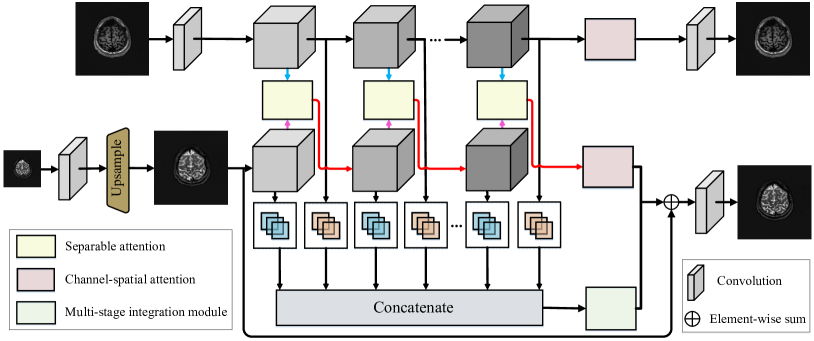
Super-resolving the Magnetic Resonance (MR) image of a target contrast under the guidance of the corresponding auxiliary contrast, which provides additional anatomical information, is a new and effective solution for fast MR imaging. However, current multi-contrast super-resolution (SR) methods tend to concatenate different contrasts directly, ignoring their relationships in different clues, e.g., in the high-intensity and low-intensity regions. In this study, we propose a separable attention network (comprising high-intensity priority attention and low-intensity separation attention), named SANet. Our SANet could explore the areas of high-intensity and low-intensity regions in the "forward" and "reverse" directions with the help of the auxiliary contrast, while learning clearer anatomical structure and edge information for the SR of a target-contrast MR image. SANet provides three appealing benefits: (1) It is the first model to explore a separable attention mechanism that uses the auxiliary contrast to predict the high-intensity and low-intensity regions regions, diverting more attention to refining any uncertain details between these regions and correcting the fine areas in the reconstructed results. (2) A multi-stage integration module is proposed to learn the response of multi-contrast fusion at multiple stages, get the dependency between the fused representations, and boost their representation ability. (3) Extensive experiments with various state-of-the-art multi-contrast SR methods on fastMRI and clinical extit{in vivo} datasets demonstrate the superiority of our model.
연구 동기 및 목표
- 기존의 다중 대조 초해상도 방법들이 고강도 및 저강도 영역에서 상호 의존성을 모델링하지 않고 대조를 단순히 연결함으로써 발생하는 한계를 해결하기 위해.
- 보조 MR 대조에서 유용한 상호 보완적 해부학적 정보를 명시적으로 모델링하여 초해상도 품질을 향상시키기 위해.
- 주목적 영역 간 불확실한 경계를 주의 기반 특징 정밀 조정을 통해 개선하는 메커니즘 개발을 위해.
- 네트워크 단계 간 융합 의존성을 캡처하는 다단계 통합 모듈을 통해 표현 학습을 향상시키기 위해.
- 최소한의 계산 오버헤드로 높은 성능을 달성하면서도 파라미터 효율적인 초해상도를 실현하기 위해.
제안 방법
- 고강도 우선 및 저강도 분리 경로로 주의를 분리하여 강도 영역 간 불확실한 경계를 정밀 조정하는 분리 가능 주의 메커니즘을 제안한다.
- 다중 네트워크 깊이에서 다중 대조 융합의 특징 반응을 학습하고 향상시키는 다단계 통합 모듈을 도입한다.
- 목표 대조와 보조 대조의 기여를 균형 잡기 위해 학습 가능한 주의 가중치 비율(α)을 사용하며, 최적 성능은 α = 0.7에서 달성된다.
- 추론 수렴 속도 향상과 안정적인 학습을 확보하기 위해 추론 검증 실험에서 L1 손실 함수를 사용한다.
- 조정 가능한 잔차 그룹(2~6개)을 갖춘 잔차 네트워크를 설계하였으며, 6개 그룹에서 최적 성능을 보이며 PSNR 및 SSIM이 안정된다.
- 공유된 특징 추출 및 대조별 특화 정밀 조정 브랜치를 갖춘 점진적 학습 전략을 적용한다.
![Figure 1: Comparison between single-contrast method SMORE [ 9 ] ), multi-contrast method Lyu et al. [ 10 ] , and our SANet on in vivo datasets. We effectively reconstruct the target contrast image by exploring the complementary information between the clear anatomical structure and boundary details](https://ar5iv.labs.arxiv.org/html/2109.01664/assets/x1.png)
실험 결과
연구 질문
- RQ1고강도 및 저강도 영역을 구분하는 분리 가능 주의 메커니즘이 다중 대조 MR 초해상도에 기여하는가?
- RQ2보조 대조 정보의 융합은 미세한 해부학적 구조 및 에지 복원에 어떤 영향을 미치는가?
- RQ3주의 메커니즘에서 목표 대조와 보조 대조의 기여 비율을 최적화하면 어떻게 되는가?
- RQ4다중 대조 특징의 다단계 융합은 표현 학습 및 초해상도 성능 향상에 어떻게 기여하는가?
- RQ5기존의 EDSR 기반 모델 대비 더 적은 파라미터로도 제안된 방법이 더 뛰어난 성능을 달성하는가?
주요 결과
- SANet는 2배 확대 시 SMS 데이터셋에서 PSNR 42.10 dB, SSIM 0.997을 기록하여 기준 모델을 능가한다.
- 최적의 주의 가중치 비율 α = 0.7에서 최고의 PSNR 및 SSIM 성능를 기록하며, α = 0.3 이하일 경우 성능 저하가著명하게 발생한다.
- 6개의 잔차 그룹에서 성능가 평형에 도달하며, PSNR 및 SSIM가 안정화되어 과적합 없이 충분한 능력을 확보함을 시사한다.
- SANet는 6개의 잔차 그룹을 사용할 경우 뿐만 아니라 총 11M 파라미터만을 요구하여 EDSR(43M) 및 SMORE(두 개의 EDSR 브랜치)보다 훨씬 적은 파라미터로 더 뛰어난 성능을 달성한다.
- 목표 및 보조 대조를 동시에 초해상도 처리할 경우, 목표 영역에 대해 PSNR 31.72 dB, SSIM 0.700을 기록하였고, 보조 영역에 대해서는 PSNR 32.3 dB, SSIM 0.705를 기록하여 강력한 다중 대조 융합 성능를 입증한다.
- 절단 실험 결과 L2 손실 함수와 유사한 성능를 기록하면서도 수렴 속도가 더 빠르므로 최종 모델에서 L1 손실 함수의 사용이 타당하다고 확인되었다.
더 나은 연구,지금 바로 시작하세요
논문 읽기부터 검토까지, 연구 시간을 획기적으로 줄여보세요.
카드 등록 없음 · 무료 플랜 제공
이 리뷰는 AI가 만들고, 인간 에디터가 검토했습니다.