
[논문 리뷰] Exploring the nature of UV-bright $z \gtrsim 10$ galaxies detected by JWST: star formation, black hole accretion, or a non-universal IMF?
본 연구는 Cosmic Archaeology Tool (CAT) 세미-해석적 모델을 사용하여 Pop III/II 별과 AGN의 역할을 z~4에서 20까지의 UV 광도 함수에서 정량화하고 JWST 데이터를 비교하며, z>10에서의 긴장을 해결하기 위한 IMF 진화를 검증한다.
We use the Cosmic Archaeology Tool (CAT) semi-analytical model to explore the contribution of Population (Pop) III/II stars and active galactic nuclei (AGNs) to the galaxy UV luminosity function (LF) evolution at $4 \leq z \leq 20$. We compare in particular with recent JWST data in order to explore the apparent tension between observations and theoretical models in the number density of bright galaxies at $z \gtrsim 10$. The model predicts a star formation history dominated by UV faint ($M_{ m UV} > - 18$) galaxies, with a Pop III contribution of $\lesssim 10\%$ ($\lesssim 0.5\%$) at $z \simeq 20$ ($z \simeq 10$). Stars are the primary sources of cosmic reionization, with $5 - 10 \%$ of ionizing photons escaping into the intergalatic medium at $5 \leq z \leq 10$, while the contribution of unobscured AGNs becomes dominant only at $z \lesssim 5$. The predicted stellar and AGN UV LFs reproduce the observational data at $5 \lesssim z \lesssim 9 - 10$. At higher redshift, CAT predicts a steeper evolution in the faint-end slope ($M_{ m UV} > - 18$), and a number density of bright galaxies ($M_{ m UV} \simeq -20$) consistent with data at $z \sim 10 - 11$, but smaller by 0.8 dex at $z \sim 12 - 13$, and 1.2 dex at $z \sim 14 - 16$, when compared to the values estimated by recent studies. Including the AGN emission does not affect the above findings, as AGNs contribute at most to $\lesssim 10 \%$ of the total UV luminosity at $M_{ m UV} < - 19$ and $z \gtrsim 10$. Interestingly, considering a gradual transition in the stellar IMF, modulated by metallicity and redshift as suggested by recent simulations, the model agrees with JWST data at $z \sim 12 - 13$, and the disagreement at $z \sim 14 - 16$ is reduced to 0.5 dex.
연구 동기 및 목표
- z~4에서 20까지 UV LF 진화에 대한 Pop III/II 별과 AGN의 기여를 평가한다.
- z>10에서 밝은 끝의 UV 광도에 미치는 AGN 방출의 영향을 평가한다.
- 금속성/적색편에 의해 주도되는 점진적 IMF 전이를 UVLF 예측에 대해 테스트한다.
- JWST 관측과 CAT 예측을 비교하여 긴장을 확인하고 가능한 해법을 모색한다.
제안 방법
- z=4에서 z=24까지의 대질량 DM 병합 이력의 큰 샘플을 생성하기 위해 CAT를 활용한다.
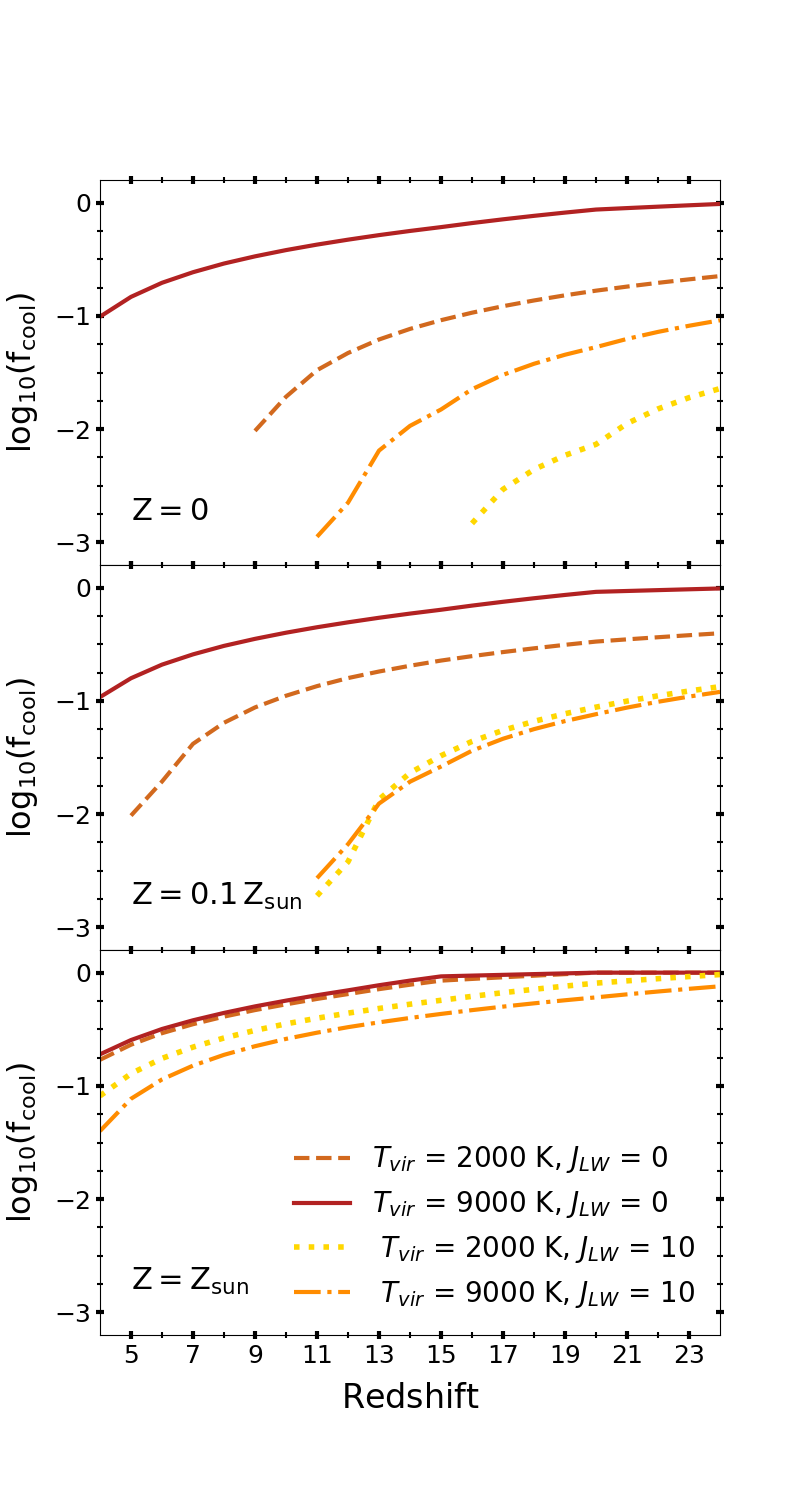
- 보정된 SFR 규정을 사용하여 미니할로 및 원자 냉각 할로에서의 항성형성을 모델링한다.
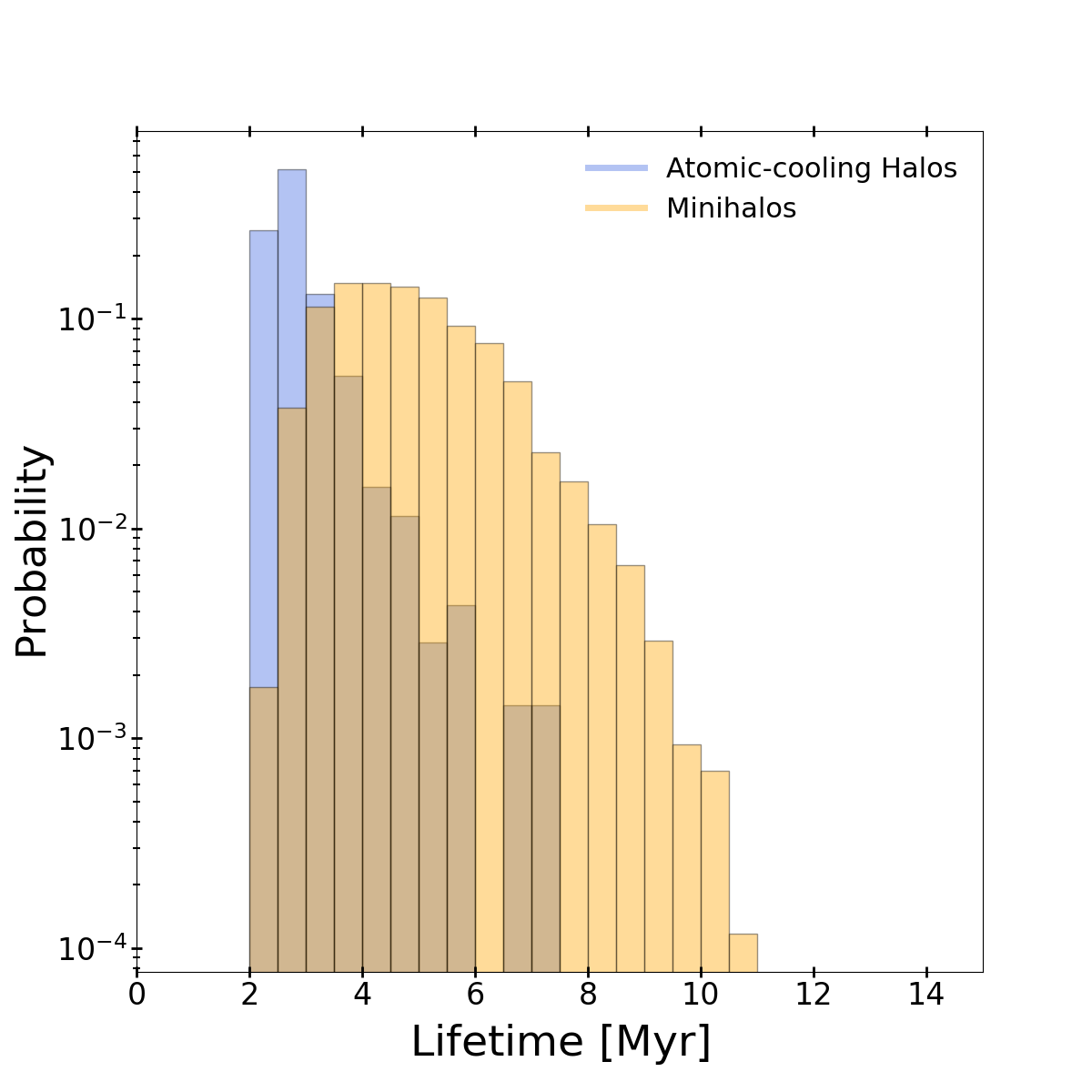
- Pop III IMF를 확률적 샘플링으로 구현하고 Zcrit으로 Pop II로의 전이를 도입하며, Pop III STAR FORM 효율을 향상시키는 것을 포함한다.
- BH 시드 형성, Eddington 상한으로 Bondi-Hoyle 가스 흡수에 의한 성장, 그리고 합병을 계산한다.
- 냉각과 항성형성에 영향을 주는 SN 및 AGN 기계적 피드백 및 LW/UV 복사 피드백을 포함한다.
- Pop II/III 별 및 초기 BH들로부터의 광이온화 방출을 모델링하고, redshift 의존적 탈출 분수와 IGM 응집을 사용해 재이온화를 추적하며(Q_HII) tau_e를 추정한다.
실험 결과
연구 질문
- RQ1Pop III/II 별과 AGN의 기여가 4 ≤ z ≤ 20에서 UV 광도 함수에 대해 상대적으로 얼마나 되는가?
- RQ2관측된 UV LF를 이론 예측과 일치시키려면 z ≳ 10에서 AGN 방출을 포함하는 것이 가능한가?
- RQ3금속성/적색편에 따른 점진적 IMF 전이가 JWST 데이터와의 일치를 개선하는가?
- RQ4JWST 측정과 모델 예측의 약한/강한 끝에서의 차이는 어디에서 나타나며 어떤 긴장이 남는가?
주요 결과
- Pop III의 UV 광도 기여는 작으며, z ≈ 20에서 ≲10%, z ≈ 10에서 ≲0.5%이다.
- 별은 여전히 우주 재이온화의 주요 원천이며, z=5에서 z=10 사이에 이온화 광자의 5–10%가 IGM으로 방출된다.
- Unobscured AGNs는 z ≳ 10에서 M_UV < −19에 대해 전체 UV 광도에서 최대 ≲10%를 기여한다.
- 별과 AGN으로부터의 예측 UV LFs는 5 ≲ z ≲ 9–10에서 데이터와 일치한다; 더 높은 z에서 약한 끝의 진화는 더 가파르고, z~10–11 근처의 밝은 끝 밀도는 데이터와 일치하지만 z~12–13에서 약 0.8 dex, z~14–16에서 약 1.2 dex만큼 일부 연구에 비해 낮다.
- AGN 방출을 포함해도 고-z 구간의 LF에 대한 결론을 크게 바꾸지 않는다.
- 금속성/적색편에 따른 점진적 IMF 전이는 z~12–13에서 JWST 데이터와 일치시키고 z~14–16의 불일치를 약 ~0.5 dex로 감소시킨다.
더 나은 연구,지금 바로 시작하세요
연구 설계부터 논문 작성까지, 연구 시간을 획기적으로 줄여보세요.
카드 등록 없음 · 무료 플랜 제공
이 리뷰는 AI가 만들고, 인간 에디터가 검토했습니다.