
[논문 리뷰] Extreme mass ratio inspirals in galaxies with dark matter halos
본 논문은 Schwarzschild 블랙홀 시공에 헤르쿤크형 다크 매터 헤일로가 내재된 환경에서 EMRI 궤도 역학과 중력파 신호에 대한 해석적 표현을 도출하고, 다크 매터 헤일로가 LISA 대역 신호에서 검출 가능한 위상 차이(dephasing)와 매칭 불일치(mismatches)를 남김을 보인다.
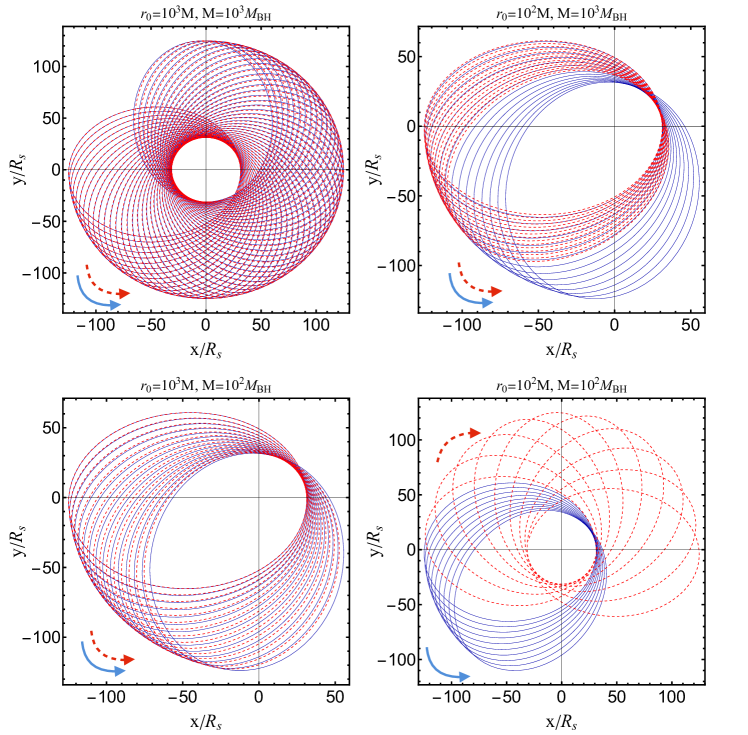
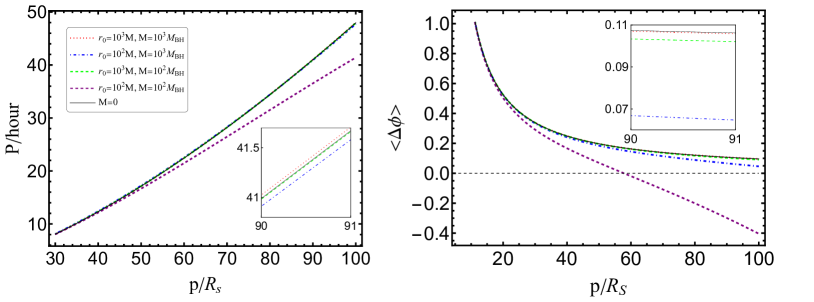
Using an analytic, static, and spherically symmetric metric for a Schwarzschild black hole immersed in a dark matter (DM) halo with the Hernquist-type profile, we derive analytic expressions for the orbital period and precession of eccentric extreme mass ratio inspirals (EMRIs) surrounded by DM halos, and we show how the precession rates decrease and even undergo a prograde-to-retrograde precession transition if the density of DM halo is large enough. The presence of local DM halos also retards the decrease of the semi-latus rectum and the eccentricity. The orbital evolution of EMRIs immersed in DM halos is then calculated numerically by considering the combined effects of gravitational radiation reaction, dynamical friction, and accretion. Comparing the number of orbital cycles accumulated over a one-year evolution for EMRIs with and without DM halos, we find that DM halos with compactness as small as $10^{-5}$ can be detected. From the mismatch between gravitational waveforms of EMRIs with and without DM halos, we show that EMRIs in galaxies can be used to probe the existence of DM halos and detect the compactness of DM halos as small as $10^{-5}$. Employing the Fisher information matrix method, we find that larger compactness and density values of DM halos help to reduce the estimation error of parameters and further break the degeneracy between the parameters.
연구 동기 및 목표
- 거대질량 블랙홀 주위의 다크 매터 헤일로가 EMRI 궤도와 GW 신호에 미치는 영향을 평가한다.
- DM 환경에서 궤도 주기와 근회전에 대한 해석적 공식을 도출한다.
- DM 헤일로로 인한 GW 위상 차이(dephasing)와 파형 불일치를 정량화하여 LISA 탐지 가능성을 평가한다.
제안 방법
- 헤르쿤크형 DM 헤일로 내부의 Schwarzschild 블랙홀에 대한 정적 구대칭 계(metric)을 사용한다.
- 측지선 운동으로부터 궤도 요소(p, e)와 근회전에 대한 해석적 표현을 도출한다.
- 환경 보정(dE/dt, dL/dt)을 포함한 주도 파급의 GW 플럭스를 계산한다.
- GW 방출에 의한 에너지-운동량 균형으로부터 p(t)와 e(t)를 진화시킨다.
- 무공간(vacuum) 경우에 대한 위상 차이를 포함한 시간 영역의 GW 파형을 계산한다.
- LISA를 위한 궤도 주기 수와 파형 불일치를 통해 탐지 가능성을 평가한다.
실험 결과
연구 질문
- RQ1헤르쿤크 DM 헤일로가 중심 Schwarzschild BH 주위의 측지선 궤도에 어떤 영향을 미치는가?
- RQ2DM 헤일로에 의한 궤도 주기, 근회전 및 궤도 요소 진화의 해석적 보정은 무엇인가?
- RQ3DM 헤일로가 LISA 같은 우주 기반 검출기에서 관측되는 EMRI 신호의 위상 차이나 파형 불일치를 만들어낼 수 있는가?
- RQ4GW 관측을 통한 DM 헤일로 압축도(compactness) M/r0의 검출 가능 임계는 무엇인가?
- RQ5이심률이 높은 궤도가 DM 헤일로의 탐지 가능성에 어떤 영향을 주는가?
주요 결과
- DM 헤일로는 궤도 근회전을 감소시키고, 충분히 밀도가 높은 경우 역행 근회전을 유발할 수 있다.
- DM 헤일로는 GW 방출에 따른 p의 감소 및 이심률의 감소를 느리게 한다.
- 합병 1년 전까지 DM 헤일로의 압축도(compactness)가 10^-4에 불과해도 주기 차이에 의한 위상 차이를 통해 탐지 가능하다.
- DM-포함 EMRI와 진공 EMRI 간의 파형 불일치는 LISA에 대해 DM 헤일로의 압축도가 약 10^-5까지도 탐지 가능함을 보여준다.
- 이심률 궤도는 원궤도에 비해 DM 헤일로의 더 작은 압축도를 탐지하는 능력을 높인다.
- 본 연구는 DM 헤일로 보정(식 Eq. 23–24)의 T(주기)와 Δφ(근지전근) 해석식을 제공한다.
더 나은 연구,지금 바로 시작하세요
논문 읽기부터 검토까지, 연구 시간을 획기적으로 줄여보세요.
카드 등록 없음 · 무료 플랜 제공
이 리뷰는 AI가 만들고, 인간 에디터가 검토했습니다.