
[논문 리뷰] Femtosecond laser induced creation of G and W-centers in silicon-on-insulator substrates
이 연구는 펌터세컨드 레이저 소결을 통해 실리콘 온 인슐레이터(SOI) 기반에서 W-센터와 G-센터—실리콘 기반 양자 발광체—를 결정론적이고 요구에 따라 생성하는 것을 보여준다. 이 방법은 기존 이온 주입 기술과 유사한 결함 품질을 달성하며 탄소 이온 주입 없이도 생성이 가능하고, 저온 소결을 통해 G-센터를 선택적으로 제거하고 W-센터 발광을 향상시켜 정밀하고 국소적이며 저비용의 양자 발광체 제작을 가능하게 한다.
The creation of fluorescent defects in silicon is a key stepping stone towards assuring the integration perspectives of quantum photonic devices into existing technologies. Here we demonstrate the creation, by femtosecond laser annealing, of W and G-centers in commercial silicon on insulator (SOI) previously implanted with 12C+ ions. Their quality is comparable to that found for the same emitters obtained with conventional implant processes; as quantified by the photoluminescence radiative lifetime, the broadening of their zero-phonon line (ZPL) and the evolution of these quantities with temperature. In addition to this, we show that both defects can be created without carbon implantation and that we can erase the G-centers by annealing while enhancing the W-centers' emission. These demonstrations are relevant to the deterministic and operando generation of quantum emitters in silicon.
연구 동기 및 목표
- 기존 광학 및 전자 통합 플랫폼과 호환되는 실리콘 기반 양자 발광체를 결정론적이고 저비용으로 제작할 수 있는 방법을 개발하기 위해.
- 펌터세컨드 레이저 소결이 기존 주입 방법과 유사한 광학적 성질을 갖는 W- 및 G-센터를 생성할 수 있음을 입증하기 위해.
- 이 레이저 기반 방법을 통해 SOI에서 G- 및 W-센터 형성에 탄소 이온 주입이 필수적인지 조사하기 위해.
- 방사선 후 열처리를 통해 G-센터를 선택적으로 제거하고 W-센터 발광을 향상시킬 수 있는지 탐색하기 위해.
제안 방법
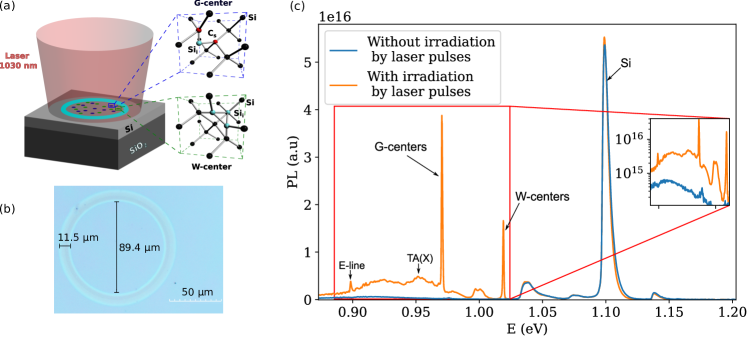
- 1030 nm, <200 fs, 1 kHz 반복 주기의 펌터세컨드 레이저 펄스를 750 mm 평면 볼록 렌즈를 사용해 SOI 웨이퍼에 집중시켜 局부 열소결을 유도하였다.
- 에너지 95–218 µJ에서 1–5 펄스로 조사하여 220 nm 두께의 상부 실리콘 계층에 결함을 생성하였다.
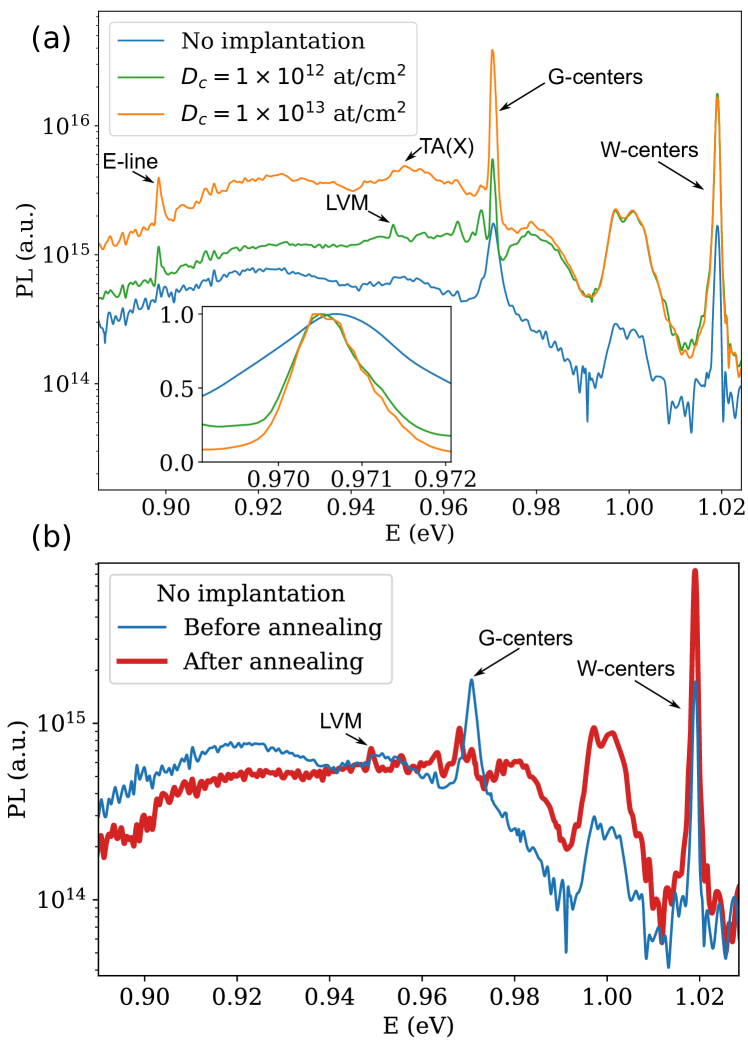
- 두 종류의 SOI 기반을 사용하였다: 34 keV 에너지로 1×10¹² 및 1×10¹³ cm⁻² 농도의 12C+ 이온 주입을 한 기판과 잔류 탄소가 있는 순수 SOI 기반.
- 방사선 후 125 °C에서 5분 동안 소결 처리를 실시하여 결함의 진화 및 선택적 G-센터 제거를 연구하였다.
- 405 nm 연속파 펌프 레이저와 InGaAs 검출기(900–1600 nm)를 갖춘 분광계를 사용해 12 K에서 광발광(PL) 측정을 수행하였다.
- 시간 분 giải PL 및 온도 의존 PL 측정을 통해 복사 수명, 영점 진동선(ZPL) 넓이, ZPL의 열적 적색 이동을 분석하였다.
실험 결과
연구 질문
- RQ1펌터세컨드 레이저 소결을 통해 기존 주입 방법과 유사한 광학적 성질을 갖는 W- 및 G-센터를 SOI 기반에서 생성할 수 있는가?
- RQ2이 레이저 기반 방법을 통해 SOI에서 G- 및 W-센터 형성에 탄소 이온 주입이 필수적인가?
- RQ3저온 소결을 통해 G-센터를 선택적으로 제거하고 W-센터 발광을 향상시킬 수 있는가?
- RQ4이 레이저 공정을 통해 결정론적이고 요구에 따라, 공간적으로 국소화된 실리콘 기반 양자 발광체를 제작할 수 있는가?
주요 결과
- 펌터세컨드 레이저 소결로 생성된 W- 및 G-센터의 광발광 복사 수명, ZPL 넓이, 온도 의존 ZPL 이동은 기존 주입 방법으로 제작된 결함의 문헌 자료와 유사하다.
- 탄소 주입 없이도 순수 SOI 기반에서 G- 및 W-센터를 성공적으로 생성하였으며, 이는 웨이퍼 내 잔류 탄소만으로도 결함 형성이 가능하다는 것을 시사한다.
- 주입되지 않은 샘플의 G-센터 ZPL은 주입된 샘플보다 넓은 선형과 청색 이동을 보였으며, 이는 내부 응력과 결함 농도가 낮음을 반영한다.
- 저온 소결(125 °C, 5분)은 G-센터를 선택적으로 제거하였고, W-센터의 PL 발광 강도는 약간 향상시켰다. 이는 이전 연구 결과와는 반대된 결과이다.
- 결함 생성의 공간적 국소화는 레이저 빔 크기(약 178 µm)와 일치하여 국소적이고 잠재적으로 단일 결함 공학이 가능하다.
- 이 방법은 이온 주입 없이도 결정론적이고 요구에 따라, 영역 제한된 W-센터 생성이 가능하며, 양자 광학 통합을 위한 확장 가능하고 비용 효율적인 대안을 제공한다.
더 나은 연구,지금 바로 시작하세요
논문 읽기부터 검토까지, 연구 시간을 획기적으로 줄여보세요.
카드 등록 없음 · 무료 플랜 제공
이 리뷰는 AI가 만들고, 인간 에디터가 검토했습니다.